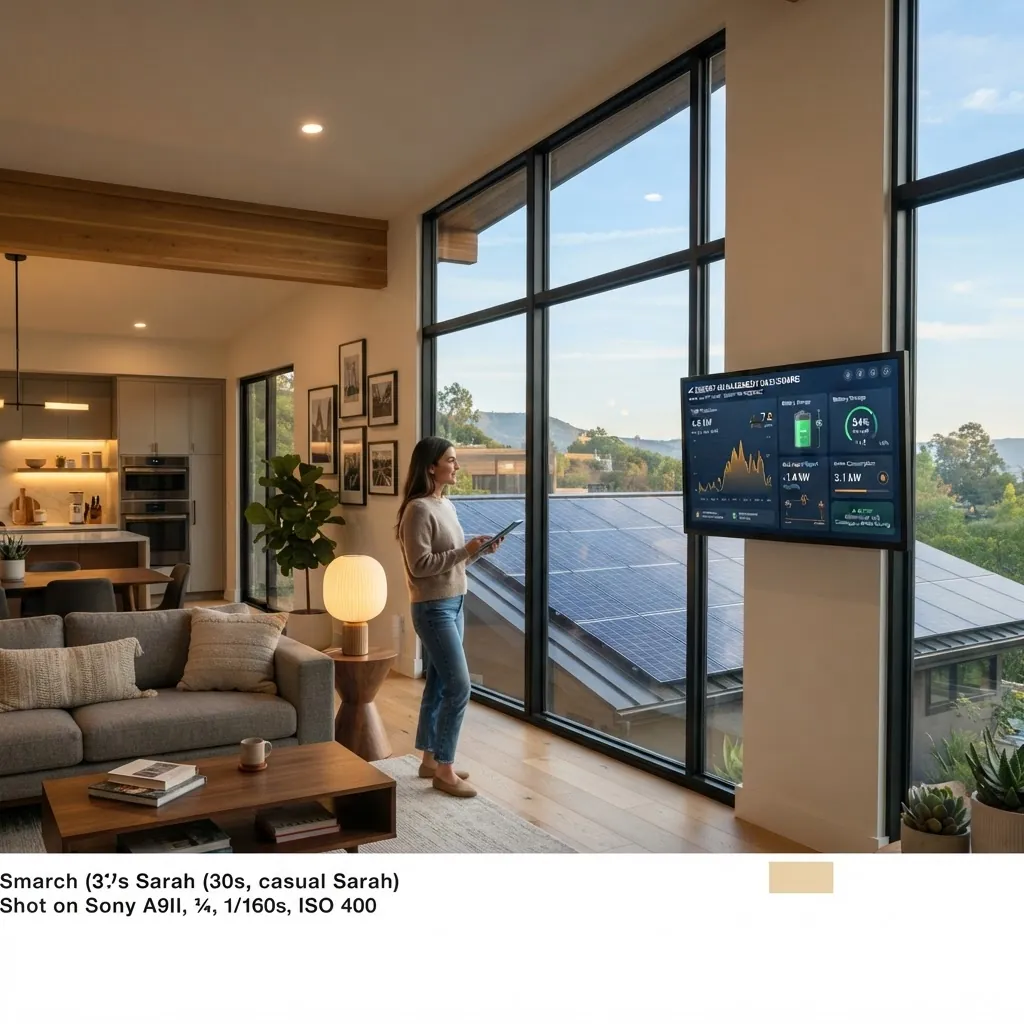
Smart Home AI Energy Management 2026 — Save Money With Solar & Battery Storage
The smart home trend of 2026 isn't robot vacuums or voice-controlled lights — it's AI managing your energy. From predictive solar forecasting to automated load shifting and virtual power plants, here's how homeowners are cutting electricity bills by 15-30% with AI.
Table of Contents
What Is AI Energy Management?
Smart home energy management has been around for years — smart thermostats, scheduled appliances, basic solar monitoring. But 2026 is the year AI took it to another level. Instead of you setting schedules and rules, the AI learns your patterns, predicts weather, and makes real-time decisions about when to store energy, when to use it, and when to sell it back to the grid.
The global smart home market is projected to hit $848 billion by 2034, and energy management is the fastest-growing segment. The reason is simple: energy costs are rising, and AI can save you real money without any lifestyle changes.
How It Works
AI energy management works on three levels:
1. Monitoring
Smart meters and circuit-level sensors track exactly where your energy goes — HVAC, hot water, EV charger, kitchen appliances, everything. This data feeds into an AI model that learns your household patterns.
2. Prediction
The AI predicts future energy needs based on weather forecasts, your historical usage, and grid pricing. If it knows tomorrow will be sunny, it plans to maximize solar generation. If a cold snap is coming, it pre-charges the battery and pre-heats the home during off-peak hours.
3. Optimization
This is where the savings happen. The AI automatically shifts energy-intensive tasks to the cheapest times, decides whether to use solar directly, store it in batteries, or sell it to the grid — all without you lifting a finger.
"The smart home of 2026 isn't about convenience — it's about the AI quietly saving you money while you sleep."
Solar + Battery: The Foundation
AI energy management works best when paired with solar panels and a home battery. Here's why the combination is powerful:
- Solar generates during the day when you may not need it
- AI stores the excess in your battery instead of selling it cheap to the grid
- Battery discharges during peak evening hours when rates are highest
- AI predicts weather — if tomorrow is cloudy, it conserves battery tonight
- Grid-tied backup — if the grid goes down, the battery keeps essentials running
In Canada, solar adoption is accelerating thanks to federal rebates and provincial incentive programs. Atlantic Canada specifically has growing solar programs, making this increasingly accessible even in regions with less sun than the prairies.
Automated Load Shifting
Even without solar, AI can save you money through load shifting. If your utility offers time-of-use (TOU) pricing — where electricity costs more during peak hours — the AI automatically:
- Pre-cools or pre-heats your home before peak hours
- Runs the dishwasher and laundry during off-peak times
- Delays EV charging to the cheapest overnight window
- Turns down the water heater during peak demand
Ontario has had TOU pricing for years. New Brunswick and Nova Scotia are expanding their TOU programs. Even a 10-15% bill reduction from load shifting alone makes the investment worthwhile.
| Scenario | Savings Potential | What's Needed |
|---|---|---|
| Load shifting only (TOU plan) | 10-15% | Smart meter + AI HEMS |
| Solar + AI optimization | 20-40% | Solar panels + AI HEMS |
| Solar + Battery + AI + VPP | 30-50%+ revenue | Full system |
Virtual Power Plants
One of the most exciting developments in 2026 is the rise of Virtual Power Plants (VPPs). Here's how they work:
Instead of a single massive power plant, a VPP aggregates thousands of home battery systems and coordinates them to support the grid. When demand peaks, the VPP operator draws power from participating home batteries. You get paid for the energy they use, and your battery recharges during cheaper off-peak hours.
The AI manages everything automatically — it knows your usage patterns and ensures your battery always has enough charge for your needs while maximizing VPP participation revenue.
VPP programs are expanding across Canada, with pilots in Ontario, Alberta, and Quebec. If you have a home battery, VPP participation can generate $500-2,000 per year in revenue depending on your system size and grid participation.
Trending Products in 2026
The key products driving AI energy management in 2026:
- Smart Meters — real-time, circuit-level energy monitoring
- HEMS (Home Energy Management Systems) — the AI brain that ties everything together
- Solar + Battery Systems — Tesla Powerwall, Enphase IQ Battery, Canadian Solar systems
- Smart Thermostats — predictive learning models that optimize HVAC timing
- EV Chargers — integrate with home solar for solar-only EV charging
- Smart Plugs/Outlets — individual appliance monitoring and control
What This Means for Canadians
Canadian energy costs vary wildly by province. Here's how AI energy management applies across the country:
- Ontario: TOU pricing makes load shifting immediately valuable. Solar + battery is popular with net metering programs.
- Alberta: Deregulated market with fluctuating prices. AI optimization has high potential, especially for VPP participation.
- British Columbia: Hydro power is cheap, but solar + battery provides backup and self-sufficiency.
- Atlantic Canada: Growing solar incentives in New Brunswick and Nova Scotia. Load shifting valuable where TOU is available. Wind + solar hybrid systems gaining interest.
- Quebec: Lowest electricity rates in Canada, but battery backup for winter storms is valuable.
Start Simple
You don't need a full solar + battery system to benefit. A smart thermostat with predictive learning and a few smart plugs on time-of-use billing can save 10-15% immediately. Scale up from there — add solar when the math works for your province, then add battery storage, then consider VPP participation.
Frequently Asked Questions
Buy on Amazon
Affiliate Disclosure: As an Amazon Associate I earn from qualifying purchases. If you buy through these links, I may earn a small commission at no extra cost to you.