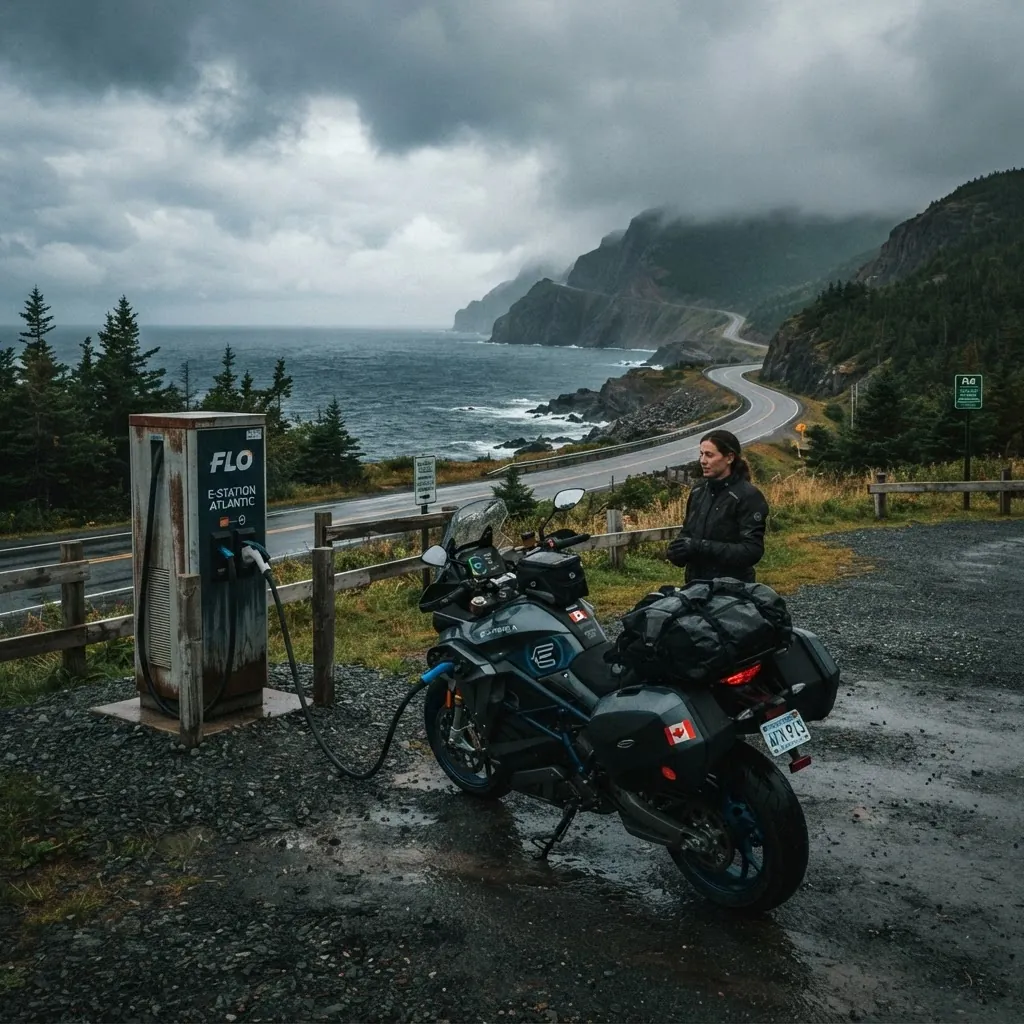
Electric Motorcycle Touring — Is It Ready for Atlantic Canada?
The electric motorcycle market is growing 21% year over year, and the bikes are getting genuinely good. But touring Atlantic Canada is a different challenge than commuting in Toronto. I looked at the charging infrastructure, the best electric touring bikes, and whether you could actually ride from Dieppe to Digby on battery power alone.
Table of Contents
The Electric Touring Bikes Available Now
Three electric motorcycles are worth considering for touring in 2026, and they vary significantly in range, price, and capability:
| Bike | City Range | Highway Range (est.) | Price (USD) | Charging |
|---|---|---|---|---|
| Zero SR/F | 176 mi / 283 km | ~117 mi / 188 km | From $18,495 | Level 2 + optional DC fast charge |
| LiveWire ONE | 146 mi / 235 km | ~95 mi / 153 km | From $16,499 | DC fast charge (CCS) |
| Can-Am Origin | 90 mi / 145 km | ~60 mi / 97 km | TBD | Level 2 only |
The Zero SR/F is the range leader and the only realistic option for touring. With the optional Charge Tank accessory, it can accept DC fast charging at up to 50 kW, getting from 20% to 80% in about 40 minutes. Without the Charge Tank, you're stuck on Level 2 charging, which means 1–6 hour stops.
The LiveWire ONE (formerly Harley-Davidson LiveWire) has DC fast charging built in, which is a real advantage. But its 146-mile (235 km) city range drops to roughly 95 miles (153 km) at sustained highway speeds. That's a lot of charging stops on a touring day.
The Can-Am Origin is a dual-sport electric bike with just 90 miles (145 km) of city range. It's a great around-town machine, but it's not a touring bike. Skip it for this conversation.
Charging Infrastructure in Atlantic Canada
This is where the conversation gets real. Atlantic Canada's EV charging network has improved significantly — the federal government announced 157 new chargers across the region in October 2025 — but it's still patchy for motorcycle touring.
Here's the current state by province:
New Brunswick
- Tesla Superchargers: 5 along the Trans-Canada Highway, plus 1 in Quispamsis and 1 in Miramichi
- NB Power eCharge Network: 100 kW DC fast chargers at select locations
- Petro-Canada DC fast chargers along major corridors
- Verdict: Workable on the TCH, sparse on secondary roads
Nova Scotia
- Tesla Superchargers: 2 on the TCH toward Halifax
- Level 2 chargers growing in Halifax and along the South Shore
- Verdict: OK to Halifax, gaps on coastal and Cabot Trail routes
Prince Edward Island
- Some Level 2 chargers in Charlottetown and Summerside
- Very limited DC fast charging
- Verdict: Challenging for a touring electric bike
Newfoundland and Labrador
- Minimal charging infrastructure outside St. John's
- The Marine Atlantic ferry crossing is the biggest barrier — you'd arrive with whatever charge you left port with
- Verdict: Not practical in 2026
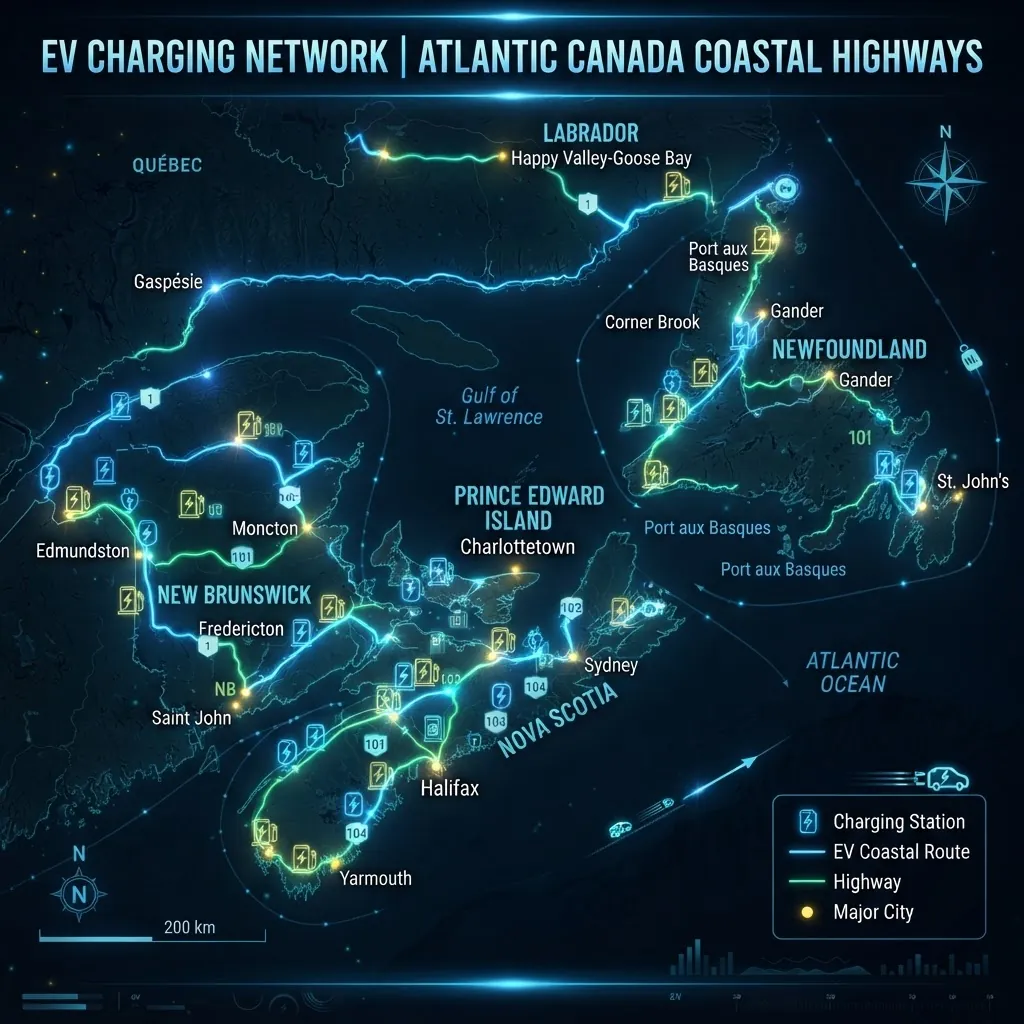
Charging coverage is improving, but Atlantic Canada's coastal routes still have significant gaps.
Route Test: Dieppe to Digby
Let's test a realistic Atlantic Canada touring route. Dieppe, NB to Digby, NS for the Wharf Rat Rally. There are two ways to get there, and both change the math significantly for an electric motorcycle. For more, see the Stark VARG electric motorcycle.
Option 1: All-Highway Route (via Amherst)
The longer but more straightforward route: head west from Dieppe on the Trans-Canada Highway (Route 2) through Sussex, continue to the NS border near Sackville, then into Amherst. From Amherst, head south to Truro and west on Highway 101 through the Annapolis Valley to Digby. This is about 460 km (286 miles) one way — all highway, with DC fast chargers along the TCH corridor in New Brunswick and Nova Scotia.
Option 2: Ferry Route (via Saint John to Digby)
The shorter driving route: ride to Saint John, NB (~160 km / 99 miles), then take the Bay Ferries crossing to Digby, NS. Total riding distance is about 160 km (99 miles) plus the 2.5-hour ferry crossing. The ferry itself doesn't have charging infrastructure, so you arrive in Digby with whatever charge you left Saint John with.
On my Indian Pursuit, neither route is a concern. The 390 km (242 mile) range covers the Saint John leg on one tank, and the all-highway route just needs one fuel stop in Amherst. Total refueling time: 3–6 minutes.
Electric Motorcycle: Highway Route (460 km / 286 miles)
On a Zero SR/F with the Charge Tank at highway speeds (~117 mi / 188 km real-world range):
- Start in Dieppe with 100% charge
- Ride to Sussex, NB (~60 km / 37 mi) — first potential charge stop if needed
- Ride to Amherst, NS (~100 km / 62 mi from Sussex) — stop for a DC fast charge, 20-80% in ~40 min
- Ride to Digby (~300 km / 186 mi from Amherst via Truro and the Annapolis Valley) — arrive with low battery, likely need a top-up in Truro or Kentville
- Total charging time: 2–2.5 hours added to a 5-hour ride
Electric Motorcycle: Ferry Route (160 km / 99 miles + ferry)
This is more manageable but has a catch:
- Start in Dieppe with 100% charge
- Ride to Saint John, NB (~160 km / 99 miles) — arrive with 20-30% battery remaining
- Board the ferry (2.5 hours) — no charging on the ferry, so you arrive in Digby with the same 20-30%
- Find a charger in Digby before you can ride anywhere else
- Total charging time: ~1 hour, but you're stuck waiting for the ferry schedule
The ferry route is shorter but locks you into the ferry timetable — and you arrive in Digby with low battery and limited charging options. The highway route is longer but at least the chargers are along the way.
Either way, that's a gas ride that takes one fuel stop turned into an electric ride that takes 1–2.5 hours of charging plus schedule constraints. Not impossible, but not the spontaneous touring experience that makes motorcycle travel great.
The Real-World Charging Reality
There's a bigger problem than just charging time: charger availability and reliability. This is the part the spec sheets don't tell you.
Limited Stations, Long Waits
Unlike gas stations — which are everywhere in Atlantic Canada — DC fast chargers are still sparse. On the TCH corridor through New Brunswick, there are maybe 5–6 fast charger locations. That sounds okay until you realize there might be one or two actual charging stalls at each location. On a busy summer travel weekend, you could arrive at a charger and find someone else already using it. Now you're not just charging for 40 minutes — you're waiting 40 minutes for your turn, then charging another 40. That's 80 minutes at a single stop, and there's no guarantee the next charger down the road is free either.
On a gas bike, if one station is busy, there's another one 2 minutes down the road. With EV chargers, the next one might be 100 km (62 miles) away. You can't just pull into the next exit.
Broken Chargers
This is the one that can actually strand you. EV charger reliability is a real problem across Canada, and Atlantic Canada is no exception. Common issues:
- Charger out of service — the unit is there but the screen is black, or it throws an error every time you try to initiate a charge. Some stay broken for weeks before being repaired.
- Network connectivity issues — many chargers need to communicate with a backend server to authorize payment. If the cellular connection drops (which happens in rural Atlantic Canada), the charger won't start even if it's technically working.
- Compatibility problems — some CCS chargers work fine with cars but have intermittent issues with motorcycle charging profiles. The connector fits, the handshake fails.
- Cold weather failures — chargers in exposed locations can become unreliable in winter temperatures. Not a summer touring issue, but relevant for shoulder-season riders.
I've seen stories from EV drivers in the Maritimes who arrived at a charger listed as "operational" on the app, only to find it dead. When the next nearest charger is 100+ km away and you're at 15% battery, that's not an inconvenience — that's being stranded. On a motorcycle, you can't exactly sit at a charging station for 3 hours waiting for a repair tech. You don't have a climate-controlled cabin to wait in.
The Range Anxiety Tax
Even when everything works, you end up riding conservatively. On my Indian Pursuit, I ride at the speed I want, take the route I want, and stop when I want. On an electric touring bike, every decision is filtered through battery math: "Can I make the next charger if I skip this one?" "What if I hit a headwind?" "What if it's cold and my range drops 20%?" You're not touring — you're managing a battery budget. For a 4,000 km (2,485 mile) trip like the ECIC Muskoka ride, that mental load would wear you down fast.
None of this is a knock on electric motorcycles — the bikes themselves are getting excellent. The Zero SR/F is a genuinely fun ride. But the infrastructure in Atlantic Canada isn't there yet for the kind of spontaneous, long-distance touring that makes motorcycle travel worth doing. When there are as many working DC fast chargers as there are gas stations, the conversation changes. We're not there yet.
The problem isn't the bikes — it's that Atlantic Canada's best riding roads are the ones farthest from the chargers.
Real-World Range at Highway Speeds
Manufacturers quote city range, which is always the highest number. Touring means sustained highway speeds, and that's where electric motorcycles lose a significant chunk of their rated range:
- Zero SR/F: 176 mi (283 km) city drops to ~140 mi (225 km) at 100 km/h (62 mph) sustained
- LiveWire ONE: 146 mi (235 km) city drops to ~95 mi (153 km) at highway speeds
- At 110+ km/h (68+ mph): Expect another 15-20% reduction
Cold weather — which we get 7 months of in Atlantic Canada — reduces range by another 20-30%. A Zero SR/F that does 117 miles (188 km) at highway speeds in July might only do 82 miles (132 km) in October. That changes the routing math entirely.
Electric vs Gas Touring — The Honest Math
| Factor | Indian Pursuit (Gas) | Zero SR/F (Electric) |
|---|---|---|
| Range per fill/charge | 390 km / 242 mi | ~225 km / 140 mi (highway) |
| Refuel/recharge time | 3 minutes | 40 min (DC fast) to 6 hrs (Level 2) |
| Cost per 100 km | ~$7.50 CAD (gas) | ~$2.00 CAD (electricity) |
| Infrastructure | Every gas station | Limited, coastal gaps |
| Cold weather range | Unaffected | -20 to -30% |
| Maintenance | Oil, valves, belts | Minimal — no oil changes |
| Touring practicality | Excellent | Challenging in Atlantic Canada |
The economics of electric touring are genuinely compelling — about $2 per 100 km (62 miles) versus $7.50 for gas. And the maintenance savings are real: no oil changes, no valve adjustments, no belt replacements. But the infrastructure gap in Atlantic Canada means you're spending that saved money in time instead of dollars.
My Verdict
After 200,000 km (124,000 miles) of touring on gas motorcycles — including 10,000 km (6,200 miles) on my Indian Pursuit through New Brunswick, Nova Scotia, Ontario, and Quebec — I want to be excited about electric touring. The instant torque, the silence, the zero emissions, the low running costs. I get the appeal.
But I can't honestly recommend an electric motorcycle for Atlantic Canada touring in 2026. The bikes are good enough. The charging network is not — not yet. The routes that make this region worth riding (the Fundy Coastal Drive, the Cabot Trail, the Coastal Route through PEI) are exactly the routes with the fewest chargers.
If you live in Toronto or Montreal and commute daily, a Zero SR/F makes genuine sense. If you want to tour the Maritimes, stick with gas for now and check back in 2-3 years. The 157 new chargers announced for Atlantic Canada will help, and when Tesla opens its Supercharger network to non-Tesla vehicles more broadly (already happening in many areas), the math will shift.
My prediction: by 2028, touring Atlantic Canada on an electric motorcycle will be practical. By 2030, it'll be common. In 2026, it's an adventure for early adopters who don't mind long charging stops and meticulous route planning.
I'll be watching this space. And when the infrastructure catches up, I'll be one of the first to try it.
Frequently Asked Questions
Can you tour Atlantic Canada on an electric motorcycle?
It's possible but challenging in 2026. Major corridors like the Trans-Canada Highway through New Brunswick and Nova Scotia have DC fast chargers, but coastal routes, PEI, and Newfoundland have significant gaps. A Zero SR with 176 miles (283 km) of city range could handle most day stages, but requires careful route planning and longer stops.
How far can an electric motorcycle go on one charge?
The Zero SR/F offers up to 176 miles (283 km) of city range or 117 miles (188 km) combined. The LiveWire ONE offers 146 miles (235 km) of city range. The Can-Am Origin offers 90 miles (145 km) of city range. Real-world touring range at highway speeds is typically 60-70% of the city rating.
Are there EV charging stations in Atlantic Canada?
Yes, the network is growing. The federal government announced 157 new chargers across Atlantic Canada in October 2025. Tesla Superchargers exist along the TCH in New Brunswick (5 locations) and Nova Scotia (2 locations). However, coverage is sparse outside major corridors.
How long does it take to charge an electric motorcycle?
DC fast charging (CCS): 20-80% in about 40-60 minutes for a Zero SR with the Charge Tank. Level 2 (J1772): 1-6 hours for a full charge. Level 1 (household outlet): 8-13 hours for a full charge.
Should I buy an electric motorcycle for touring in Canada?
Not yet for Atlantic Canada touring, unless you're an early adopter who enjoys route planning. The bikes are excellent for commuting and day trips, but charging infrastructure gaps on coastal routes make multi-day touring impractical compared to a gas touring bike.