Motorcycle Fuel Efficiency: Highway vs Backroads
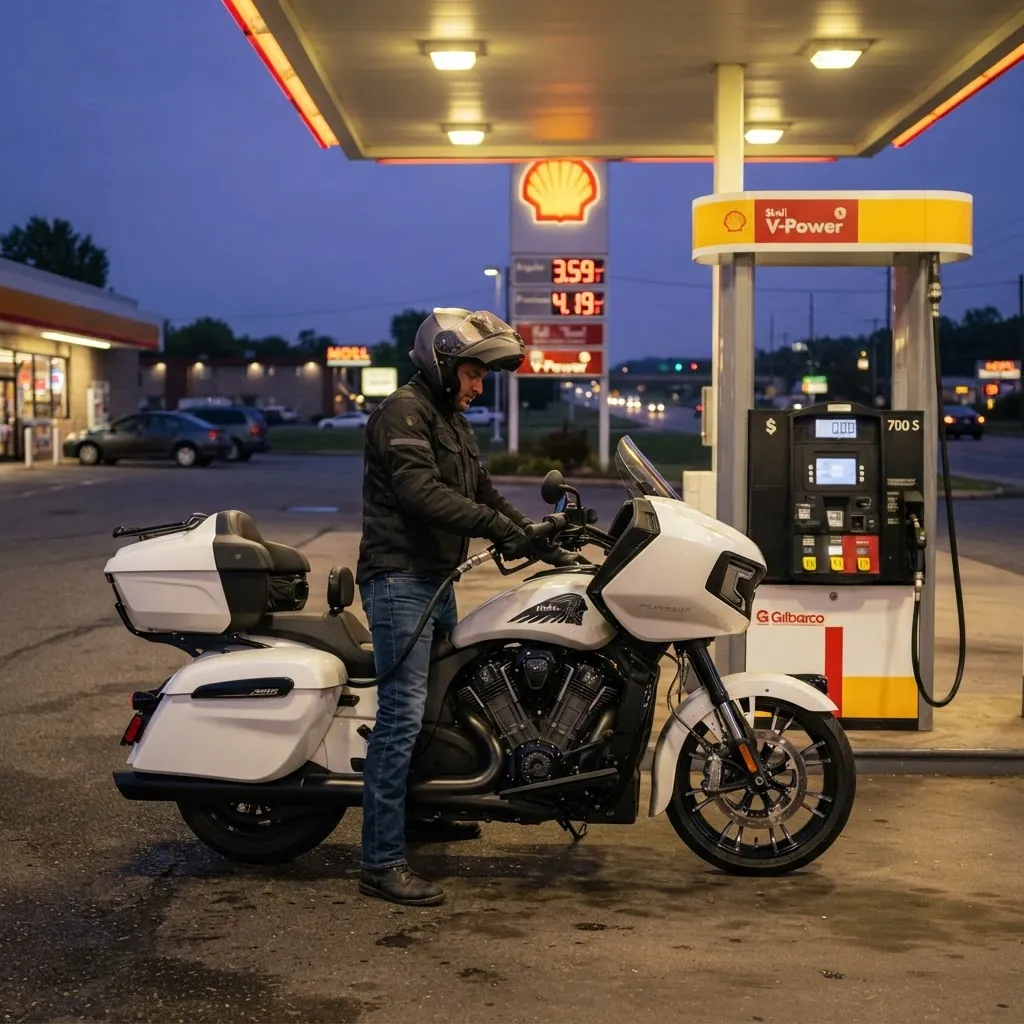
One of the first questions anyone asks about a touring bike is fuel economy. And on the Indian Pursuit, with its 22.7-liter (6-gallon) tank, the answer determines whether you're stopping for fuel every 200 km (124 miles) or stretching fuel stops to 350+ km (217+ miles).
Real-world fuel economy on a big cruiser isn't about what the manufacturer claims. It's about how you ride, where you ride, and what weight you're carrying. I've been tracking fuel efficiency across New Brunswick highway runs and backroad touring, and the differences are significant.
Real Fuel Economy on the Indian Pursuit
Let's start with what I'm actually seeing on the odometer. The Indian Pursuit PowerPlus 108ci engine with Stage 1 modifications delivers consistent fuel efficiency in the 6.0–6.7 L/100km range (15–18 US MPG, 18–22 UK MPG).
With the factory 22.7-liter tank, that translates to approximately 320–360 km (200–224 miles) per tank in mixed touring conditions. That's solid for a 937-pound bagger with luggage and passenger weight fully loaded.
But "mixed conditions" hides the real story. Highway and backroads burn fuel very differently.
Highway Riding: Best Fuel Economy
Steady-state highway running is where the Pursuit is most efficient. Cruising the Trans-Canada Highway through New Brunswick at 100–110 km/h (62–68 mph) in top gear, holding steady throttle — this is where you'll see the best numbers.
Highway runs consistently deliver 6.0–6.3 L/100km (15–17 MPG). That's because:
- Steady throttle input — no acceleration, no deceleration surges, just constant engine load.
- High gear efficiency — once you're at cruise, the engine is turning at lower RPM, working efficiently.
- Minimal wind resistance variables — a straight road means predictable aerodynamic drag.
- No elevation changes — flat New Brunswick highways let the bike coast and settle into a rhythm.
If you're planning a long-distance highway trip — Dieppe to Halifax, or the full Trans-Canada stretch — expect closer to 350–360 km (217–224 miles) per tank. That's planning distance: you can fuel up every 300 km (186 miles) comfortably without hunting for gas.
Backroad Touring: Higher Consumption
Now flip to the roads that actually make touring fun. Winding New Brunswick backroads, Cape Breton curves, PEI coastal loops — this is where fuel economy takes a hit.
Backroad touring delivers 6.5–6.7 L/100km (15–16 MPG). That doesn't sound like much different than highway, but the effective range drops to 320–340 km (200–211 miles) per tank because:
- Constant throttle modulation — accelerating out of corners, rolling off entering corners, engine working harder across the power band.
- Lower gears, higher RPM — you're not in top gear for hours. You're dropping down for corners, staying in mid-range gears where the engine works harder.
- Elevation changes — backroads in Atlantic Canada aren't flat. That hill you climb between fuel stops means engine load you don't get on the highway.
- Sustained lower speeds — 60–80 km/h (37–50 mph) average, not the 100+ km/h cruise that's most efficient.
On a recent backroad touring day through rural New Brunswick — roughly 280 km (174 miles) of winding terrain with passenger and luggage weight — I saw 6.6 L/100km and needed to fuel up before reaching a point that had been 320 km away.
Fuel Stops on Atlantic Canada Tours
Here's what changes when you're planning a multi-day touring trip across New Brunswick or beyond:
- Highway segments: Fuel every 300 km (186 miles) comfortably. If you're doing a day ride on the Trans-Canada, you're hitting fuel stops every 3–3.5 hours.
- Backroad segments: Plan fuel every 250–280 km (155–174 miles) to be safe. Winding scenic routes mean you want a fuel stop before you're genuinely low.
- Multi-day touring: Always fuel up at known stations rather than running to half a tank. In rural New Brunswick and Nova Scotia, gas stations are sometimes 60–80 km (37–50 miles) apart.
- Two-up riding: Additional passenger weight and luggage load pushes consumption higher. Plan accordingly — might drop 20–30 km per tank when fully loaded touring.
What Affects Fuel Economy Most?
More important than highway vs backroads, here's what actually moves the needle:
- Throttle smoothness — aggressive acceleration burns noticeably more fuel. Smooth roll-ons and steady cruising make a real difference.
- Gear selection — riding in too-low a gear for the speed wastes fuel. Highway 5th gear at cruise is more efficient than 4th at the same speed.
- Load weight — extra luggage, passenger weight, or equipment directly impacts consumption. Two-up touring with full gear will cost 10–15% in range.
- Wind conditions — a strong headwind noticeably impacts efficiency. Tailwind helps. Atlantic Canada's coastal winds can swing range by 20–30 km per tank.
Bottom Line for Pursuit Touring
The Indian Pursuit is a reasonably fuel-efficient big cruiser for touring. With a 22.7-liter tank and 6.0–6.7 L/100km real-world economy, you're getting 320–360 km (200–224 miles) per tank depending on the riding.
For Atlantic Canada touring, plan fuel stops every 250–300 km (155–186 miles). That's 3–3.5 hours of riding on backroads, or 2.5–3 hours on the highway. Build that into your route planning, fuel up at known stations in rural areas, and you'll never be stranded hunting for gas on a winding backroad in the middle of nowhere.
That's solid cruiser economy. Enjoy the ride.