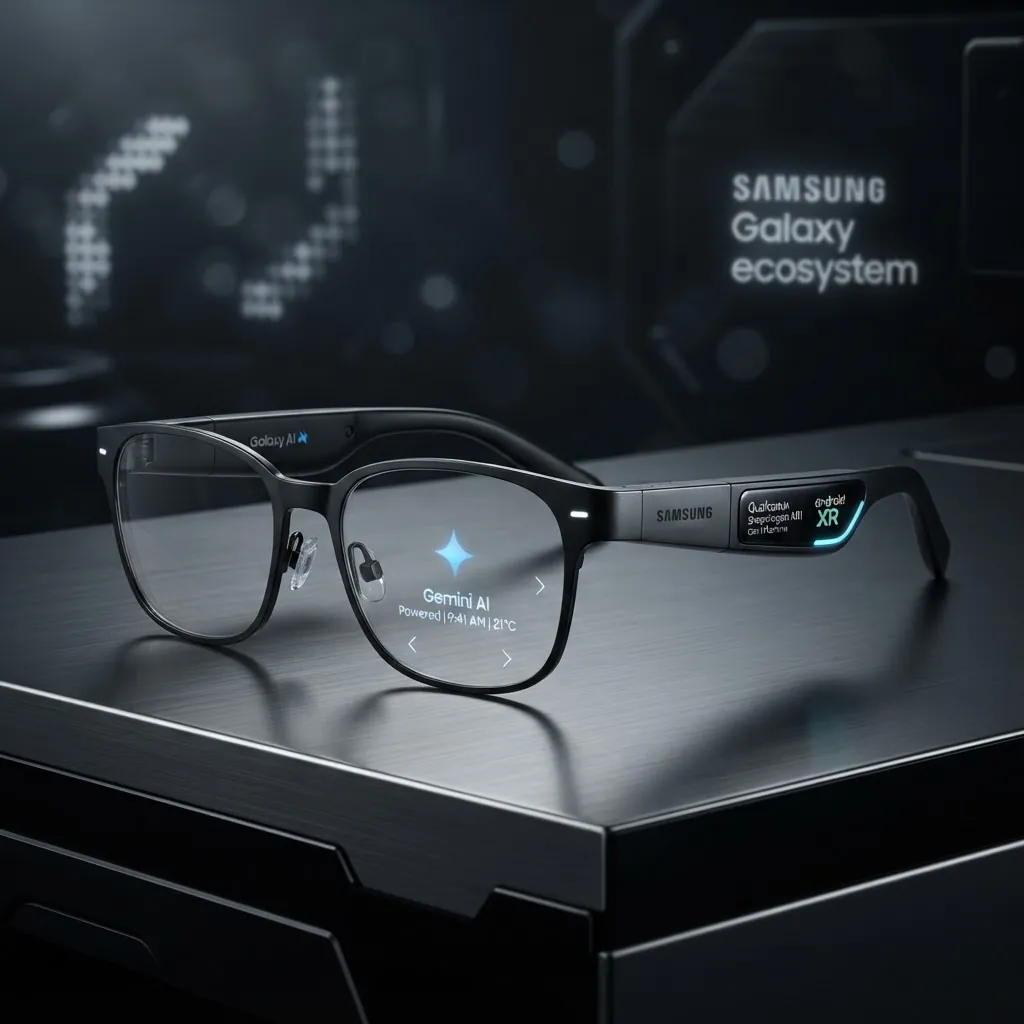
Samsung Galaxy Glasses 2026 — The First Real Ray-Ban Meta Challenger
Samsung and Google have spent three years building a smart glasses competitor, and it's launching this fall. With Gemini AI, Android XR, and a dual-LED privacy system that out-thinks Meta's, the Galaxy Glasses could reshape the market that Meta currently dominates with roughly 70% share (IDC, Q1 2026). Here's what's been reported — note that nothing is officially confirmed by Samsung yet.
Table of Contents
⚠️ IMPORTANT DISCLAIMER
The Samsung Galaxy Glasses are not yet released and have not been officially spec'd by Samsung. The specs, pricing, and features in this article come from regulatory filings, leaked details, Google's Android XR documentation, and industry reporting — none of it is confirmed by Samsung. Samsung announced a fall 2026 window at Google I/O, but final specifications may differ. Treat all details as speculation until Samsung's official launch.
What Are Galaxy Glasses?
Galaxy Glasses are Samsung's first consumer smart glasses, built in partnership with Google and Qualcomm. They run Google's new Android XR operating system with Gemini AI built in — making them the first smart glasses to offer Google's AI assistant natively rather than Meta's.
The collaboration started in 2023 when Samsung, Google, and Qualcomm began co-developing a shared hardware-software stack for mixed-reality wearables. The Galaxy XR headset shipped first in October 2025 at $1,799 USD. The smart glasses — codenamed "Jinju" (model SM-O200J) — follow in fall 2026.
Importantly, the first-generation Galaxy Glasses do not have a built-in display. They're audio-first, like the Ray-Ban Meta. A second-generation model codenamed "Haean" is rumored for 2027 and may add a micro-LED display for AR overlays — but this is pure speculation at this point. Samsung is taking a phased approach — get the audio and AI experience right first, add visual later.
Full Specs Breakdown
Samsung has NOT released an official spec sheet. The details below come from regulatory filings, leaked reports, and Google's Android XR documentation. They are unconfirmed and may change before launch:
| Specification | Galaxy Glasses (Expected) |
|---|---|
| Chipset | Qualcomm Snapdragon AR1 (unconfirmed — possibly AR1+ Gen 1) |
| Camera | 12MP Sony IMX681 with autofocus, flush-mounted |
| Battery | 155 mAh (confirmed via regulatory filing) |
| Battery Life | Estimated 6–8 hours depending on usage |
| Audio | Directional speakers (not bone conduction) |
| Microphones | Multi-mic array with noise cancellation |
| Connectivity | Bluetooth 5.3 + Wi-Fi (phone-tethered) |
| OS | Android XR with Gemini AI |
| Controls | Dedicated camera button, right-temple touchpad |
| Privacy LEDs | Dual LED (inward + outward) |
| Frame Partners | Gentle Monster + Warby Parker |
| Price (unconfirmed) | $379–$499 USD |
| Launch | Fall 2026 |
The 155 mAh battery is nearly identical to the Ray-Ban Meta Gen 2's 154 mAh cell. That's not a coincidence — both devices share the same Snapdragon AR1 platform, and the battery constraint is a physical limitation of fitting technology into eyewear that sits on a human face for hours.
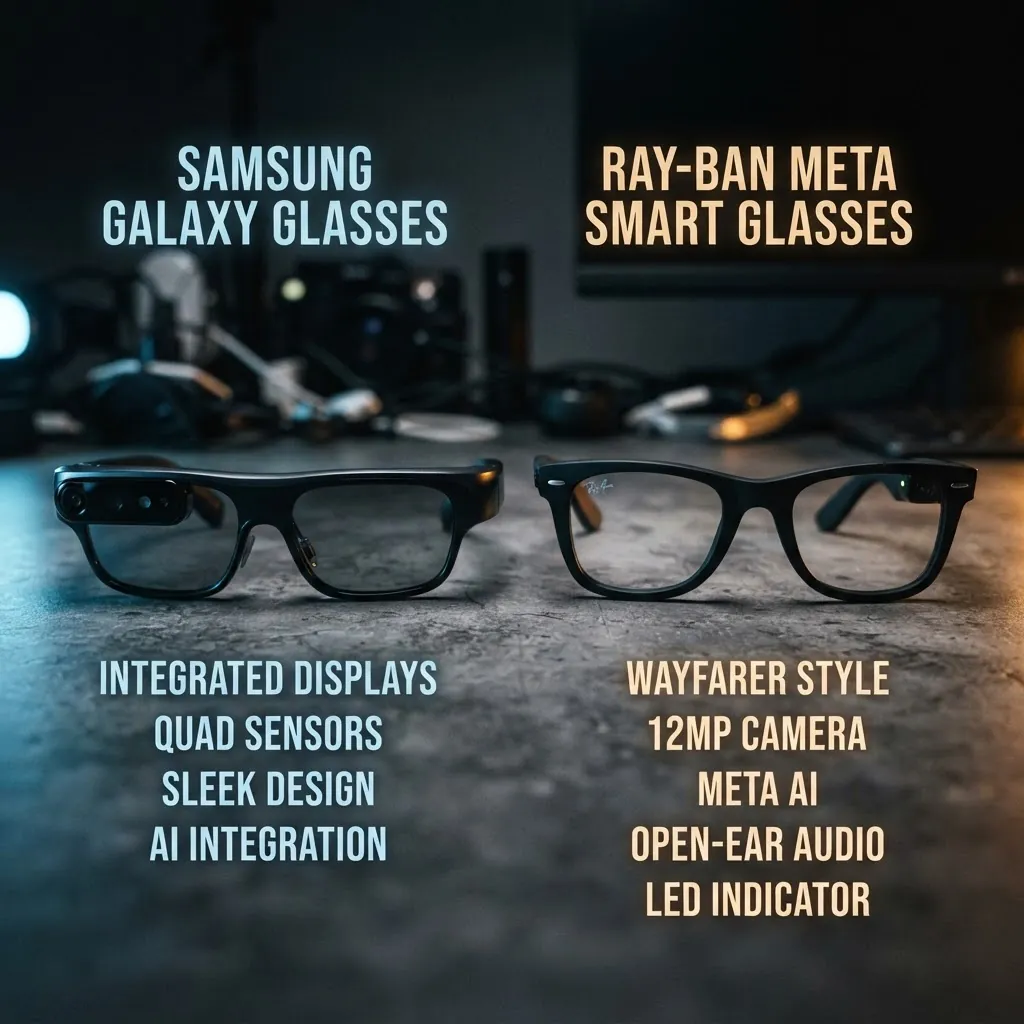
Samsung and Google vs Meta — the first real smart glasses competition.
Galaxy Glasses vs Ray-Ban Meta
I've been wearing Ray-Ban Meta smart glasses daily — I use them for recording ride footage and capturing moments hands-free while touring. Here's how the Galaxy Glasses compare based on what's confirmed:
| Feature | Galaxy Glasses (Expected) | Ray-Ban Meta Gen 2 |
|---|---|---|
| Chipset | Snapdragon AR1+ Gen 1 | Snapdragon AR1 Gen 1 |
| AI Assistant | Gemini (Google) | Meta AI |
| OS | Android XR | Meta View (custom) |
| Camera | 12MP Sony IMX681 | 12MP |
| Privacy LED | Dual (inward + outward) | Single (outward) |
| Navigation | Google Maps hands-free | Limited |
| Translation | Real-time via Gemini | Available via Meta AI |
| Frame Styles | Gentle Monster + Warby Parker | Ray-Ban (EssilorLuxottica) |
| Market Share | 0% (new entrant) | ~70% |
| Price | $379–$499 (expected) | $299–$429 |
| Ecosystem | Android + iOS compatible | Android + iOS compatible |
The biggest advantages Samsung brings: Gemini AI (which is genuinely better at visual queries and contextual understanding than Meta AI in my experience), Google Maps integration (turn-by-turn navigation in your glasses without a phone screen), and the dual-LED privacy system that tells both you and bystanders when the camera is active.
Meta's advantages: first-mover dominance, a mature software experience, the Ray-Ban brand cachet, and a lower entry price. Meta has also been iterating rapidly — the July 2026 privacy update that disables the camera if the LED is tampered with shows they're not standing still.
Gemini AI — The Real Differentiator
The most compelling reason to consider Galaxy Glasses over Ray-Ban Meta isn't the hardware — it's Gemini. Google's AI assistant has a significant edge in several areas that matter for smart glasses:
- Visual queries: Ask "what am I looking at?" and Gemini can identify landmarks, objects, and text through the 12MP camera with Google's massive knowledge graph
- Navigation: Google Maps hands-free — spoken turn-by-turn directions without looking at a phone screen
- Real-time translation: Gemini translates conversations in real-time through the directional speakers
- Deeper Google integration: Calendar, Gmail, Search, Photos — the entire Google ecosystem accessible by voice
- On-device AI: The AR1+ chip can run small language models on-device for low-latency tasks like wake-word detection, even without phone connectivity
Meta AI is good, but it's limited by Meta's ecosystem. Gemini has the full weight of Google Search, Maps, and the Android platform behind it. If you live in the Google ecosystem (Gmail, Calendar, Android phone), Galaxy Glasses could be a more natural fit.
The hardware race is close. The AI race is where Samsung and Google could pull ahead — if Gemini delivers on its promises in real-world use.
Privacy Design — Better Than Meta?
One area where Galaxy Glasses already out-spec Ray-Ban Meta is privacy hardware. Google's Android XR documentation specifies a dual-LED indicator system: one LED faces the wearer to confirm recording status, and a second LED faces outward to signal bystanders.
Ray-Ban Meta currently has a single outward-facing LED. Meta added a software update in July 2026 that disables the camera if that LED is tampered with, but the hardware design itself is less transparent than what Samsung and Google are proposing.
Whether dual LEDs meaningfully changes how the public perceives camera-equipped glasses is an open question. But for privacy-conscious users (and for courts and schools that are increasingly banning smart glasses), Samsung's approach is at least a step in the right direction.
Should You Wait or Buy Meta Now?
I get asked this constantly. My honest answer:
- If you need smart glasses today: Buy Ray-Ban Meta. The experience is mature, the frames are excellent, and Meta AI works well enough for daily use. You can get them for $299–$429 today.
- If you live in the Google ecosystem: Wait for Galaxy Glasses. Gemini integration with Gmail, Calendar, Maps, and Search will be meaningfully better if you're an Android user who relies on Google services.
- If you care about privacy design: Wait for Galaxy Glasses. The dual-LED system is a real hardware advantage.
- If you want a display: Wait until 2027. Neither current generation has one.
- If you're a content creator who films while riding: Either works. I use Meta glasses for motorcycle touring and they're great. Galaxy Glasses should be equally capable with a similar 12MP camera.
My plan: I'll test the Galaxy Glasses as soon as they're available this fall and do a proper hands-on comparison with my Ray-Ban Metas. The smart glasses space is about to get competitive, and that's good for everyone.
Frequently Asked Questions
When are Samsung Galaxy Glasses coming out?
Samsung announced a fall 2026 launch window at Google I/O 2026. However, final specs and exact release date are not confirmed. They are expected to run Google's Android XR with Gemini AI.
How much will Samsung Galaxy Glasses cost?
Expected pricing is $379 to $499 USD, matching the Ray-Ban Meta price range. Samsung is betting that Gemini AI integration, Android XR ecosystem depth, and dual-LED privacy design justify the same price point.
How do Samsung Galaxy Glasses compare to Ray-Ban Meta?
Both use the Qualcomm Snapdragon AR1 platform and have a 12MP camera. Galaxy Glasses add Gemini AI (vs Meta AI), a dual-LED privacy indicator system, Android XR with deeper Google integration, and frame partnerships with Gentle Monster and Warby Parker. Ray-Ban Meta has first-mover advantage with roughly 70% market share (IDC, Q1 2026).
Do Samsung Galaxy Glasses have a display?
No. The first-generation Galaxy Glasses are reported to be audio-first without a built-in display. A second-generation model rumored for 2027 may add a micro-LED display — but this is speculation, not confirmed by Samsung.
What AI does Samsung Galaxy Glasses use?
Samsung Galaxy Glasses run Google's Gemini AI through the Android XR operating system. Gemini handles voice commands, visual queries through the 12MP camera, navigation via Google Maps, and real-time translation.