Motorcycle Safety Technology 2026 — The Gear That's Saving Lives
Motorcycle safety tech has come a long way from ABS and a good jacket. In 2026, we've got cornering ABS, adaptive headlights, smart helmets with HUD, radar-based blind spot detection, and stability control systems borrowed from cars. Here's what actually works — and what's still hype.
Table of Contents
After over 200,000 km (124,000 miles) on motorcycles, I've learned one thing: you can't control what other drivers do. But you can stack the odds in your favor with the right technology. Here's a look at the safety tech that's actually making a difference in 2026.
Cornering ABS
Standard ABS prevents wheel lock during hard braking — but only when the bike is upright. The moment you lean into a corner, standard ABS is essentially blind. That's where cornering ABS changes the game.
Cornering ABS uses an IMU (Inertial Measurement Unit) — a six-axis sensor that detects the motorcycle's lean angle, pitch, and yaw. When you brake in a corner, the system modulates brake pressure based on how far you're leaned over. This prevents the front wheel from washing out, which is one of the most common crash scenarios for experienced riders.
| System | Works Upright | Works in Corners | Found On |
|---|---|---|---|
| Standard ABS | Yes | No | Most bikes 2010+ |
| Cornering ABS | Yes | Yes | Premium bikes 2018+ |
| MSC (Stability Control) | Yes | Yes + traction/wheelie | Flagship bikes 2020+ |
If you're shopping for a new bike, cornering ABS should be on your must-have list. The data shows it works — Bosch reports that motorcycles equipped with cornering ABS see up to 31% fewer crashes in cornering scenarios compared to standard ABS.
Adaptive Headlights
Traditional headlights point straight ahead, even when you're leaned over in a corner. This means the road ahead of you — where you're actually going — is dark. Adaptive headlights solve this.
The system uses IMU data to detect lean angle and then adjusts the headlight beam. Some systems use motorized swiveling bulbs; others use multiple LED segments that activate individually as you lean. The result: the beam follows the curve of the road, illuminating where you're headed instead of where the bike is pointed.
Indian Motorcycle offers adaptive headlight technology on several models, and it's particularly valuable for night touring. If you've ever taken a tight downhill corner in the dark on a 937 lb (425 kg) touring bike, you know exactly why this matters.
"Standard ABS is like wearing a seatbelt. Cornering ABS is like having airbags too. Once you've had it, you won't go back."
Smart Helmets and HUD
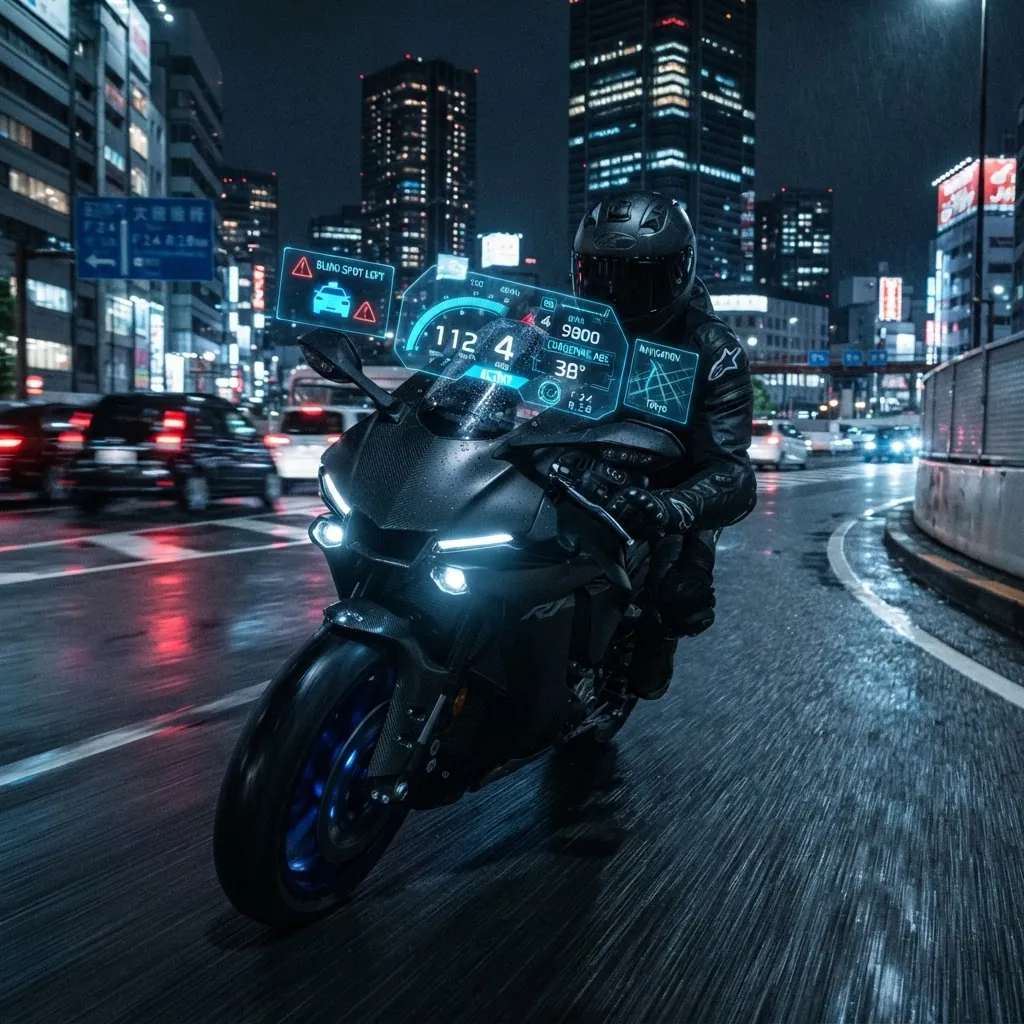
The promise of heads-up display (HUD) helmets has been around for years, but 2026 is the first time the technology is genuinely practical. Current smart helmets offer:
- Turn-by-turn navigation projected on the visor — no looking down at a GPS
- Speed display — your current speed overlaid in your field of view
- Blind spot warnings — indicators when a vehicle is in your blind spot
- Crash detection — automatic emergency contact notification on impact
- Voice control — make calls, change music, get directions without taking hands off the bars
The challenge? Price. Smart helmets range from $600 to $1,500+, and the technology is still maturing. Battery life is typically 6-10 hours, which means you're charging overnight on tour. And the HUD can be distracting if you're not used to it.
My take: if you're a daily commuter in heavy traffic, the blind spot detection and navigation are genuinely useful. For long-distance touring, I'd wait another generation. A quality traditional helmet with a good Bluetooth intercom still gives you 90% of the safety benefits at a fraction of the cost.
Motorcycle Stability Control (MSC)
MSC is the motorcycle equivalent of electronic stability control in cars — and it's the most comprehensive safety system available on a motorcycle. It combines:
- Cornering ABS — safe braking in corners
- Traction control — prevents rear wheel slip on acceleration
- Wheelie control — prevents front wheel lift
- Rear lift mitigation — prevents the rear wheel from lifting during hard braking
- Hill start control — prevents rollback on inclines
All of this runs through the IMU, processing data hundreds of times per second. The motorcycle stability control market is growing at 13.6% annually, and it's becoming standard on more mid-range bikes, not just flagships.
Radar and Blind Spot Detection
Bosch has introduced next-generation radar-based rider assistance systems in 2026, bringing car-level safety tech to motorcycles. These systems use front and rear radar to provide:
- Adaptive cruise control — maintains distance from the vehicle ahead
- Blind spot detection — warns when a vehicle is in your blind spot
- Forward collision warning — alerts you to approaching vehicles
- Rear collision warning — alerts when a vehicle is approaching fast from behind
This is particularly valuable for touring riders who spend long hours on highways. The adaptive cruise control reduces fatigue on long days, and the collision warnings give you critical extra seconds to react.
Visibility Technology
Sometimes the simplest safety tech is the most effective. Being seen is half the battle on a motorcycle.
- LED auxiliary lights — dramatically improve daytime visibility to other drivers
- Modulated headlights — pulse during daytime to catch attention (legal in most jurisdictions)
- Brake light modulators — flash your brake light to grab attention
- High-visibility gear — reflective strips and bright colors
My Visibility Setup
I run a white motorcycle (Indian Pursuit Dark Horse Icon) with a white helmet, plus front and rear auxiliary lighting. White bikes are statistically more visible to other drivers than dark-colored bikes. Combined with auxiliary lighting that creates a triangle of light at the front, this significantly improves the chance of being seen — especially at intersections.
What I Run on My Pursuit
My 2024 Indian Pursuit Dark Horse Icon doesn't have the full radar suite — that's newer tech. But here's what it does have that makes a real safety difference on long tours:
- Cruise control — reduces hand fatigue on 8-hour days
- ABS — standard, both wheels
- Ride Command display — GPS navigation without a phone
- 6-speaker audio — hear GPS directions without earbuds blocking traffic noise
- White bike + white helmet — maximum visibility
- Front and rear auxiliary lights — triangle of light for intersection safety
In 10,000 km (6,200 miles) of riding this bike — including a 4,000 km (2,485 mile) round trip to Muskoka — this setup has served me well. The most important safety tech is still between your ears: situational awareness, ATGATT (All The Gear All The Time), and riding within your limits.
Insta360 Ace Pro 2 — Record Your Rides for Safety
Front and rear cameras aren't just for content — they're dashcam evidence if something goes wrong. I run dual Ace Pro 2 cameras on my Pursuit for exactly this reason.
Amazon.ca Amazon.com