Sena vs Cardo vs Budget: Is the Premium Intercom Actually Worth It? (2026)
In This Article
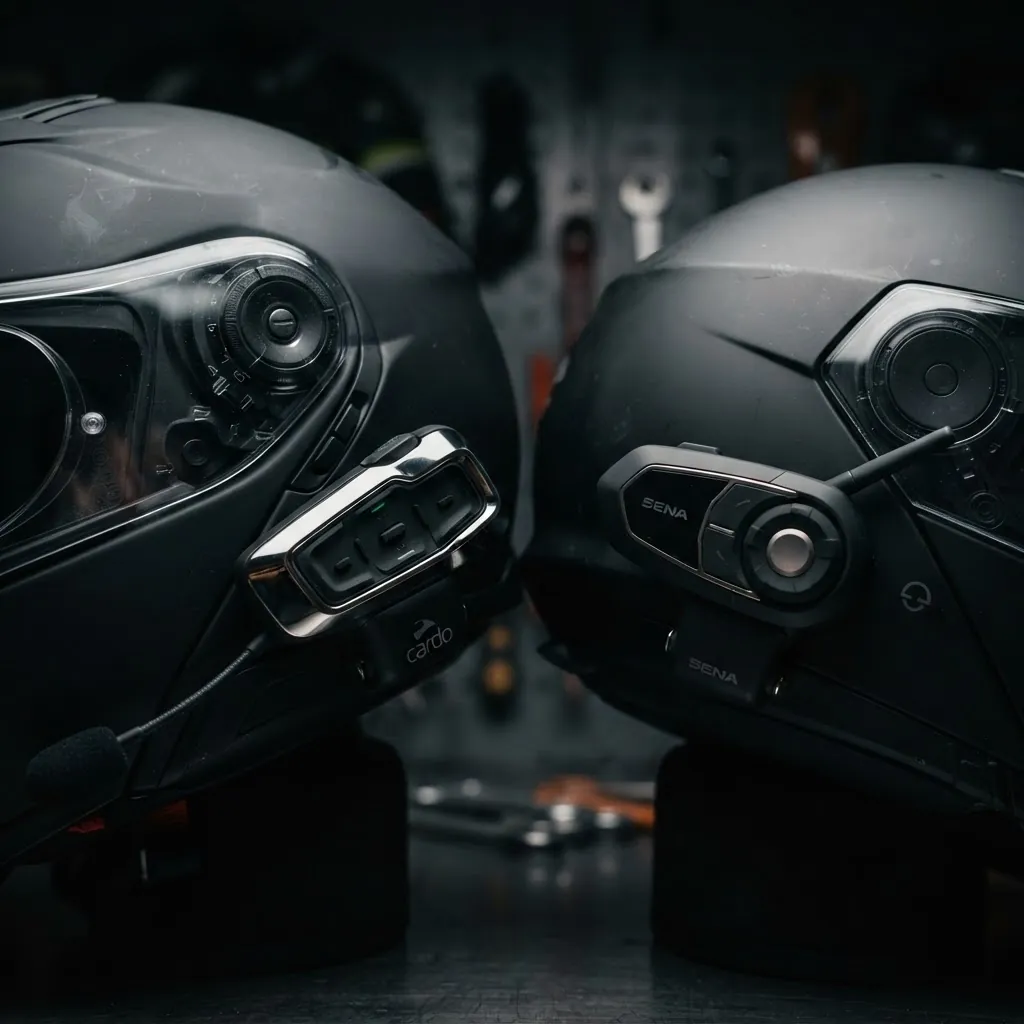
The motorcycle intercom market has a problem: it's designed to make you feel like anything under $300 is garbage. Cardo and Sena spend heavily on marketing, their flagship units dominate search results and YouTube reviews, and the implicit message is that budget options aren't worth your time.
After 200,000 km (124,000 miles) of riding — solo, two-up with my partner Monique, and in group rides with the Halifax IMRG crew — the market has enough options at enough price points to give you an honest answer. There are situations where Sena or Cardo genuinely earns the premium. There are also situations where you'd be wasting money.
The Real Question Nobody Asks
Before comparing models, ask yourself what you actually need from a helmet intercom. Most reviews skip this step and go straight to specs. But the right intercom depends entirely on how you ride.
Solo rider, music and GPS audio only? You don't need Sena or Cardo. Full stop. A $60–90 CAD unit from Amazon will handle Bluetooth audio just fine, and you'll never use the intercom features you're paying for.
Two-up touring with a passenger? The intercom quality matters much more — you're talking all day, and audio clarity and connection stability become genuinely important to the experience.
Group riding with 4+ bikes? Now you're in territory where mesh networking matters, and the brand ecosystem (everyone on the same brand connects more reliably) starts to make a real argument for Sena or Cardo.
When Premium Is Actually Worth It
Here's where I land after real-world use at multiple price points:
Premium is worth it for two-up riders doing long days. If you and your passenger are talking for 6–8 hours across 500 km (310 miles) of mixed terrain, the audio clarity difference between a $80 unit and a $350 unit is noticeable. Premium units handle wind noise better at highway speed, maintain clearer voice separation from road and engine noise, and the connection is more stable through long stretches without re-pairing.
Premium is worth it for established group ride crews where everyone is on the same brand. Mesh networking on premium units is genuinely seamless — you put your helmet on, it connects, done. Budget mesh units work but require more fiddling, especially when multiple units are trying to connect simultaneously.
Premium is not worth it for solo riders who primarily want music and the occasional phone call. The $300+ premium buys you intercom features you won't use. For more, see the NYTalk N8 intercom.
Sena 50S and 60S — The Case For and Against
Sena 50S
~$380–430 CAD single unit | ~$680–750 CAD dual pack
The 50S runs dual-chip architecture — Bluetooth and Mesh 2.0 simultaneously — so you can connect to the mesh group and still pair your phone for music and calls at the same time. The SOUND BY Harman Kardon speakers are a meaningful upgrade from budget units, especially for music quality at highway speed.
Pros
- Harman Kardon audio — noticeable difference
- Simultaneous Bluetooth + Mesh
- Large user base — easy to find group rides
- Reliable firmware updates
Cons
- Mesh 2.0 (not 3.0) at this price
- Some reported connection drops in large groups
- Premium price for Canadian buyers
Best for: Two-up touring where audio quality matters, established Sena-ecosystem groups.
Sena 60S Mesh AI
~$440–500 CAD single unit
The 60S is Sena's current flagship with AI noise cancellation and Mesh 2.0. The AI noise processing is genuinely effective — it targets wind and engine noise specifically rather than just applying blanket noise reduction. At 130 km/h (80 mph) on the Indian Pursuit with a Stage 1 exhaust, voice clarity is excellent both directions.
Best for: Serious long-distance solo or two-up touring where voice clarity is the priority. The AI noise cancellation earns its premium at highway speed.
Cardo Packtalk Edge — Where It Wins
Cardo Packtalk Edge
~$380–420 CAD single unit
Cardo's DMC (Dynamic Mesh Communication) has consistently outperformed Sena's mesh in group connection stability in independent testing. Where Sena runs Bluetooth and Mesh through separate chips, Cardo's full mesh implementation means every unit connects directly to every other unit — no daisy-chain, no single point of failure.
Pros
- DMC mesh — superior group stability
- JBL speakers — excellent audio
- IP67 waterproof (better than some Sena ratings)
- Natural voice tone preferred by many riders
Cons
- Smaller user base in Canada vs Sena
- App can be fiddly on first setup
- Premium price
Best for: Group rides of 6+ bikes where mesh stability is the priority. Cardo's group connection is the best in the business.

The Best Budget Options on Amazon Canada
This is the section most Sena and Cardo reviews skip because there's no affiliate incentive to send you to a $70 unit. Here's the honest breakdown of what actually works at the lower price points.
Fodsports FX8 Pro — Best Budget Mesh Unit
~$90–120 CAD | Dual-unit packs available
The FX8 Pro runs Bluetooth 5.0 with 10-rider mesh support and has been independently reviewed as the most reliable budget mesh option available on Amazon Canada. The audio isn't Harman Kardon, but voice clarity two-up at highway speed is serviceable — noticeably better than older budget units. Battery life is solid at 12+ hours. If you want to try two-up intercom without committing to a $700 CAD dual Sena pack, the FX8 Pro is the smartest starting point.
Best for: Riders new to intercoms, budget-conscious two-up touring, groups where not everyone wants to spend $400.
LEXIN B4FM — Best Budget Solo Option
~$60–80 CAD
The B4FM supports 10-rider intercom with a 2,000 m (1.2 mile) range, IP67 waterproofing, and FM radio. It's been on the market long enough to have genuine long-term reliability data — this isn't a fly-by-night Amazon brand. For a solo rider who wants Bluetooth music, GPS audio, and the occasional phone call, the B4FM is hard to argue against at this price.
Best for: Solo riders who primarily need music and phone connectivity, not serious group intercom.
Full Price Tier Breakdown
Intercom Options — Canadian Pricing 2026
My Verdict After 200,000 km
If you're two-up touring regularly and doing long days — buy Sena or Cardo. The audio quality and connection stability difference is real, and you'll use every dollar of that premium on a 500 km (310 mile) day. I'd lean Cardo Packtalk Edge for group-focused riders, Sena 60S for premium two-up audio.
If you're a solo rider who wants music and GPS audio — don't spend $400. A Fodsports FX8 Pro or LEXIN B4FM will serve you well for a fraction of the price. Put the difference toward your next tank of gas or your next overnight stay.
If you're group riding with a crew where not everyone wants to spend $400+ — the NYTalk N8 Mesh 3.0 is the honest group solution. I've reviewed it separately and it earns a genuine recommendation at its price point.
Gear Mentioned — Verified Links
Frequently Asked Questions
Is Sena or Cardo better for motorcycle intercoms?
Sena and Cardo are the two premium leaders. Sena offers mesh intercom with Harman Kardon audio and is known for ease of use. Cardo offers natural voice operation and mesh technology with over-the-air updates. Both are excellent — Sena tends to win on audio quality, Cardo on features and update support. Budget alternatives like Fodsports and LEXIN deliver 70% of the functionality at 30% of the price.
What is the best budget motorcycle intercom?
The Fodsports M1S Pro and LEXIN G2P are the best budget motorcycle intercoms. Both support mesh or Bluetooth pairing for multiple riders, music sharing, and phone calls at a fraction of the Sena or Cardo price. The NYTalk N8 is another strong budget mesh option for two-up riding.
How much does a motorcycle intercom cost?
Budget intercoms like Fodsports and LEXIN range from $60 to $120 CAD. Mid-range options like the NYTalk N8 run $130 to $180 CAD. Premium systems from Sena and Cardo range from $350 to $500+ CAD. The price difference buys better audio quality, mesh range, and build durability.
Do budget motorcycle intercoms work with Sena or Cardo?
Most budget intercoms use Bluetooth and can pair with one Sena or Cardo unit at a time via Bluetooth pairing, but they cannot join Sena or Cardo mesh networks. If your riding group uses Sena mesh or Cardo mesh, you will need a matching brand to participate in group mesh communication.
Is a motorcycle intercom worth it for solo riders?
Even solo riders benefit from an intercom for GPS navigation audio, phone calls, and music streaming. However, if you never ride two-up or in groups, a simple Bluetooth earbud setup may be sufficient. Intercoms become essential for passenger communication and group rides.