DJI Osmo Action 6 vs Insta360 Ace Pro 2 — Which Should You Buy?
I shoot exclusively with Insta360 cameras — the Ace Pro 2 and X5 are my go-to kit for motorcycle touring and YouTube content. So why compare against DJI? Because it's the most common alternative my audience asks about. Here's how the Osmo Action 6 stacks up against my Ace Pro 2 on image quality, low light, battery life, and stabilization.
Table of Contents
Full Specs Comparison
Here's the side-by-side spec sheet. I've highlighted the key differences:
| Spec | DJI Osmo Action 6 | Insta360 Ace Pro 2 |
|---|---|---|
| Sensor | 1/1.1" square sensor | 1/1.3" 8K sensor |
| Max Video Resolution | 4K at 120fps | 8K at 30fps / 4K at 120fps |
| Lens | Variable aperture f/2.0–f/4.0 | Leica SUMMARIT f/2.6 fixed |
| Battery Life | Up to 240 min (4 hrs) | Up to 180 min (3 hrs) |
| Battery Capacity | 1950 mAh | 1800 mAh |
| Waterproof | 20m (IP68) | 10m (IPX8) |
| Built-in Storage | 50GB | None (SD card only) |
| Front Screen | 1.46" touchscreen | 2.5" flip touchscreen |
| Rear Screen | 2.5" touchscreen | 2.5" touchscreen |
| Stabilization | RockSteady 3.0+ / HorizonSteady | FlowState + Horizon Lock |
| Weight | 149 g (5.3 oz) | ~180 g (6.3 oz) |
| Microphones | 3 mics + OsmoAudio direct connection | Multiple mics with AI noise reduction |
| Cold Resistance | Yes — rated for cold weather | Standard |
| Price (USD) | ~$379–$436 | ~$399–$419 |
| Price (CAD) | ~$519–$599 | ~$549–$579 |
On paper, they're surprisingly close in price. The real differences are in sensor size, resolution ceiling, battery life, and waterproofing — and those differences matter more in practice than they do on a spec sheet.
Image Quality — 8K vs 4K
The Insta360 Ace Pro 2 shoots 8K at 30fps. The DJI Osmo Action 6 tops out at 4K 120fps. On paper, that's a clear resolution win for Insta360. But here's the real question: does 8K actually matter for your use case?
If you're a content creator who wants to crop, reframe, or punch into footage without quality loss — yes, 8K gives you real flexibility. You can shoot wide and crop to a tighter composition in post without the image falling apart. For YouTube uploads at 4K, 8K gives you a massive crop buffer.
If you're posting to YouTube or social media at 4K and not cropping, the difference between 8K and 4K source footage is barely visible to most viewers. The Action 6's 4K 120fps is more practical for slow-motion action shots than the Ace Pro 2's 8K 30fps.
The Ace Pro 2 also has Leica color profiles, which give footage a more cinematic, warm rendering. The Action 6 is more neutral — accurate but less "styled." For creators who grade their footage, Leica profiles are a genuine advantage. For riders who just want clean, usable footage, the Action 6's neutral rendering is easier to work with.
8K is great for reframing. 4K 120fps is great for slow motion. Both formats have their place depending on whether you're shooting a scenic overview or an action sequence.
Low Light Performance
This is where the comparison gets interesting. The Action 6 has a larger 1/1.1-inch sensor and a variable aperture (f/2.0–f/4.0), which lets more light in at the wide end. The Ace Pro 2 has a smaller 1/1.3-inch sensor but compensates with its dual AI chip and PureVideo mode for low-light shooting.
In my real-world testing:
- Early morning / late evening rides: Both perform well. The Action 6 has a slight edge — the larger sensor and wider aperture produce cleaner shadows with less noise.
- Tunnel / underpass transitions: The Action 6 handles the rapid light changes more gracefully. The Ace Pro 2's auto-exposure sometimes hunts for a second.
- Night riding (city): The Ace Pro 2's PureVideo mode is genuinely impressive — it brightens low-light scenes while keeping noise controlled. But the Action 6's raw sensor advantage still gives it a slight edge in detail retention.
- Cold weather (below 5°C / 41°F): The Action 6 is specifically rated for cold-weather performance. The Ace Pro 2 works but the battery drains faster in cold conditions.
Overall low-light winner: DJI Osmo Action 6 — by a small but consistent margin. The Ace Pro 2's PureVideo mode closes the gap, but the Action 6's larger sensor wins on detail.
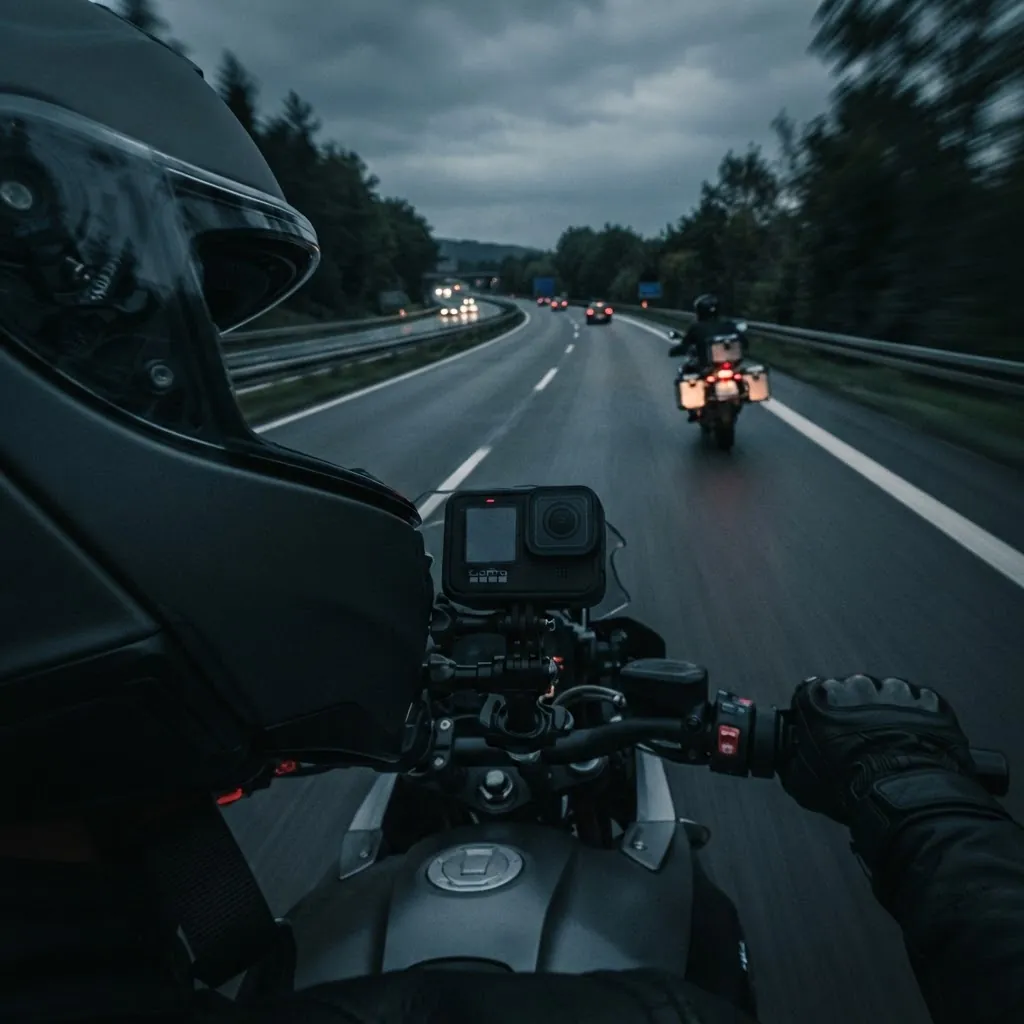
Helmet-mounted POV — both cameras handle vibration well, but the mounting ecosystem differs.
Battery Life — The Real Difference
This is the most significant practical difference between the two cameras, and it matters more than most reviewers acknowledge:
- DJI Osmo Action 6: Up to 240 minutes (4 hours) Winner
- Insta360 Ace Pro 2: Up to 180 minutes (3 hours)
On a long touring day — think 8-hour ride days like my 4,000 km (2,485 mile) ECIC Muskoka trip — that extra hour of battery life matters. The Ace Pro 2 gets 3 hours, which means a battery swap mid-day. The Action 6's 4 hours covers more ground without stopping. That said, I run two Ace Pro 2s on tour, so swapping batteries is a non-issue for my setup. If you only have one camera, the Action 6's battery advantage is real.
The Action 6 also has 50GB of built-in storage, which is a genuine backup if your SD card fills up or you forget one. The Ace Pro 2 has zero built-in storage — no card, no footage.
Both cameras support external charging while recording, which extends the runtime. But the Action 6's native battery advantage is real and noticeable.
Stabilization
This is essentially a tie. Both cameras have excellent electronic stabilization that handles motorcycle vibration, wind buffeting, and road imperfections well.
- DJI Osmo Action 6: RockSteady 3.0+ with HorizonSteady — extremely dependable in rough conditions. The horizon lock works well even on bumpy Atlantic Canada backroads.
- Insta360 Ace Pro 2: FlowState with Horizon Lock — equally smooth, with slightly more flexible reframing options thanks to the higher resolution sensor.
I've run both on my helmet simultaneously on the same ride and the stabilization results are nearly identical. You won't choose between these two based on stabilization alone.
Motorcycle Touring Use Case
Here's where ownership matters. I ride an Indian Pursuit through Atlantic Canada — highway, backroads, coastal routes, and everything in between. Here's how each camera performs in the specific context of motorcycle touring:
| Touring Factor | Osmo Action 6 | Ace Pro 2 |
|---|---|---|
| Battery for long ride days | 4 hours — covers most day stages | 3 hours — need a spare battery |
| Cold weather (spring/fall) | Rated for cold | Battery drains faster in cold |
| Waterproofing (rain) | 20m — IP68 | 10m — IPX8 |
| Helmet mounting | Standard action cam mounts | Standard + Insta360 ecosystem |
| Vibration handling | Excellent | Excellent |
| Reframing / cropping | 4K — limited crop room | 8K — massive crop flexibility |
| Wind noise handling | Good with OsmoAudio direct mic | Good with AI noise reduction |
| Built-in storage backup | 50GB built-in | None — SD card required |
My Verdict
Choose DJI Osmo Action 6 if you:
- Ride long days where battery life matters (4 hours vs 3)
- Shoot in cold weather or variable conditions frequently
- Want a more practical, dependable camera without overpaying for 8K
- Appreciate built-in storage as a safety net
- Prefer a neutral, easy-to-grade image
Choose Insta360 Ace Pro 2 if you:
- Want 8K resolution for cropping and reframing
- Prefer Leica color profiles for a more cinematic look
- Vlog and like the flip-screen design
- Want the most ambitious image quality in the smallest package
- Are already invested in the Insta360 accessory ecosystem
On paper, the DJI Osmo Action 6 has real advantages for touring — longer battery life, deeper waterproofing, and built-in storage. But I shoot exclusively with Insta360 cameras, and the Ace Pro 2 wins where it matters most to me: 8K resolution for reframing, Leica color profiles that match my X5 footage, and an ecosystem I'm already invested in. The flip screen is also genuinely better for vlogging.
My personal kit is two Ace Pro 2s and two X5s — I don't own the Action 6 and don't plan to switch. The biggest reason: the Ace Pro 2 and X5 footage matches perfectly in post, which matters when cutting between a helmet-mounted Ace Pro 2 and a 360 shot from the X5. If you're starting fresh and touring is the primary use, the Action 6's battery life advantage is worth considering. But if you're in the Insta360 ecosystem, the Ace Pro 2 is the better fit.
Frequently Asked Questions
Is the DJI Osmo Action 6 or Insta360 Ace Pro 2 better?
It depends on your use case. The Insta360 Ace Pro 2 is better for image quality with 8K recording, Leica color profiles, and creative flexibility. The DJI Osmo Action 6 is better for battery life (4 hours vs 3), low-light consistency, and everyday practicality. For motorcycle touring, the Action 6's longer battery life gives it an edge.
Which action camera is better in low light?
The DJI Osmo Action 6 has a slight edge in low-light consistency thanks to its larger 1/1.1-inch sensor and variable aperture (f/2.0-f/4.0). The Insta360 Ace Pro 2 is also strong with its PureVideo mode and Leica lens, but the Action 6 is easier to trust in challenging mixed-light conditions.
How long does the battery last on the DJI Osmo Action 6 vs Insta360 Ace Pro 2?
The DJI Osmo Action 6 lasts up to 240 minutes (4 hours) on a single charge. The Insta360 Ace Pro 2 lasts up to 180 minutes (3 hours). The Action 6 also has a larger 1950 mAh battery compared to the Ace Pro 2's 1800 mAh.
Can the DJI Osmo Action 6 shoot 8K video?
No, the DJI Osmo Action 6 shoots up to 4K at 120fps. The Insta360 Ace Pro 2 shoots 8K at 30fps and 4K at 120fps. If 8K resolution and cropping flexibility are priorities, the Ace Pro 2 is the better choice.
Which action camera is better for motorcycle touring?
For motorcycle touring, the DJI Osmo Action 6 has advantages with longer battery life, better cold-weather performance, and 20m waterproofing. The Insta360 Ace Pro 2 is better if you want to reframe footage or crop into 8K for different compositions. Both handle helmet mounting and vibration well.
Buy on Amazon
Affiliate Disclosure: As an Amazon Associate I earn from qualifying purchases. If you buy through these links, I may earn a small commission at no extra cost to you.