Used Motorcycle Buying Guide 2026: What to Check Before You Buy
Table of Contents
I bought my current Indian Pursuit from a dealer — nearly new, low kilometres, and everything checked out. But I still did a full inspection before signing anything. That habit has saved me on other purchases over the years, and it's the reason this checklist exists.
This guide is the inspection checklist I wish I'd had on my first few used bike purchases. Print it, take it with you, and check every single item.
Before You Go: Research and Preparation
Don't show up to look at a bike without doing your homework first. The seller will know more about the bike than you do — that's an information advantage that costs you money.
- Check comparable listings — Search Cycle Trader, Kijiji, Facebook Marketplace, and local dealer inventory for the same model and year. Know the going price range before you make an offer.
- Research common problems — Every model has known issues. Search forums (Reddit r/motorcycles, model-specific forums) for "common problems" and "what to look for." For example, some BMW GS models are known for final drive failures; some Indian models have had clutch issues.
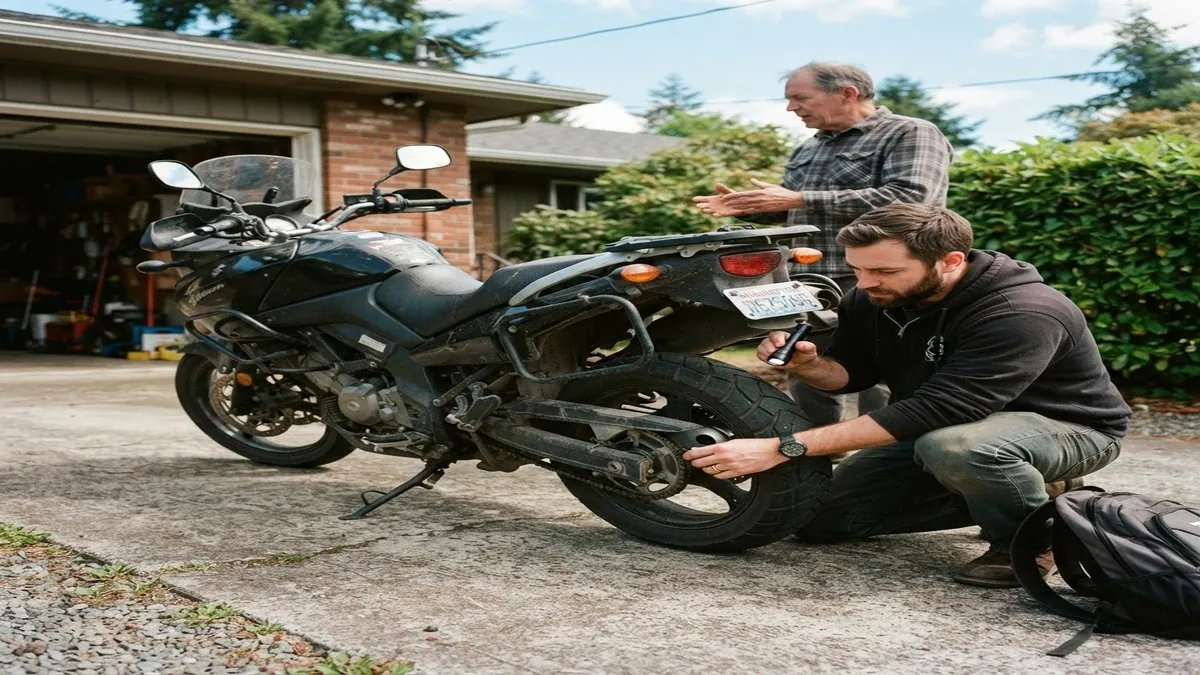
- Bring the right tools — Flashlight, work gloves, tire pressure gauge, multimeter (for electrical), and a friend. A second set of eyes catches things you'll miss.
- Go in daylight — Never inspect a bike at night or in a garage with poor lighting. You need to see paint matching, frame welds, and fluid colors clearly.
The Frame — Where to Start
If the frame is damaged, walk away. No amount of savings is worth a bent frame. Here's what to check:
Frame Inspection Checklist
- Visual welds — look for non-factory welding marks or grinding
- Paint matching — mismatched paint suggests crash repairs
- Front-to-rear wheel alignment — stand behind the bike and check that both wheels line up
- Steering stops — check for broken or bent steering stops on the triple clamp
- Engine mounting bolts — all present and torqued, no Loctite caked on (sign of recent removal)
- Swingarm pivot — grab the swingarm and try to move it side to side; any play is bad
- Fork seals — look for oil residue on the fork tubes
- Subframe — check for bends or cracks under the seat
Engine and Fluids
The engine tells you how the bike was treated. A well-maintained engine can last 100,000+ km. A neglected one is a money pit.
Engine and Fluid Checklist
- Oil level and color — should be amber to dark brown, not milky (coolant leak) or metallic
- Coolant color — should be green, pink, or orange (depending on brand), not rusty
- Start from cold — ask the seller NOT to start it before you arrive. Cold starts reveal valve noise and starting issues
- Exhaust smoke — blue smoke = burning oil, white smoke = coolant, black smoke = running rich
- Idle quality — should idle smoothly after warm-up, not hunt or stall
- Throttle response — twist the throttle; should be smooth with no sticking
- Clutch feel — pull the lever; should be smooth, not notchy. With the bike in gear and clutch in, it should roll freely
- Listen for knocks — a knocking sound at idle can mean worn main bearings (expensive)
Ask for maintenance records. A seller who kept receipts cared about the bike. A seller who says "I always changed the oil" but has no receipts is guessing.
Tires, Brakes, and Wheels
Tires and brakes are consumables, but they tell you about the bike's history and they're expensive to replace.
Tires, Brakes, and Wheels Checklist
- Tire date code — 4-digit DOT code on the sidewall. Tires older than 5 years need replacement regardless of tread
- Tire tread depth — minimum 2/32" (1.6mm). Use the wear bar indicators
- Tire wear pattern — cupping or scalloping suggests suspension issues
- Brake pad thickness — look through the caliper. Less than 2mm means replacement needed
- Brake rotor condition — look for deep grooves or blue discoloration (overheating)
- Brake lever feel — should be firm, not spongy (air in lines) or stuck to the bar
- Wheel rims — check for dents, cracks, or bent edges (especially on cast wheels)
- Wheel bearings — lift the bike and spin each wheel; listen for grinding or feel for play
Replacing both tires on a touring bike costs $400-800 CAD. New brake pads and rotors add another $300-600. Shop tires | Shop brake pads. Factor these into your offer if they need replacement.
Chain and Sprockets
The chain and sprockets are an easy $200-400 repair — shop chain kits, but they also reveal maintenance habits. A rusty, loose chain means the owner didn't maintain the bike — and probably skipped other maintenance too.
Chain and Sprocket Checklist
- Chain tension — check the spec; typically 25-35mm of slack at the midpoint
- Chain condition — no rust, no tight spots, no kinks. Lift the chain off the rear sprocket; if it lifts more than a few millimetres, the chain is stretched
- Sprocket teeth — should be symmetrical. Hooked or pointed teeth mean replacement needed
- Rear sprocket — check for looseness on the carrier
- Counter-shaft sprocket — harder to see, but check for visible wear
Electronics and Lighting
Modern motorcycles have complex electronics. Test everything — electrical problems can be expensive and hard to diagnose.
Electronics Checklist
- Headlight — high and low beam
- Turn signals — front and rear, left and right
- Brake lights — front lever and rear pedal
- Horn
- Gauges — all indicator lights illuminate on startup, then turn off (except those that should stay on)
- Display — no dead pixels or flickering
- ABS light — should illuminate on startup and turn off after rolling
- Ride modes — if the bike has them, cycle through each
- Heated grips — if equipped, test both sides
- Power outlet — if equipped, test with a phone charger
Red Flags — Walk Away Immediately
- Frame welds — Non-factory welding anywhere on the frame means a crash repair. Even if it "looks fine," the structural integrity is compromised.
- Title issues — Salvage, rebuilt, or missing title. The bike may be stolen or totalled. Don't touch it.
- Won't start cold — If the seller pre-warms the bike before you arrive, they're hiding a starting issue. A healthy bike starts cold.
- Milky oil — Coolant in the oil means a head gasket or cylinder failure. $2,000+ repair.
- VIN mismatch — Frame VIN and engine VIN should match the registration. If they don't, the bike may be assembled from parts.
- Seller pressure — "I have another buyer coming in an hour" or "I need cash today" are pressure tactics. A legitimate seller will give you time to inspect.
- Price too good to be true — A $10,000 bike listed for $6,000 is either stolen, damaged, or a scam. The market sets the price.
- No test ride without cash in hand — This is actually reasonable from the seller's perspective. But if they won't let you test ride at all, something is wrong.
How to Negotiate the Price
Most private sellers price 10-20% above what they'll accept. Here's how to negotiate fairly without being a jerk:
- Don't negotiate before inspecting. Show up, look interested, do the full inspection. The seller is more likely to deal with someone who's serious.
- Document every issue. Worn tires, scratched fairings, stale fluid, dirty chain — each item has a cost. Present them as a list, not as criticism.
- Research comps. "I've seen three of these listed at $X with newer tires and lower miles." Facts are more effective than feelings.
- Make a fair offer. Don't lowball. Offer what the bike is actually worth given its condition. A reasonable seller will counter, and you'll meet in the middle.
- Cash talks. "I can pay $X cash today and pick it up tomorrow." Sellers value certainty and speed.
- Be willing to walk. The strongest negotiating position is genuinely being willing to walk away. If the seller won't budge and the price isn't fair, leave. There's always another bike.
On a previous bike purchase, the seller's asking price reflected what the bike looked like in photos — not what it was worth. A worn chain, low brake pads, and tires approaching replacement added up to nearly $800 in immediate costs. I itemized each one and made an offer reflecting the actual condition. We met in the middle. The inspection paid for itself before I even rode home.
Paperwork and Legal
Before you hand over money, make sure the paperwork is clean:
- VIN check — Run the VIN through your province/state database to confirm no liens, no theft, no salvage status
- Registration — Match the VIN on the registration to the bike. Match the seller's ID to the registered owner name
- Bill of sale — Write one. Include date, VIN, sale price, seller name and buyer name, both signatures
- Service records — Transfer any existing records. If the bike is under warranty, confirm transferability
- Insurance — Arrange insurance before you ride away. Most providers can activate coverage over the phone
Disclosure: This article contains affiliate links for products I use. If you purchase through these links, I earn a small commission at no additional cost to you.