Why a 360 Camera Makes More Sense for Motorcycle Touring in 2026
Traditional action cameras make you choose what to point at before you ride — and you often miss the best moment. 360 cameras capture everything around you and let you decide later. After riding with Insta360 X5 cameras for thousands of kilometres, here is why 360 has become my default touring setup.
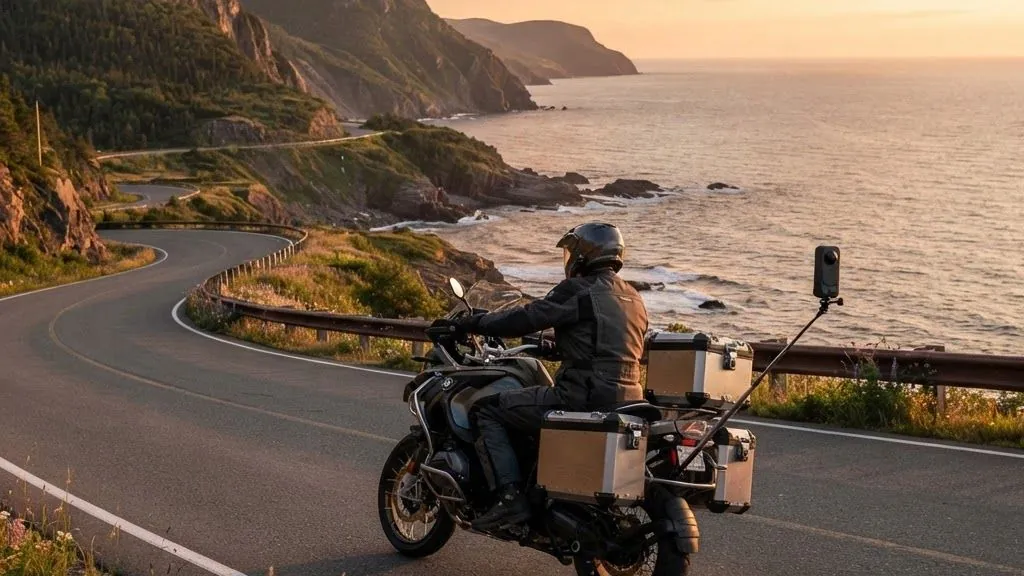
Table of Contents
The case for 360 on a motorcycle
A traditional action camera (GoPro, Insta360 Ace Pro) captures one direction. If you mount it forward, you get the road ahead. If you mount it on your helmet, you get POV. If something interesting happens to your left or behind you — a scenic overlook, wildlife, another rider doing something notable — you miss it. You committed to a direction before you started riding.
A 360 camera captures everything in every direction simultaneously. Two fisheye lenses record a full sphere of video. When you edit, you choose which direction to show. If the best moment was to your left, you point the virtual camera left. If it was behind you, you point it back. You never miss the shot because you captured all of it.
For motorcycle touring, this is transformative. On scenic routes like the Cabot Trail or the Trans-Canada through New Brunswick, you often do not know which side the best view will be. With a 360 camera, it does not matter — you capture everything and decide later.
How 360 reframing works
Reframing is the process of converting 360-degree footage into a standard 16:9 video by choosing which direction the virtual camera points. You do this in post-production:
- Keyframe animation: Set keyframes at different points in the timeline, each pointing in a different direction. The software smoothly pans between them. This creates cinematic camera movements from static 360 footage.
- Auto-reframing: Insta360's desktop app and mobile app can automatically track the most interesting subject (a rider, a vehicle, a landmark) and keep it centered. This is the fastest way to create watchable content from raw 360 footage.
- Hyperlapse: 360 footage is perfect for hyperlapse — speed up the footage while the virtual camera pans around. A 30-minute ride becomes a 30-second dynamic clip that shows the entire 360 environment.
- Multi-export: From a single 360 clip, you can export multiple angles — a forward-facing shot, a POV shot, and a chase shot — all from the same footage. One take, multiple clips.
The trade-off is resolution. 360 cameras record at 5.7K or 8K across the entire sphere. When you reframe to a standard 16:9 view, you are cropping into that sphere, so the final output resolution is lower — typically 1080p to 4K depending on how much you zoom in. For social media and YouTube, 1080p is fine. For high-quality productions, the resolution loss is noticeable.
Mounting options that work on a bike
Where you mount the 360 camera changes what you can capture:
- Selfie stick on a mount: The classic 360 touring setup. Mount a selfie stick on the handlebar or rear seat, extend it 30-60 cm (12-24 in) above the bike. The camera captures the bike, the rider, and the entire environment. This is the "third person" shot that makes 360 touring footage look professional.
- Helmet mount: Mount the camera on top of the helmet with a short extension. The 360 captures your POV plus everything around you. Good for vlogging — you can reframe to show your face or the road ahead.
- Side mount: Mount on the side of the bike, pointing outward. The camera captures the road and scenery from a low angle. Useful for B-roll.
- Chest mount: Mount on your chest with a short selfie stick. The camera sees forward, your handlebars, and the road. Good for immersive POV footage.
Important: The selfie stick must be invisible in 360 footage because the stitching algorithm removes it. Use a stick that is thin and matches the stitching distance of your camera. Insta360's official invisible selfie sticks are designed for this.
Battery and storage management
360 cameras consume more power and storage than traditional action cameras because they are recording two fisheye lenses simultaneously. Here is what to plan for on a touring trip:
- Battery life: The Insta360 X5 records for approximately 80-100 minutes per charge on a single battery. For a full day of riding, carry 3-4 spare batteries. Each battery is small and lightweight (about 30g).
- Storage: 360 footage at 5.7K/30fps consumes approximately 1 GB per 3-4 minutes of recording. A 60-minute ride produces roughly 15-20 GB. Carry multiple high-capacity SD cards (128 GB or 256 GB, UHS-I U3 or better). A 256 GB card holds about 8-10 hours of 360 footage.
- Offloading: On multi-day trips, you need to offload footage daily. Bring a laptop or a portable SSD with USB-C and transfer each evening. Do not rely on a single SD card for the entire trip — if it fails, you lose everything.
- Cold weather: Lithium-ion batteries drain faster in cold temperatures. In Canadian autumn riding (5-10 degrees C / 41-50 degrees F), expect 20-30% shorter battery life. Keep spare batteries in an inside jacket pocket to keep them warm.
The editing advantage
The biggest advantage of 360 is in editing. Traditional footage is fixed — if the framing is wrong, you can crop or stabilize but you cannot change the direction. With 360, you have complete creative control in post-production:
- Never reshoot: If the sun was behind the camera and the foreground is dark, reframe to a different angle that was better lit. If a car passed by and you wanted to track it, reframe to follow it.
- Stabilization: 360 cameras have excellent built-in stabilization because they use the full sphere to detect motion. The footage looks gimbal-smooth even on a vibrating motorcycle.
- Vertical video: Want a vertical clip for Instagram Reels or YouTube Shorts? Export from the 360 footage in 9:16. No need to re-shoot — the 360 sphere has all the vertical content you need.
- Storytelling: You can create a sequence where the camera starts looking forward, pans to show the rider, then pans back to reveal a scenic view — all from a single clip with keyframe animation.
Where 360 cameras still struggle
360 is not perfect for every situation:
- Resolution: Reframed 360 footage is lower resolution than a dedicated action camera pointed at one direction. A GoPro HERO13 at 5.3K produces sharper 16:9 footage than an Insta360 X5 reframed from 5.7K 360.
- Low light: 360 cameras have small sensors and wide-angle lenses. In low light (dawn, dusk, tunnels), the footage is noisy and soft. A traditional action camera with a larger sensor (Insta360 Ace Pro 2) performs better in these conditions.
- Audio: Built-in 360 camera mics pick up wind from all directions, making them worse for audio than a directional camera. Always record audio separately (phone in pocket, Sena intercom) and sync in post.
- Stitching artifacts: At the seam where the two lenses' fields of view overlap, you may see stitching artifacts — visible lines, ghosting, or distortion. This is most noticeable when objects are very close to the camera. Mount the camera at least 30 cm (12 in) away from your body to minimize stitching issues.
The touring setup I use
For motorcycle touring, I carry two cameras:
- Insta360 X5 on a selfie stick: Mounted on the rear seat, extended above the bike for the third-person touring shot. This is the primary camera for the day.
- Insta360 GO 3S on the helmet: For POV and vlogging shots. The GO 3S is 39g and unnoticeable on the helmet.
- Audio: Sena 50S intercom mic inside the helmet, recording to a separate audio file. Synced with camera footage in DaVinci Resolve.
- Spare batteries: 4 X5 batteries + 2 GO 3S batteries for a full day of recording.
- Storage: 2x 256 GB SD cards (one in each camera) + a portable SSD for daily offloading.
This setup captures the entire riding experience — third-person touring footage, POV, and clean audio — all from a motorcycle. The X5 captures the environment; the GO 3S captures the personal perspective; the Sena captures the voice.
Frequently Asked Questions
For touring, yes. The ability to capture everything and choose your framing later is a massive advantage on scenic routes where you do not know where the best view will be. For action sports where you need maximum resolution in one direction, a GoPro is better.
Plan for approximately 15-20 GB per hour of recording. For a full day (4-6 hours of riding), that is 60-120 GB. Carry at least one 256 GB SD card and a portable SSD for daily offloading on multi-day trips.
Not strictly, but it dramatically improves the footage. A selfie stick elevates the camera above the bike for a third-person perspective and moves it away from your body to reduce stitching artifacts. Insta360's invisible selfie sticks are designed for this.
360 camera mics pick up wind from all directions and are poor for motorcycle use. Always record audio separately — a Sena or Cardo intercom mic inside your helmet, or a phone in your jacket pocket. Sync in post-production using a hand clap at the start of the ride.
Information checked August 25, 2026. Camera specifications and battery life may vary with firmware updates. Verify current specs on the manufacturer's website.