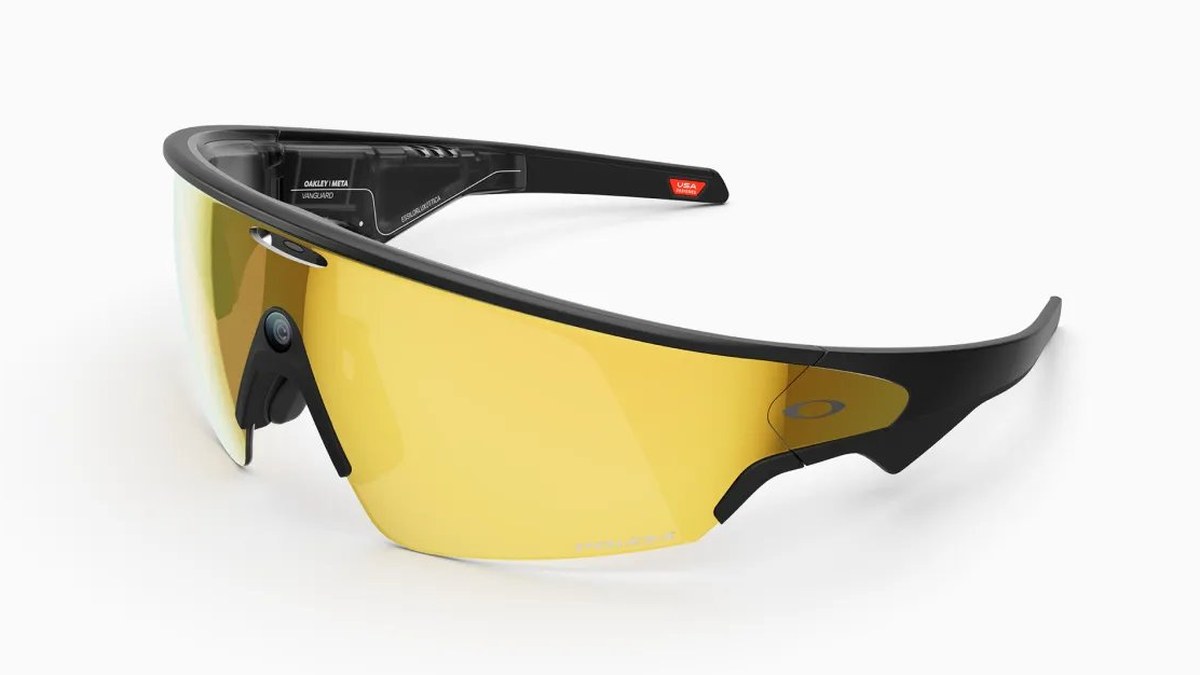
Image: Property of Oakley
Oakley Meta Vanguard vs Ray-Ban Meta Gen 2: A Riding Season Verdict
Two pairs of Meta glasses, one question that matters to a rider: which one is still on your face at hour six, and which one you can actually keep on under a helmet.
In This Article
Meta has two smart glasses lines that look like a simple price ladder and are not. The Ray-Ban Meta Gen 2 starts at $379 USD, the Oakley Meta Vanguard is $499 USD, and a rider looking at both will assume the extra $120 buys better hardware across the board. It does not. The two pairs are built for different jobs, and the difference shows up hardest on a motorcycle, where the glasses have to survive wind, a helmet, gloves and a long day with no charging stop.
I wear the Oakley Meta Vanguard. The point here is not to compare two spec sheets someone else wrote, it is to answer the question I actually get asked at fuel stops: if you ride, which one.
The numbers side by side
Start with what the manufacturers publish, because everything else is opinion layered on top of it.
| Oakley Meta Vanguard | Ray-Ban Meta Gen 2 | |
|---|---|---|
| Starting price (USD) | $499 | $379 |
| Battery, moderate use | Up to 9 hours | Up to 8 hours |
| Continuous audio or calls | Up to 6 hours | Not stated as a single figure |
| Charging case | Up to 36 additional hours | Case included |
| Video capture | 3K at 30 fps | Photo and video capture |
| Storage | 32GB | 32GB |
| Display | None | None |
Two things jump out. The Vanguard's 9 hours is a moderate-use number, and Meta's own audio figure for it is 6, which is the number that matters if you ride with turn-by-turn navigation running and music on. The second is that neither pair has a display. These are capture-and-audio glasses, not the HUD glasses you may have seen announced by other brands. That matters more than the price gap, and I will come back to it.
Battery through a real ride day
A moderate-use rating and a riding day are not the same test. On a bike, the glasses are not sitting on a desk draining slowly. They are paired to a phone that is itself running navigation, they are playing audio into your ears over wind noise, and every so often you are telling them to record something.
The honest way to plan around this is to treat the continuous-audio figure as your ceiling, not the moderate-use figure. For the Vanguard, that ceiling is 6 hours. A full Atlantic Canada day ride from, say, Moncton out around the Fundy coast and back is easily 6 to 8 hours of saddle time. The glasses will not survive it on one charge if you have audio running the whole way.
The charging case is the answer both brands give you, and it works, but it only works if the case is in a pocket or a tank bag. The 36 extra hours Oakley quotes means you can top up at a lunch stop and get through the afternoon. What you cannot do is swap a battery mid-ride the way you can with an action camera.
There is a second battery reality nobody puts in a review: cold. November riding in New Brunswick means the glasses are sitting on a cold face at 5 degrees or below, and lithium cells do not deliver their rated capacity in that. Both pairs will come up short of the quoted numbers on a late-season ride, and the pair with the larger battery buffer is the one that gets you home with navigation still talking.
What they capture, and what they do not
The Vanguard records 3K at 30 fps. That sounds like a useful number until you put it next to what a rider actually wants, which is a Helmet-mounted action camera. Neither pair is a substitute for an action camera, for three practical reasons.
- Clip length is short. These glasses record short snippets, not continuous ride footage. You are capturing moments, not the ride.
- No stabilisation worth the name. A motorcycle at 100 km/h transmits a lot of vibration. Footage from glasses mounted on your face is jittery in a way that GoPro and Insta360 handle in software and hardware.
- The camera is on your face, so it points where you look and nowhere else. No wide bar-mount perspective, no rear-facing angle, no clean shot of your own bike in motion.
What they are genuinely good at is the thing an action camera is bad at: capturing something in two seconds without breaking stride. The bridge, the moose at the side of the road, the moment at the lookout. The Vanguard does that with a single press, and it is on your face already, which is the entire advantage.
Helmet and wind: the fit problem
This is where the two pairs diverge most for a rider, and it has nothing to do with price.
The Vanguard is a wraparound sport frame with a larger lens and arms that hug the head. That shape exists for wind, and it does what it was designed to do: it seals well enough that your eyes are not streaming at highway speed, which is the difference between wearing glasses and taking them off at the first overpass.
The Ray-Ban Meta Gen 2 comes in Wayfarer, Skyler and Headliner shapes. These are street frames. The Wayfarer in particular has a thicker temple than a sport frame, and a thicker temple inside a helmet liner is exactly the pressure point that gives you a headache at hour three. Whether it works for you depends on your helmet's cheek pad and ear cutout, and that is not something a spec table can answer.
What I can tell you is the method: put the helmet on with the glasses already on, before you decide anything. Not glasses after helmet, because that is how you bend a temple. Glasses first, then helmet, and if you feel pressure behind the ear at rest, it will be worse at speed with the visor down.
One more fit note that catches people. A full-face helmet with a tight chin bar and glasses on your face is workable. A modular or open-face helmet with a visor is easier. If you wear a balaclava or a neck tube in November, that extra layer changes the fit again, and you should test with it on.
Audio and voice at speed
Both lines run open-ear speakers in the temple, which is the right choice for a rider because it leaves your ears open to traffic. That is the safety argument for smart glasses over earbuds on a bike, and it is a real one. You hear the car before you see it.
The problem at highway speed is that open speakers and wind noise compete. Around town and up to about 80 km/h, both pairs are clear enough for navigation prompts and a phone call. Above that, with a helmet and wind, you are raising your voice for the assistant and asking people to repeat themselves. No manufacturer publishes a wind-noise figure, so this is one you learn by riding.
The Vanguard's advantage here is the sport frame again. It sits closer and blocks more of the wind that reaches the speaker, so it holds up slightly longer before the noise floor wins. It is not a night-and-day difference, but it is measurable on a long highway day.
Canadian pricing reality
Neither price above is Canadian. The Vanguard at $499 USD and the Ray-Ban Meta Gen 2 from $379 USD are US figures, and what you pay here depends on the exchange rate the day the retailer prices it, plus tax. At a rough 1.38 exchange rate, that is about $690 CAD for the Vanguard and about $525 CAD for the Gen 2 before tax. Treat those as an estimate, not a quote, because Canadian retail pricing on both lines moves with the dollar.
The $120 USD gap works out to roughly $165 CAD. That is the real question a buyer faces: is the sport frame and the bigger battery worth $165 more than a street frame.
The verdict
If you ride, the Oakley Meta Vanguard is the one to buy, and it is not close. The frame shape is the reason. A street frame under a helmet is a comfort problem you solve by taking the glasses off, and glasses you take off are glasses that are not capturing anything. Add the larger battery buffer and the 6-hour continuous audio figure and the $120 gap stops looking like a premium and starts looking like the cost of the thing working.
Buy the Ray-Ban Meta Gen 2 instead if you want glasses you wear off the bike more than on it. It is the better everyday pair, it comes in shapes you can wear into a meeting, and $379 is a lower entry to find out whether smart glasses are for you at all. Just do not buy it expecting it to be your riding pair.
And in both cases, keep the action camera. Neither of these is replacing a GoPro or an Insta360 on the helmet, and anybody telling you otherwise has not looked at their own footage.
FAQ
Can you wear smart glasses under a motorcycle helmet?
Yes, if you put the glasses on before the helmet and the frame is thin enough at the temple. Sport frames like the Oakley Meta Vanguard work better than thicker street frames like the Ray-Ban Wayfarer, which can create pressure behind the ear on a long ride.
How long does the Oakley Meta Vanguard battery last on a ride?
Oakley rates it at up to 9 hours of moderate use, or up to 6 hours of continuous audio playback or calling, plus up to 36 more hours from the charging case. On a bike with navigation and music running, plan around the 6-hour figure and top up at a stop.
Do Oakley Meta Vanguard or Ray-Ban Meta Gen 2 replace an action camera?
No. They record short clips, they have no real stabilisation for motorcycle vibration, and the camera points only where you look. They are for capturing moments quickly, not for recording a ride.
Do smart glasses have a display?
The Oakley Meta Vanguard and the Ray-Ban Meta Gen 2 do not. They capture photos and video and play audio. Glasses with a heads-up display are a separate product category.
Sources: Oakley product page for the Meta Vanguard, Meta's Ray-Ban Meta Gen 2 product page, and The Verge's launch coverage. Prices are USD as published; Canadian figures in this article are estimates at an approximate exchange rate and are labelled as such.