
Photo: Greg Toope
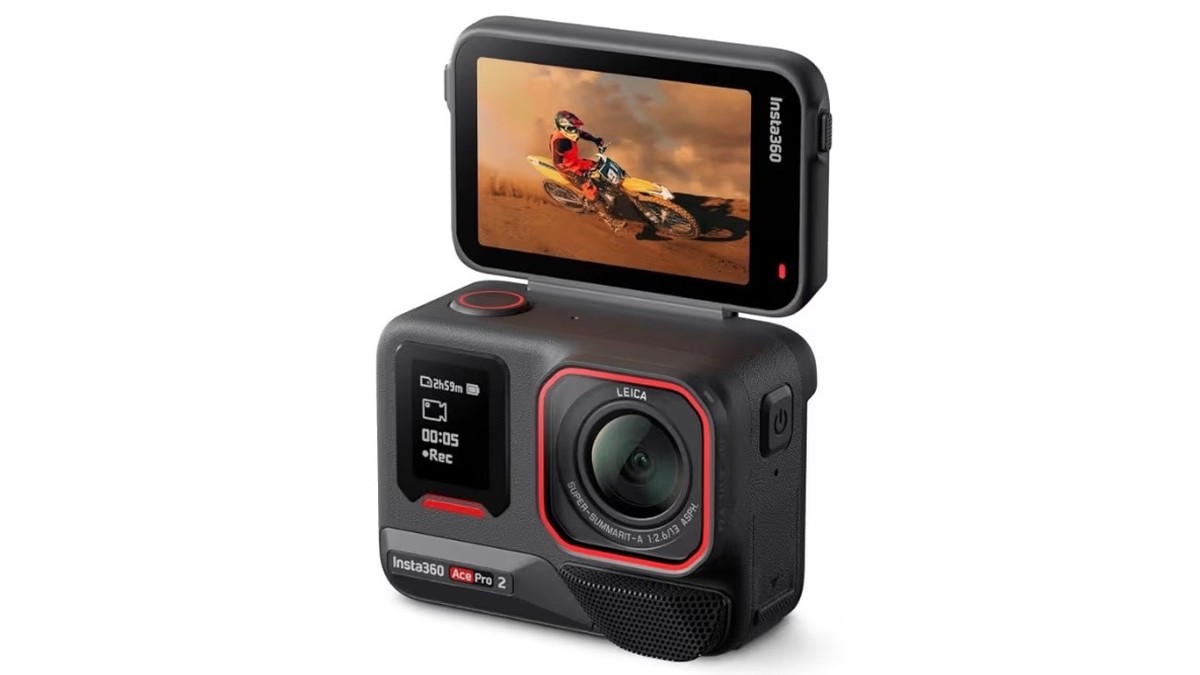
Insta360 markets the Ace Pro 2 on two things: 8K, and a low-light mode called PureVideo. If you ride at night, the second is the one that matters, and it is also the one surrounded by the most marketing fog. This is a documentation-first answer. Everything below comes from Insta360's own materials or is labelled as an open question that only recorded night footage can settle. I am not going to tell you the mode is great or useless until I have run it on a dark Atlantic Canada highway and looked at the files.
What PureVideo actually is, per Insta360
Insta360's launch release describes PureVideo as a specialized shooting mode that drastically reduces noise and enhances details in real time for cleaner, brighter images, even in extreme low light. The mechanism it names is a custom-trained AI neural network running on the camera's dedicated Pro Imaging Chip, the piece of hardware that separates the Ace Pro 2 from a single-chip action camera.
The language matters for a rider. It is not a sensor mode, and it is not simply a higher ISO ceiling. It is a processing pipeline with its own trained model, switched on when you select the mode. That has two consequences worth knowing before a night ride: it costs compute, and it will have limits on resolution and frame rate that the normal video modes do not carry.
Insta360 also states the mode is aimed explicitly at evening use. Its own copy names evening rides as a target scenario. That is a manufacturer claim about intent, not a measured result, and holding that distinction is the difference between a useful answer and a spec sheet recital.
The settings PureVideo will and will not give you
This is where most night-riding write-ups fall apart, because they treat every number on the box as available in every mode. Insta360's specification list does not work that way. PureVideo is listed as a 4K-class mode, and the camera's 8K capability sits alongside it as a separate set of video modes rather than inside it.
| Capability | Where the official material puts it | What that means at night |
|---|---|---|
| PureVideo | 4K (4:3) at 3840×2880 in the 24, 25 and 30fps range | Your night mode is a 4K mode. Plan the edit around 4K, not 8K. |
| 8K video | Up to 8K at 30fps in the standard video modes | Excellent in daylight, but not a night option. |
| Active HDR | 4K at 60fps | A high-contrast daylight tool, not a low-light mode. |
| Slow motion | 4K at up to 120fps | Also daylight. Night slow motion is not what PureVideo is for. |
The practical read: if your night footage goes into the same edit as your daytime footage, shoot the day at 4K too. Dropping an 8K daylight clip and a 4K night clip into one timeline means either the night material gets upscaled or the day material gets thrown away, and neither is free.
One further constraint riders report consistently in owner communities is that PureVideo is a heavily automated mode with fewer manual controls than standard video. Treat that as a user observation rather than a specification, but it points at something real: at night you are trusting the camera's processing decisions rather than dialling exposure yourself.
Why the mode is a plausible fit for a motorcycle
Night riding is a genuinely hostile input for a small sensor. You have very little light, a headlight beam that is brutally bright in the centre and black at the edges, and constant vibration shaking the frame. Most action cameras answer that with a slow shutter, which produces motion blur the moment you are moving, or a high ISO, which produces grain.
That is exactly the trade-off a trained noise-reduction pipeline is built to attack. If the neural network can separate grain from detail, you keep more shutter speed and less grain than a purely analogue pipeline allows. Whether it does that on a moving motorcycle at 90 km/h is the open question, and Insta360's own copy is a claim about capability rather than a test result.
The honest position: the specification tells you the mode exists, what it runs on, and what resolutions it allows. It cannot tell you whether the footage is clean enough to publish. That gap closes by recording, not by reading.
Two things that decide your night footage before the mode does
PureVideo is the third most important variable in night riding footage, not the first. The first two are mounting and framing, and both get decided before you press record.
Mounting controls the noise
A camera bolted to a rigid bar transmits every engine vibration into the sensor, and a noise-reduction algorithm working on a frame already blurred by micro-shake has less real detail to preserve. Helmet and chest mounts move with your body and soak up a surprising amount of that. FlowState stabilization and 360-degree horizon lock handle rotation and roll, but stabilization cannot recover detail that vibration removed first.
Your headlight is the whole scene
At night the bike's own headlight becomes the key light, and a headlight is a hard, narrow source. Anything inside the beam is well exposed and anything outside it falls into black. This is a compositional problem more than a camera problem: frames where the road ahead fills the beam read well, and frames where the beam is a small patch in a wide field read as noisy darkness no matter how good the denoise is.
That 157-degree field of view deserves specific thought. It is very wide, which is wonderful for scenery in daylight and pull-heavy at night, because most of the frame is off-beam. Framing tighter at night is not cheating. It is using the sensor's light where the light actually exists.
Storage, battery and heat at night
Night recording changes your battery maths. The camera ships with an 1800mAh battery, and Insta360 quotes Endurance Mode as 50 percent longer runtime at 4K30 than the previous Ace Pro. PureVideo is a 4K mode running extra processing on a dedicated chip, so plan on it not being your longest-runtime mode. Assume shorter and carry a spare rather than budgeting to the optimistic number.
Storage is the easier calculation. At 4K rather than 8K you write far less data per minute, which is a genuine benefit of the mode's resolution ceiling. A night ride that would have been tight in 8K has comfortable headroom in 4K, and that matters when you are chasing a ferry or riding a dark highway with nowhere to stop and offload.
Heat is the one to watch. A camera processing every frame through a neural network, sealed in a waterproof body with no airflow, runs warmer than it does in a simple daylight mode. That is a general property of onboard processing rather than an Insta360 flaw, but it is a reason to mount where air moves instead of tucking the camera behind a screen.
What would actually settle the question
Here is the test that turns this from a spec sheet into an answer, and it is the test I intend to run rather than assert:
- Same ride, two modes. One dark highway stretch recorded in PureVideo and in standard 4K at the same frame rate, so the only variable is the processing pipeline.
- Two mounting positions. Helmet and bar, because mount rigidity changes the noise floor and a tripod review cannot tell you that.
- A lit and an unlit section. Streetlights and true darkness produce different problems, and a night mode that shines under sodium lights may fall apart with only a headlight.
- A real edit, not a still frame. Grain invisible in a paused frame becomes obvious when the clip runs in a timeline at normal speed.
Until that exists, the defensible statement is narrow: PureVideo is a documented low-light mode on a 4K-class pipeline with its own processing chip, it is designed for exactly the conditions of a night ride, and it is plausible for the job. Whether it is good enough to publish is a claim I will make with footage in front of me, or not at all.
The short answer for a night rider
If you already own an Ace Pro 2 and you ride after dark, PureVideo is worth trying on your next night ride. It costs nothing but a settings change. Shoot at a 4K frame rate, keep your daytime footage at 4K as well so the edit stays consistent, mount somewhere that dampens vibration, and frame so the headlight beam is doing the work.
If you are buying a camera specifically for night riding, do not buy on the strength of a marketing phrase. Buy on footage. The mode is real, the hardware behind it is real, and the resolution limits are documented. The image-quality claim is the part that has to be earned by recording, and no amount of specification reading substitutes for it.
PureVideo Against the Other Night Options
The confusion around night footage usually comes from mixing three different things: the low-light mode, the maximum resolution mode, and whatever you do afterwards in the edit. This table keeps them apart.
| Approach | What it changes | What it does not fix |
|---|---|---|
| PureVideo low-light mode | How the camera processes a dark scene, which is what Insta360 describes the mode as being for | Motion. A dark road at speed is still a dark road at speed. |
| Maximum resolution (8K on the Ace Pro 2) | Detail in good light, and cropping room in the edit | Light itself. More pixels do not create illumination that is not there. |
| Higher frame rate | How smoothly fast movement is captured | Brightness. It usually costs light rather than gaining it. |
| Mounting and lens care | How much flare, smear and vibration reaches the sensor | Nothing about exposure, but it decides whether the footage is usable |
| Post-processing | Noise and contrast after the fact | Detail that was never captured |
The honest ordering for a rider is mount and lens first, mode second, everything else last. A clean lens on a solid mount in PureVideo will beat a smeared lens at 8K every night of the week.
Frequently Asked Questions
Does the Insta360 Ace Pro 2 PureVideo mode record in 8K?
No. Insta360 lists PureVideo as a 4K-class mode, and the camera's 8K capability sits in its standard video modes. Wanting 8K means shooting standard video, which in low light means accepting the grain that PureVideo exists to reduce.
Is PureVideo better than just raising the ISO in normal video mode?
That is the exact question the marketing asserts and the documentation does not prove. PureVideo runs frames through a trained noise-reduction model on a dedicated imaging chip, which is a different approach from a higher ISO alone. Whether it looks better on a moving motorcycle is settled by side-by-side footage from the same ride.
What frame rate should I use for night riding on the Ace Pro 2?
Stay inside what Insta360 documents for PureVideo and pick the highest rate it allows in the resolution you want. Higher frame rates need shorter exposures, the opposite of what a dark scene wants, so 30fps and below is the sensible range at night rather than the 60 and 120fps daylight modes.
Why does a 157-degree field of view hurt at night?
A wide field spreads a narrow headlight beam across more of the frame. Everything outside the beam is recorded as darkness, and dark areas are where a small sensor has the least information to work with. Framing tighter puts more photo sites on the part of the scene that is actually lit.
Will PureVideo overheat the camera on a long night ride?
Processing every frame through a neural network generates more heat than a simple recording mode, and the body is sealed and waterproof with no airflow. It is a real consideration on a long summer ride rather than a winter one, so mount where air moves and do not trap the camera behind a screen.
Sources
- Insta360 Ace Pro 2 product page. Manufacturer product information for the camera and its feature set.
- Insta360 Ace Pro 2 official manual. Manufacturer support and manual portal.
- Insta360 Ace Pro 2 launch press release. Full release text: PureVideo description, 8K30, 4K60 Active HDR, 4K120, 12m waterproofing, 1800mAh battery, Endurance Mode, Wind Guard, FlowState, horizon lock.
- Insta360 Ace Pro 2 specification list. Manufacturer spec sheet listing PureVideo 4K (4:3) at 3840x2880 in the 24/25/30fps range.