
Some purchases you plan for months. Some happen fast — you see it, you know it's right, and two days later you're loading up the Jeep. This was the second kind. When I found an Indian Motorcycle-themed trailer listed in Matane, Quebec, I wasn't going to let it sit there while someone else grabbed it. So Monique and I loaded up our 2014 Jeep Grand Cherokee and drove roughly 1,000 km round trip to bring it home.
Here's how the whole thing went down — the drive, the detours, the reveal, the towing test, and why we ended up staying overnight in Bathurst instead of making it all the way back to Dieppe.
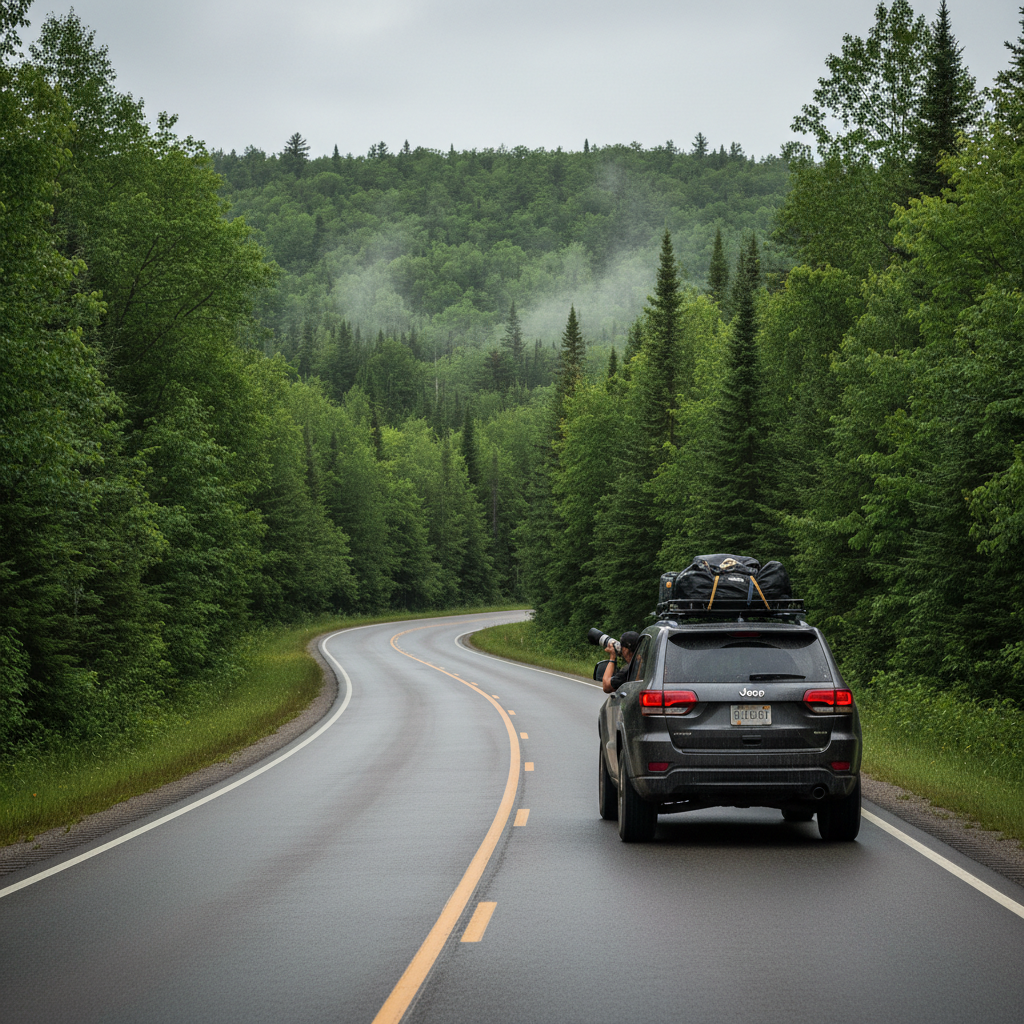
Matane is tucked in the Bas-Saint-Laurent region of Quebec, sitting right on the south shore of the St. Lawrence River. From Dieppe it's roughly 500 km one way — Highway 11 through Miramichi and Bathurst, crossing into Quebec near Campbellton, then following the 132 along the coast to Matane. It's a solid day of driving, but the route through northern New Brunswick and the Quebec coastline is genuinely beautiful, so it's not exactly a punishment.
The goal was straightforward: pick up the trailer, do a quick first tow home, and figure out the details along the way. What we didn't fully plan for was how many small complications would stack up once we got there.
We left Dieppe early, grabbed coffee and breakfast on the road, and settled into the drive. The first wrinkle was the Miramichi bridge detour — not a big deal, just added some time. From there it was a smooth push through Bathurst and into the Restigouche valley before crossing into Quebec.
"Crossing into Quebec always feels like a gear shift — the roads change, the signage changes, and suddenly you're aware you're in a different place."
The Quebec portion of the drive along the 132 coastline is worth noting for anyone who hasn't done it. The St. Lawrence is massive through here — it looks more like an ocean than a river — and the road rolls through small towns and scenic lookouts the whole way into Matane. If you're ever doing a road trip in this region, don't rush it.
Arriving in Matane, we finally got eyes on the trailer in person. The listing photos were good but they didn't fully capture how well the Indian Motorcycle branding was done. This isn't a generic black box on wheels — it's been styled to match the Indian aesthetic. Deep red, thunder black accents, and the Indian logo done properly. For anyone who rides Indian and wants their setup to tell a story at a show, campsite, or rally, this thing delivers.
Beyond looks, it's a functional unit. The trailer is sized to haul the Pursuit while also doubling as a small camper-style setup once the bike is unloaded. That dual-purpose angle is what really sold me. We're not just buying a transport box — we're buying extra flexibility for weekend trips where you want the bike there but also need somewhere to sleep or store gear.
"It wasn't just about hauling the Pursuit. The trailer can work as a base camp once the bike is out — that's what made it the right buy."
Before we could actually start towing, we hit a snag — wiring. The trailer used a different connector than the Jeep's factory hitch, so we made a Canadian Tire stop in Matane to grab an adapter. Par for the course with any used trailer pickup, honestly. Add it to the list of things to budget for when buying remotely.
Once wired up, the Jeep handled the loaded trailer with zero drama. The 2014 Grand Cherokee Limited has more than enough capability here — we're not pushing anywhere near its tow rating. Acceleration is obviously softer with the trailer behind you, braking needs more planning ahead, and fuel economy drops noticeably compared to running empty.
Here are the real numbers from the trip: without the trailer, the Jeep averaged 10.5 L/100km (26.9 MPG Imperial). With the loaded trailer behind it on the way home, that jumped to 17.5 L/100km (16.1 MPG Imperial) — a 67% increase in fuel consumption. That's a significant hit, and it's worth factoring in when planning longer tow distances. At those numbers, fuel costs roughly double compared to driving solo.
The hills and curves between Matane and Campbellton were the best real-world test — loaded on an incline is where you find out if a setup is up to the job. The Jeep pulled cleanly through every climb, but the fuel gauge moved faster than usual.
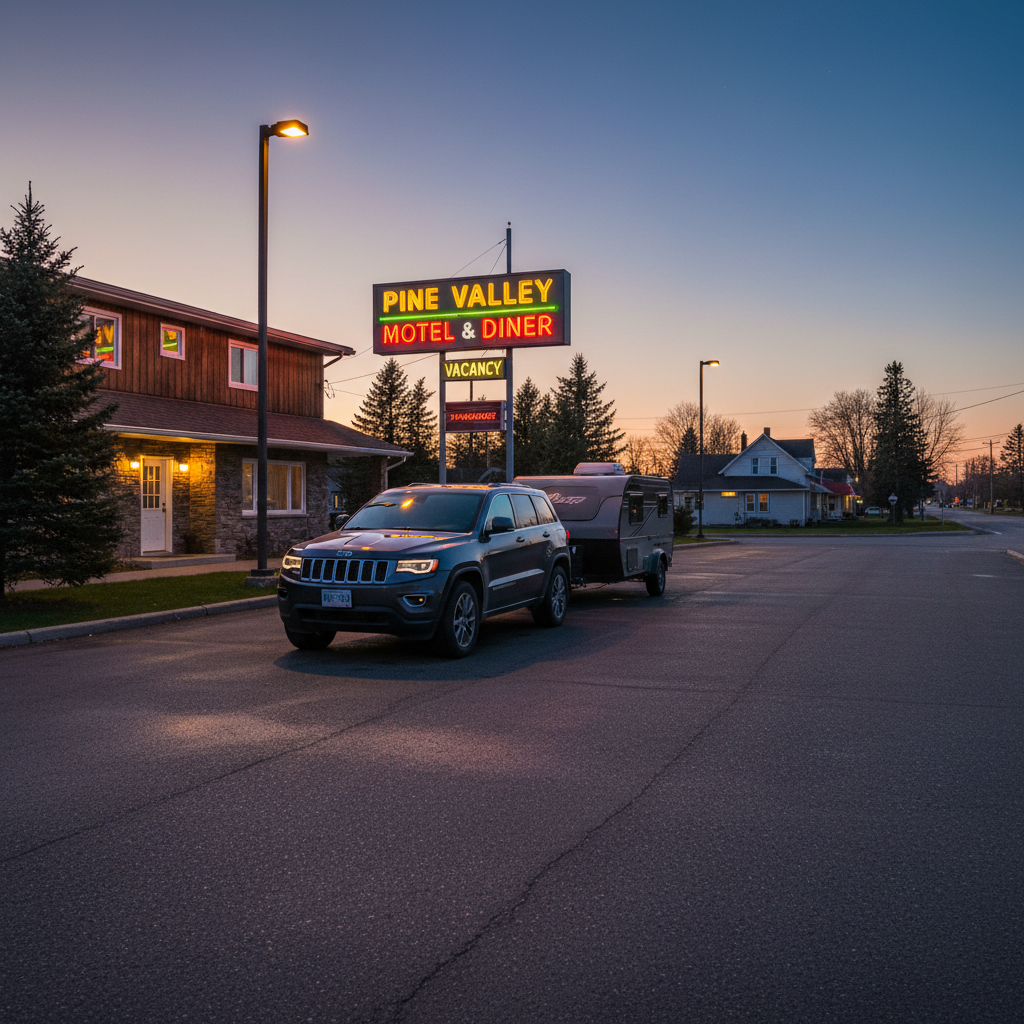
By the time we'd dealt with the wiring, grabbed food in Matane, and got rolling, the math on making it back to Dieppe the same night stopped adding up. Rather than pushing it tired with a trailer in the dark, we made the call to stop overnight in Bathurst. Right call. The drive home the next morning was relaxed, the trailer was solid, and we rolled into Dieppe feeling good about the whole thing.
It's the kind of thing that doesn't always make it into a YouTube thumbnail but it's real — trailer trips have a way of stretching your schedule, and building in flexibility makes the whole experience better.
Yeah, without question. A 1,000 km round trip to pick up the right trailer beats settling for a generic option locally. The Indian-themed styling, the dual-purpose setup, and the condition it was in made the drive worthwhile. The Jeep proved it can handle the job easily, and we've got a solid baseline now on what towing actually costs in fuel.
Next step is getting the Pursuit loaded up and taking the full rig on its first actual run — whether that's to a bike night, an event, or something further out. The Cabot Trail trip is coming up in a few weeks and the trailer opens up options we didn't have before. More on that soon.