Royal Enfield Himalayan 750 Revealed: Twin-Cylinder ADV Details
Royal Enfield has revealed the Himalayan 750 ahead of its EICMA debut on November 3. A 750cc parallel twin, cruise control, TPMS and two wheel options.
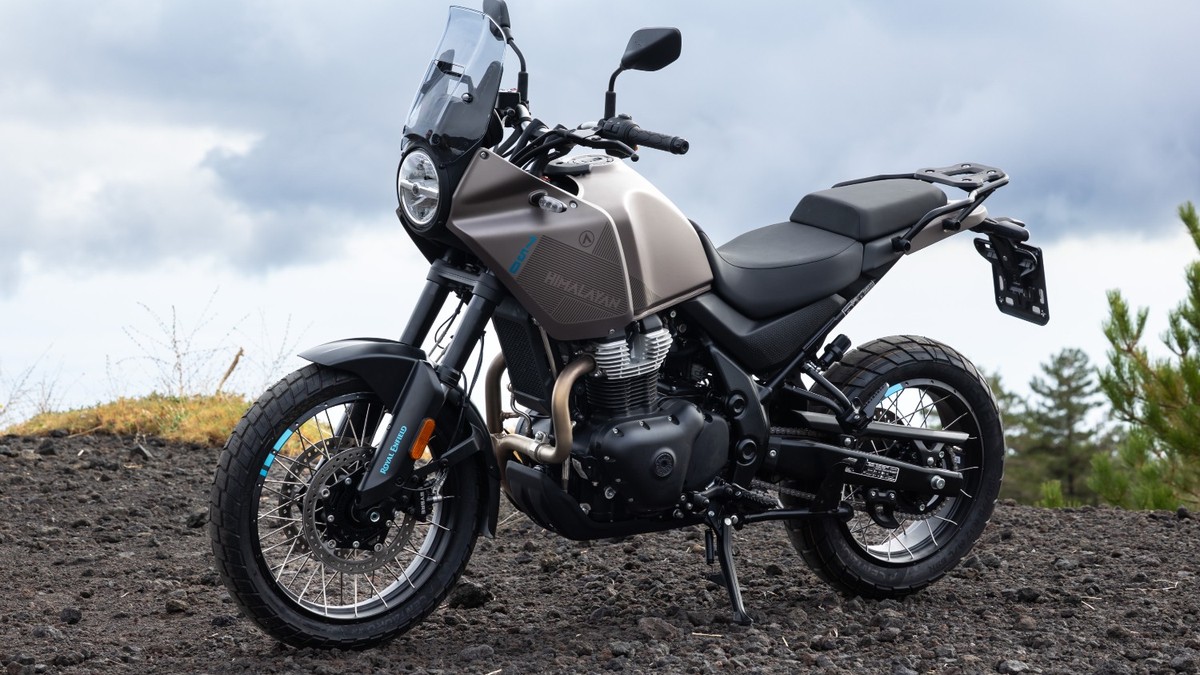
Image: Property of Royal Enfield
In this article
What was actually revealed
Royal Enfield has shown the Himalayan 750 in full, ahead of the bike's public debut at EICMA in Milan on November 3, 2026. The company published images and confirmed a series of design and equipment details. What it has not published is the number everyone wants: power, torque, weight and price are all still under wraps, with full specifications expected at the Milan show.
That distinction matters more than it sounds. A reveal like this is a design and feature announcement, not a specification announcement, and treating the two as the same thing is how bad buying advice gets written. So here is what is confirmed, what is claimed, and what nobody outside Royal Enfield actually knows yet.
The confirmed design is a departure from the smaller Himalayans. The 750 gets a cowl around the headlamp that flows back into the fuel tank, and it drops the high-set beak that defines the Himalayan 440 and 450. There is a tall fly screen above the headlamp, turn signals mounted on the cowl, all-LED lighting, a split seat, and a rear grab handle with mounting points for a top box. The tail light clusters follow the Himalayan 450 pattern, with stop lamps integrated into the turn signal housings. A two-into-one upswept exhaust finishes the profile.
The engine is the story
The Himalayan 750 is Royal Enfield's first model in a new 750cc class, and the engine is a parallel twin rather than the single that powers the 450. That is the whole point of the bike. Royal Enfield's existing twins, the 648cc unit in the Interceptor, Continental GT, Super Meteor and Shotgun, are smooth, unhurried engines built for a relaxed pace. A 750 twin in an adventure chassis is the company finally building the touring-capable ADV its Canadian and North American dealers have been asking for.
Published speculation puts output somewhere around 55 to 60 horsepower, with torque near 60 to 65 newton-metres, and a six-speed gearbox. Those figures come from Indian automotive media estimating from the displacement and the platform, not from Royal Enfield. Treat them as rumor until November 3. The honest statement right now is that the engine exists, it is a parallel twin, it displaces 750cc, and nobody outside the company has a verified output number.
Why the displacement jump matters in practice: a 450 single making roughly 40 horsepower is a fine bike for a solo rider on a weekend, but it works hard at highway speed with luggage and a passenger. An ADV that will spend its life on the Trans-Canada with a full set of panniers needs more margin than that. If the 750 lands near 60 horsepower with a broad torque curve, it slots into the space that the Suzuki V-Strom 650 and Kawasaki Versys 650 have owned for years, and it does it with the styling that has made the Himalayan 450 a sales success.
Features confirmed, and features missing
Royal Enfield has confirmed cruise control, traction control, a tyre pressure monitoring system, and adjustable suspension. The published images show a 4-inch TFT display, cruise control switches on the right-hand switchgear, and a joystick on the left to operate the screen. The front fork is pre-load adjustable. Brakes are Bybre units with twin discs up front and a single disc at the rear.
Wheel choice is one of the more interesting confirmed details: buyers get either a staggered cross-spoke tubeless setup or alloy rims. Cross-spoke tubeless wheels are the correct answer for an adventure bike that will actually leave pavement, because they let you run a tube-type tyre off-road without the puncture-and-flat risk of a tube, and the staggered sizing, a larger front, is what gives an ADV its stability on loose surfaces. Offering alloys as well is a nod to the buyers who will never take it off tarmac.
What is missing from the confirmed list is just as telling. There is no confirmed weight, no confirmed fuel capacity, no confirmed seat height, and no confirmed price. For an adventure bike, seat height and wet weight are the two numbers that decide whether a rider can actually live with it, and both are unknown.
What is rumor, not fact. Expected pricing of roughly Rs 4.0 to 4.5 lakh in India is media estimate, not an announced figure. Power and torque figures circulating online are estimates. Royal Enfield has not published a Canadian or US price, a launch date for either market, or final specifications.
What it means for Canada
Royal Enfield Canada currently lists the Himalayan 450 with a Canadian MSRP in the range of 8,699 dollars at Ontario dealers, with US MSRP at 5,999 dollars plus destination. Any Himalayan 750 that arrives here will land above that. Anyone planning around this bike should budget for a five-figure Canadian price once freight, PDI and tax are added, and should not expect that number to be announced with the EICMA reveal.
There is also a timing question Canadian buyers should be clear-eyed about. The Indian launch is scheduled for Motoverse at the end of November 2026. Canadian availability for new Royal Enfield models typically trails the home market by months, and sometimes by a full riding season. If you are shopping for an ADV to ride next spring, the Himalayan 750 is unlikely to be in a Canadian showroom in time, which makes the Himalayan 450 the practical answer for this coming season and the 750 a 2027 conversation.
For Atlantic Canada specifically, the case for a bigger ADV is real but narrower than the marketing suggests. Our season runs roughly April to November, the roads are coarse, and the good gravel is genuinely good. A 450 handles that. Where a 750 earns its keep is the long haul: a run from Moncton to Cape Breton with luggage, or a two-up trip to Newfoundland on the ferry, where the extra displacement means the engine is not screaming at 110 km/h for six hours. If your riding is mostly day trips inside the Maritimes, the smaller bike is not a compromise, it is the right size.
Himalayan 450 or Himalayan 750?
This is the question most readers will actually have, and the answer depends on one thing: how much highway is in your riding.
Buy the 450 if your riding is mostly regional. It is lighter, cheaper, easier to pick up when you drop it on a gravel road, and it has been in the market long enough that accessories, service knowledge and used examples exist. For a rider in Nova Scotia or New Brunswick doing 200 to 300 kilometre days on mixed surface, it is the more sensible bike and the extra 300cc buys you nothing you will use.
Wait for the 750 if you tour two-up, carry a lot of luggage, or regularly ride long highway stretches at speed. The parallel twin will be smoother at sustained highway revs, and cruise control, which the 450 does not offer, is genuinely useful on a long day. The trade-offs are weight, price and complexity, and all three go up.
The one group that should ignore both: riders who want a genuine off-road-capable ADV for technical terrain. A 750 twin with a 19-inch front and a road-biased chassis is a gravel-road bike, not a dirt bike. If your ambition is single track, neither Himalayan is the answer, and you already know that.
What to watch at EICMA
The November 3 debut should answer the questions that actually decide whether this bike is good: wet weight, seat height, fuel range, power and torque at the crank, and the variant structure. Royal Enfield has a habit of launching a base model and then adding variants, and the wheel choice confirms at least two configurations are coming.
What it probably will not answer is the Canadian price and arrival date. Those tend to come later, through the Canadian distributor. Watch for them separately rather than assuming they land with the global reveal.
The bigger picture: Royal Enfield has spent a decade building credibility on small-capacity retro bikes and then proved it could build a genuinely good middleweight ADV with the 450. The 750 is the company testing whether it can move upmarket into the touring class without losing the price advantage that got it here. November 3 tells us the specifications. The next two years tell us whether the strategy worked.
Frequently Asked Questions
When will the Royal Enfield Himalayan 750 be fully revealed?
The Himalayan 750 makes its public debut at EICMA in Milan on November 3, 2026, where Royal Enfield is expected to publish full specifications. The India launch is scheduled for Motoverse later in November 2026.
What engine does the Himalayan 750 use?
A 750cc parallel twin, Royal Enfield's first model in a new 750cc class. It is a different engine from the 648cc twin used in the Interceptor and Continental GT. Royal Enfield has not published power or torque figures.
How much will the Himalayan 750 cost?
No official price has been announced. Indian media estimate roughly Rs 4.0 to 4.5 lakh, which is speculation. There is no announced Canadian or US price.
Does the Himalayan 750 have cruise control?
Yes. Royal Enfield has confirmed cruise control, traction control, tyre pressure monitoring and adjustable suspension. Published images show a 4-inch TFT display and cruise switches on the right-hand switchgear.
Is the Himalayan 750 better than the Himalayan 450?
For long-distance highway touring, two-up riding and heavy luggage, the 750's parallel twin should be the better tool. For regional mixed-surface riding, the 450 is lighter, cheaper and easier to live with. The 750's weight and price are not yet announced.