How to Store a Motorcycle Battery for a Long Canadian Winter
A motorcycle battery can die over one Atlantic Canadian winter. The right way to store, charge and maintain it from November to spring, step by step.
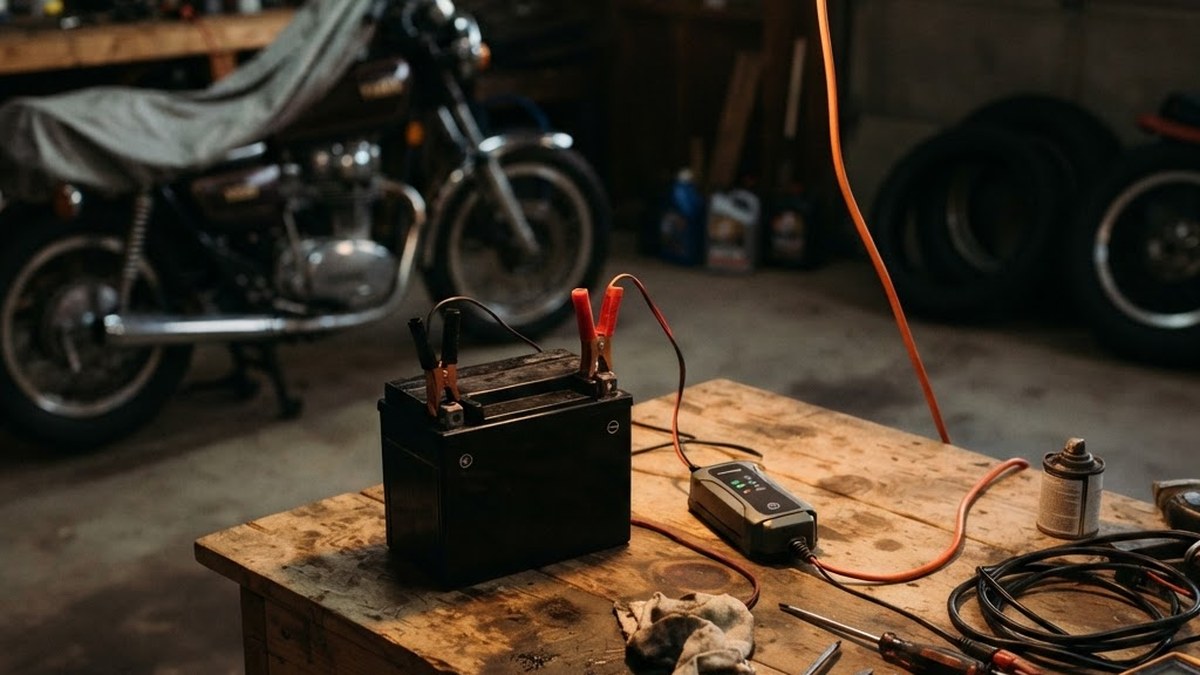
Illustration: AI-generated image
In this article
Why winter kills batteries
A lead-acid battery discharges on its own even when nothing is connected, and cold accelerates the damage. As charge drops, the electrolyte becomes closer to plain water, and a battery left flat through a deep-freeze can actually freeze and crack its case. A battery that sat at half charge in a shed that hits minus 20 Celsius (minus 4 Fahrenheit) is usually dead on arrival in spring, which is why so many riders buy a new battery every April.
Step 1: Charge it fully before storage
Put the battery on a proper charger and bring it to a full charge before it goes into storage, not after. A fully charged battery resists freezing far better and loses its charge much more slowly. Charging while the bike is still in the garage means you are not dragging a charger through snow in December to rescue a bike you cannot start anyway.
Step 2: Disconnect it completely
Modern bikes draw small currents all winter for clocks, ECUs and alarms, and those parasitic draws will flatten a battery in a couple of months. Disconnect the negative terminal first, then positive, and store the battery off the bike. It also lets you inspect the terminals for the white-green crust that indicates you should clean them before spring.
Step 3: Choose where it sleeps
A battery stores best cool but not freezing. A shelf in a heated basement corner is ideal, an unheated shed is fine if the battery is fully charged, and a garage that swings through freeze-thaw cycles is the worst option. Whatever you choose, keep it off bare concrete on a piece of wood, mostly to keep it away from floor moisture and temperature swings rather than any electrical magic.
Step 4: Maintain, do not forget
Check the battery once a month through the winter. If voltage drops below about 12.4 volts for a standard 12-volt battery, give it a top-up charge. A smart maintainer that holds the battery at a float charge does this for you, and is genuinely worth the 40 to 80 CAD. Just use a maintainer with an automatic float mode, not an old dumb charger, which will eventually overcharge.
Spring: the payoff
Come spring, a maintained battery is usually ready to go with one topping charge and clean terminals. The bike starts on the button, and the money you did not spend on a new battery goes toward fuel or the season's first trip. Five minutes of prep in November saves the most frustrating hour of April.
A quick note on battery types, because the advice differs slightly. A standard flooded lead-acid battery needs its fluid level checked before storage, and topping up only with distilled water. A sealed AGM battery, which most modern bikes including current Indians and Harleys use, needs no fluid service at all and stores the same way. Lithium batteries, increasingly common as upgrades, hold charge far longer over winter and tolerate the cold while sitting, but they should be charged with a maintainer explicitly rated for lithium chemistry, because a lead-acid float profile can damage them. If your battery is more than three or four riding seasons old, test it before investing storage effort: a battery that will not hold 12.6 volts after a full charge is telling you it wants to be replaced, and buying one in November beats discovering the same thing in April.
One last practical note for Canadian riders: label the battery with the date you stored it, and photograph the terminal configuration before disconnecting. Six months from now, in a cold garage, the question of which terminal went on first is surprisingly easy to get wrong, and reversing polarity even momentarily can damage a modern bike's electronics. The photo takes ten seconds and removes the most expensive possible mistake of the entire winter.
Frequently Asked Questions
Can a motorcycle battery freeze over winter?
Yes. A discharged lead-acid battery's electrolyte is mostly water and can freeze in a cold Canadian shed, cracking the case. A fully charged battery resists freezing down to roughly minus 60 Celsius, which is why full charge before storage matters.
Do I need a battery maintainer or just a charger?
A maintainer. A maintainer holds a safe float charge indefinitely, while a manual charger left connected will overcharge. Any automatic maintainer in the 40 to 80 CAD range handles a winter's storage easily.
Should the battery stay in the bike?
Out of the bike is safer. Modern bikes draw small currents all winter that flatten the battery, and a battery indoors at stable temperature lasts better than one in a freeze-thaw garage.
How often should I check a stored battery?
Once a month. If voltage has dropped below about 12.4 volts, top it up. That monthly glance is the entire winter workload.