Why MotoGP Won't Race Without a Medical Helicopter on Standby
Sunday's fog-grounded helicopter cancelled the Australian GP. Why motorcycle racing treats that helicopter as non-negotiable, and what it means for riders.
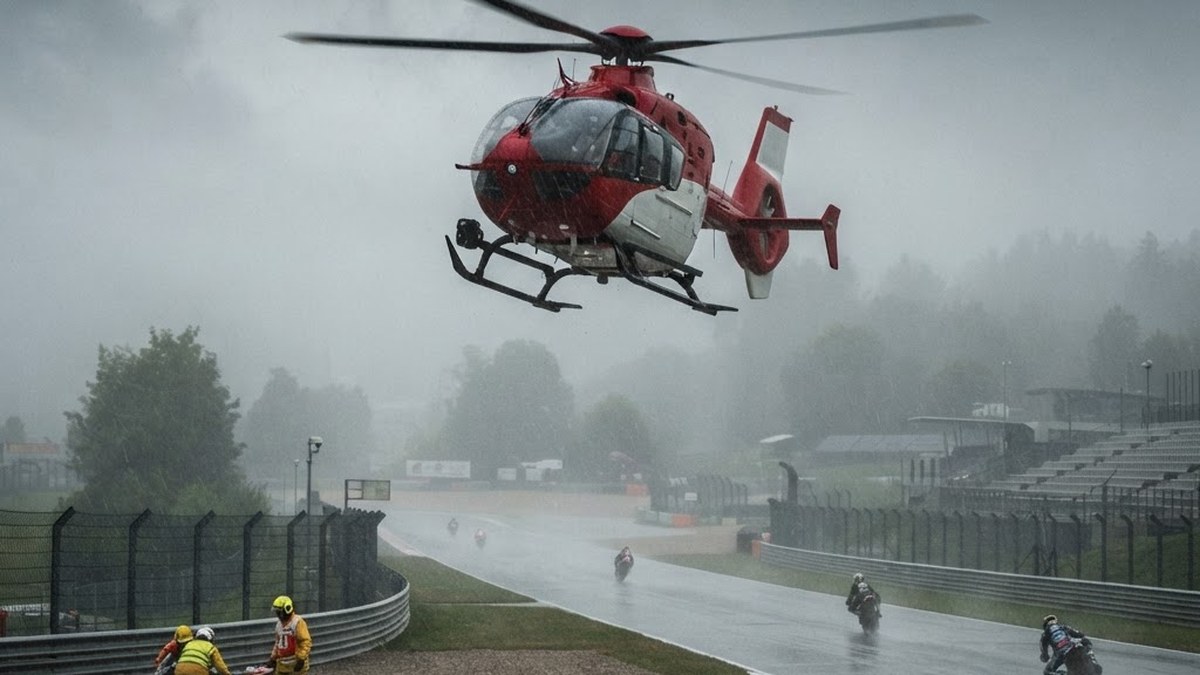
Illustration: AI-generated image
In this article
The rule that stopped a world championship round
On Sunday, October 25, MotoGP cancelled the Australian Grand Prix with riders ready and fans in the grandstands, and the reason had nothing to do with motorcycles: fog had grounded the medical helicopter. That single fact is enough to stop a world championship round, and if you watched the weekend end in anticlimax and wondered why a little fog matters that much, the answer is one of the most important safety systems in all of motorsport.
The golden hour
Trauma medicine talks about the golden hour: the window after a serious injury in which treatment most affects survival. A rider hitting Phillip Island's fast asphalt at 280 km/h (174 mph) can suffer injuries where minutes genuinely matter, and a helicopter covers the 130 kilometres (81 miles) to Melbourne's trauma centres far faster than any ambulance. Trackside response stabilizes the rider first, but the helicopter is what turns a survivable crash into a survivable day.
Why a circuit can't just substitute an ambulance
Could organizers not just use more ambulances? Medically, no. Certain injuries, head and chest trauma especially, need a trauma hospital inside roughly an hour, and rural circuit roads cannot guarantee that even with lights and sirens. This is why every major series, MotoGP, Formula 1, WorldSBK, treats the helicopter as mandatory equipment, not an optional extra. If it cannot fly, the session cannot run, full stop.
What the riders actually think
Riders rarely complain about this rule, because they are the ones it protects. Over the Phillip Island weekend, riders lined up behind the cancellation call despite the disappointment; paddock voices after Sunday described it as safety first, the only possible decision. Racers accept danger as part of the job, but they expect the sport to stack every logistical advantage on their side when things go wrong, and a grounded helicopter removes the biggest one.
The uncomfortable cost side
Coastal circuits like Phillip Island sit with the sea on one side, and weather that would barely delay a race at an inland track can shut down helicopter operations entirely. It is one of the trade-offs of racing at beautiful, exposed venues, and one reason the calendar's move toward city street circuits from 2027 appeals to organizers, whatever it costs the racing. Fog does not care how good the track is.
The takeaway for every rider
There is a lesson here that reaches beyond grand prix racing. When you ride on the street, the same maths applies: how far are you from a trauma hospital, and how long would the trip take? Riders who plan routes through rural areas, and Atlantic Canada has plenty, are making the same calculation race organizers made on Sunday, without the helicopter as backup. Ride accordingly: gear, speed, and the distance to help are all part of the same equation.
The system has been tested at the highest level repeatedly, and the record explains the faith riders place in it. Grand prix medicine has revived riders from crashes that once would have been fatal, with rapid helicopter transport to trauma care a recurring part of those saves. Every one of those outcomes traces back to the same unglamorous decision made on a foggy Sunday: when the helicopter cannot fly, the show does not go on. Fans lost a race this weekend, and that is precisely the trade the sport has chosen to make every single time.
Weather rules like this one also explain a quirk casual fans notice: sessions sometimes start on a track that is wet but visible, and other times are cancelled while the circuit looks rideable. The deciding factor is not whether the riders can see, but whether the helicopter can, because the safety requirement is about the aftermath of a crash, not the riding itself. A damp track with clear skies races; a dry-looking track in fog does not. Once you internalize that, cancellations like Sunday's stop feeling arbitrary.
Frequently Asked Questions
Why does MotoGP need a medical helicopter?
MotoGP treats a functioning medical helicopter as mandatory because a crashed rider may need trauma-centre care within the first hour after injury, and the helicopter is the only way to guarantee rapid transport from a circuit to a major hospital.
Can a race run without a medical helicopter?
No. In MotoGP and other major series, if the helicopter cannot operate, sessions and races cannot run. That is exactly why fog cancelled the 2026 Australian GP.
What is the golden hour in trauma care?
The roughly 60-minute window after a serious injury when treatment has the greatest effect on survival. Trackside medical crews stabilize riders first; the helicopter exists to get them to trauma care inside that window.
Does this rule apply to other motorsports too?
Yes. Formula 1, WorldSBK and other major series have equivalent requirements for medical helicopter coverage, for the same reason: circuits are often far from major trauma hospitals.