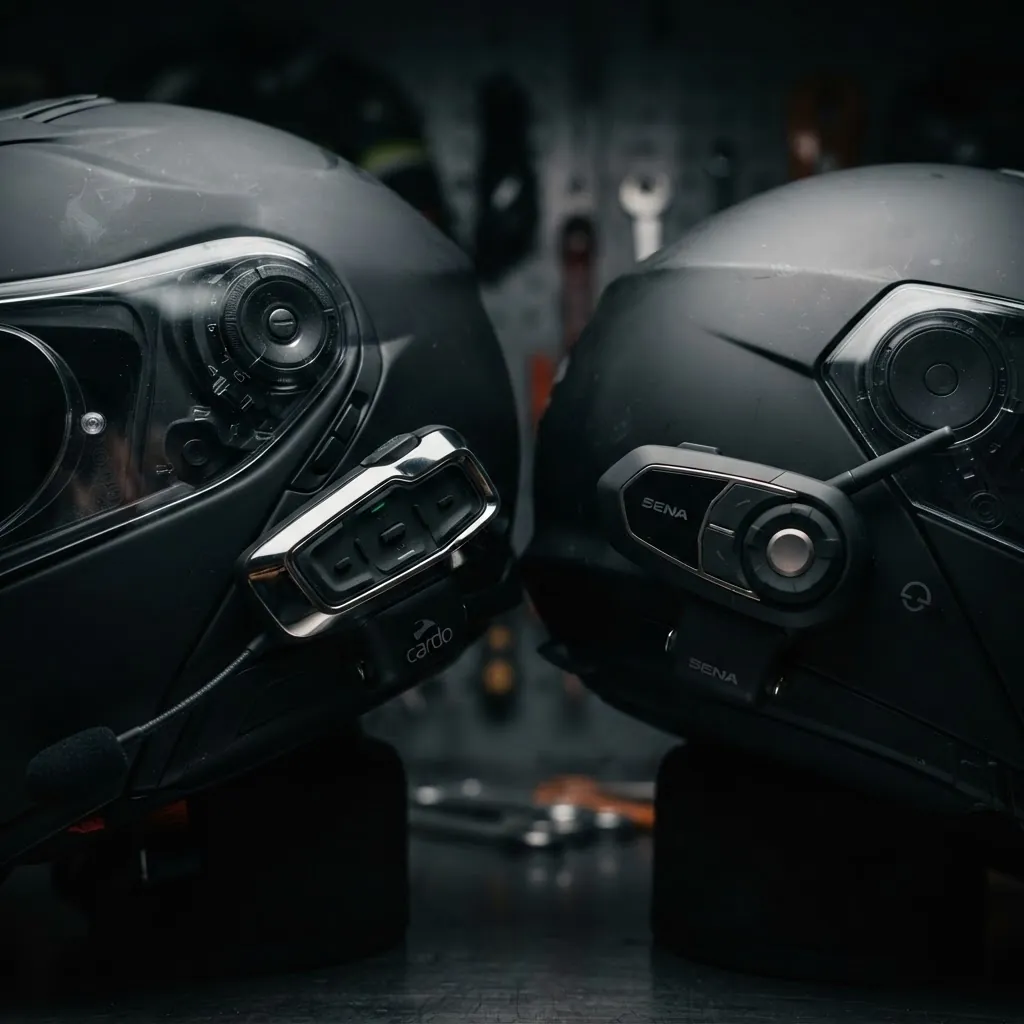

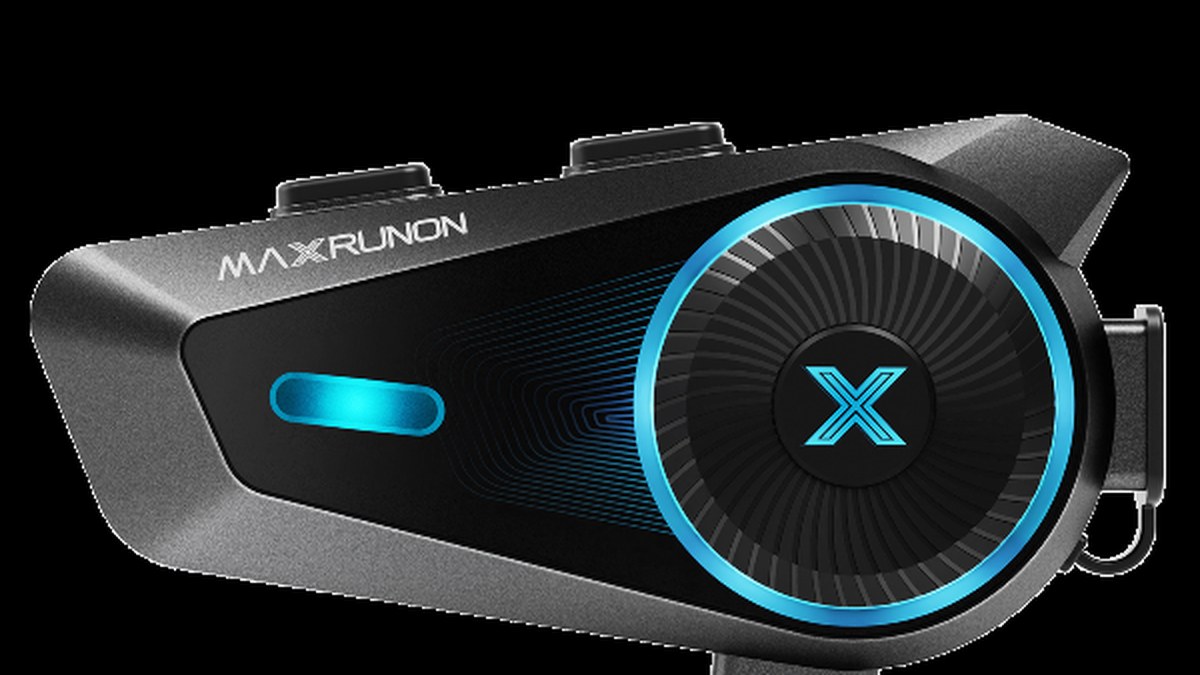
The MAXRUNON D10 is a four-rider Bluetooth intercom that sells for $62.95 USD single on the manufacturer's own store, and it is the cheapest credible way into group comms right now. It is not a mesh intercom in the Cardo or Sena sense: MAXRUNON's own specification describes a Bluetooth 5.4 group intercom for up to four riders, while the retail copy labels it "Mesh 3.0". I have not ridden with it yet, so this is a hardware and specification assessment, not a road test.
The bike is close to tucked away for the season and the first real test waits for spring. That's also why I won't call it a Cardo or Sena replacement before then.
What you get, and what it costs
A helmet intercom, sold as a single or a dual pack. In the box: main unit, 40 mm speakers, a wired button mic, a boom mic, adhesive mounting plate, back clip, speaker pads and a USB-C cable. Both mic types ship, so one unit covers a full-face, a modular and an open helmet without buying a second kit.
The documented radio is Bluetooth 5.4 group intercom for up to four riders, pairing to two devices at once such as a phone and a GPS, a claimed 1.6 km (0.9 mi) group range, IPX7 water resistance, FM radio, hands-free voice control that runs offline, and an app that pushes firmware updates over the air. None of that is unusual for 2026. The price is.
Be careful which price you compare, because there are four of them. MAXRUNON's store showed $62.95 USD for a single against a $79.99 list, and $101.95 for the dual against $129.99, on 2026-11-22. The Canadian storefront showed CAD $191.00 regular and CAD $93.00 on sale in the same Black Friday window. Amazon.com listed a 1-pack at $47.19 USD and Amazon.ca a 1-pack at $69.65 CAD. Four sellers, four currencies, sale week. The honest statement is a band of roughly $47 to $80 USD a unit, and it'll move when the sale ends. In the video I put retail at $80 to $100 USD, which is where this class normally sits outside a sale.
| Unit | Price | Claimed range | Riders | Connection |
|---|---|---|---|---|
| MAXRUNON D10, single | $62.95 USD sale, $79.99 list; Amazon.com 1-pack $47.19; Amazon.ca 1-pack $69.65 CAD | up to 1.6 km (0.9 mi) claimed | 4 | Bluetooth 5.4 group intercom, marketed as Mesh 3.0 |
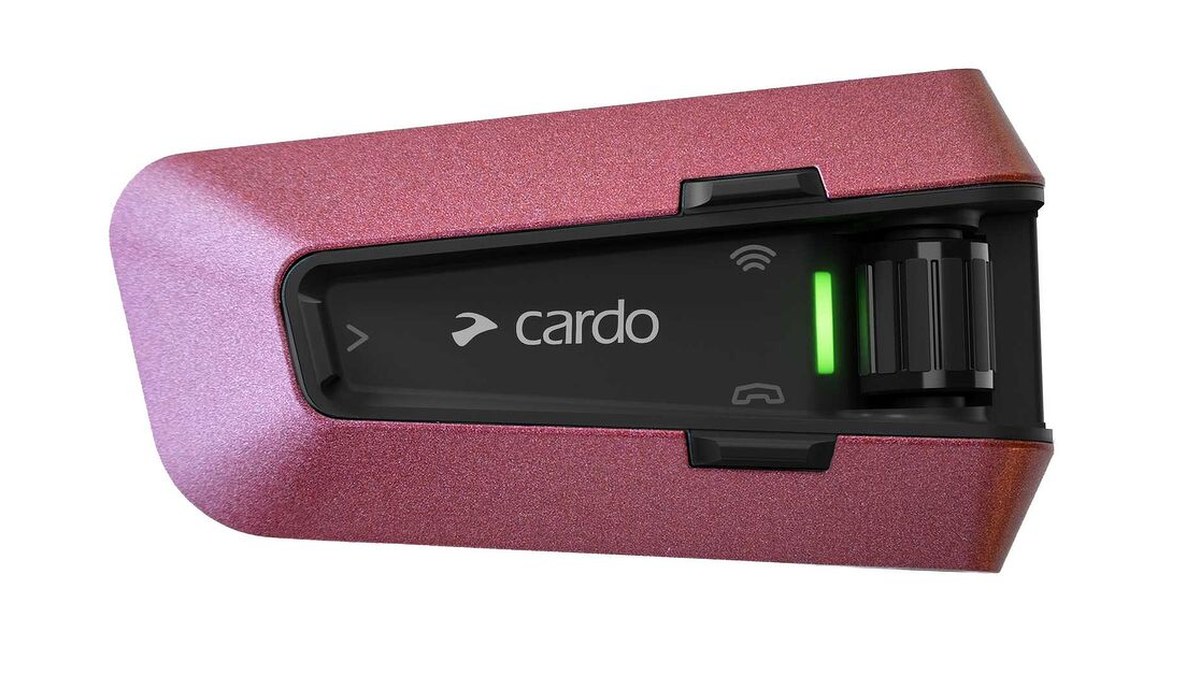
| Cardo Packtalk Edge, single | $439.95 USD | up to 1.6 km (1 mi) | up to 31 | 2nd Gen Dynamic Mesh, Bluetooth 5.2 |
| Sena 50S, single | $265.30 USD on sale from $379.00 | up to 2 km (1.2 mi) open terrain | 24 in Group Mesh | Sena Mesh Intercom 3.0, Bluetooth 5.0 |
Every range in that table is a manufacturer claim in open terrain, not a measured figure. The column that actually separates these units is riders. Four, against twenty-four, against thirty-one. For a two, three or four rider group, four is not a limit you'll ever hit. For a club ride or a rally that reforms at every junction, it's the whole decision, and no price turns four into ten. If that's your riding, start with the intercom comparison instead of this unit.
It is not a mesh intercom, and here is what that means
This is the part where a review normally reports dropouts and reconnection behaviour. I can't, because the bike hasn't moved with this unit on it. What I can tell you is what the D10 promises and what it doesn't.
The promise is a four-rider Bluetooth group intercom with one-click pairing, auto reconnect and a claimed 1.6 km. The gap to a real mesh system is structural, not a tuning problem. Mesh lets riders join and leave, relays through other riders, and heals itself when someone disappears behind a ridge. The D10 documentation publishes no mesh protocol name, no node count and no self-healing claim. That's the tell. A manufacturer with those features writes them down. What's written down is Bluetooth group intercom, and that's a set of direct links with a fixed participant list.
So what happens when a rider drops out? On a direct-link system the group is only as good as its weakest link, and re-forming after a gap depends on the unit reconnecting to the right peer. MAXRUNON states auto reconnect and one-click pairing. That's the mechanism that either works in the spring or doesn't. Until then it's a claim.
Range claims in this class are line-of-sight claims. "Roughly a kilometre" is how I put it in the video, and that lines up with the 1.6 km headline once you allow for the optimistic conditions it was measured under. On a two-lane road with the group strung out over a crest, expect less. Nobody should buy any intercom at any price expecting the brochure number.
Sound, mics and wind noise
Two microphones ship. A wired button mic for full-face helmets and a boom mic for modular and open faces. The speakers are 40 mm, the size the premium brands use, and speaker pads are included to space them off the liner. That's the correct kit list. The claims built on top of it are the part to watch.
MAXRUNON claims ENC noise cancellation to cut wind noise, a five-layer noise reduction chain combining ENC, DSP and CVC, and clear audio up to 120 km/h (75 mph). Those are retail-listing claims and none of them has been measured, here or anywhere, because this unit hasn't been at highway speed yet. A 40 mm driver and an ENC algorithm are the same ingredients every brand lists. What separates a good intercom from a bad one is tuning, and tuning is the one thing a spec sheet can't show you.
One detail that's genuinely useful: voice control runs offline. On a unit this cheap that matters, because the alternative is a phone round trip that fails exactly where you need it, on a back road with no signal. Built-in FM is the other offline feature. Nice fallback or dead weight, depending on whether you ride with a phone on the bars.
If you're mounting a camera as well, decide both at once. Mic placement and the helmet clamp fight over the same real estate, and a badly routed boom mic shows up in your footage as wind noise. The helmet camera setup guide covers the clamp side of that.
Battery, mounting and the small stuff
MAXRUNON claims 12 hours of talk time and USB-C fast charging. Sena publishes 13 and 16 hours depending on mode for the 50S, so the headline is competitive rather than remarkable, and it stays a claim until a full day of riding proves it. What matters more on a cheap unit is whether the charge still holds when the battery is two seasons old. Nobody can tell you that in November.
IPX7 is the rating to check on a helmet unit, because a helmet sees rain from angles a phone never does. It's also the claim I can least defend, since my own video says plainly that a torrential downpour at highway speed is still untested. Buy it expecting the rating to be honest, and treat a wet-weather failure in year one as a warranty conversation, not a surprise.
The small things are where budget units cut corners, so check them against your helmet before you order. The box holds one mounting solution: an adhesive plate, a back clip and speaker pads. Rotate between a summer and a winter lid and you're either buying a second plate or moving adhesive between helmets.
The LED display is worth calling out, because a helmet unit gets operated by feel with gloves on. A readable status light tells you it paired and the battery isn't flat without taking a hand off the bar to squint at a phone. OTA updates are the long-term item. Firmware that can be fixed after you buy it is the difference between a product that ages and one that gets abandoned.
Commercial terms on the manufacturer store are 30-day returns and a 1-year warranty, with 13 customer reviews on the page as of 2026-11-22. One year is normal at this price and shorter than the premium brands back their flagships with. That's part of what the premium price buys.
What the premium price actually buys
Three things come with the premium price that a spec sheet never shows you. The first is a mesh protocol with a name and published behaviour, which is what makes a group of ten riders survivable. The second is a support and firmware organisation still shipping updates in four years. The third is resale. A used Packtalk or 50S moves in a week. A used budget unit mostly doesn't. Keep gear a season or two and sell it on, and the premium unit's real cost is lower than the sticker gap suggests.
What the D10 gives you instead is the whole feature set at a price where losing one or breaking one is survivable. FM radio, offline voice control, IPX7, 12 hours, OTA updates and two mic types aren't budget-tier omissions. That's the full list. If you do two or three group rides a season with the same two friends, that's not a compromise, it's the correct buy, and the four-rider ceiling never comes up.
The honest limit: this is an assessment of hardware and price, not of how the thing behaves in a group. A premium unit earns its money the day the group splits at a junction and reforms without anyone pressing a button. I haven't had that day with the D10, and I won't claim it went well or badly until it happens. Need certainty now and ride in big groups, buy the mesh unit. Ride with the same two or three people and would rather spend the difference on fuel, and the D10's spec sheet isn't the weak point.
Frequently Asked Questions
Do I need two units for a rider and a passenger?
No. It's sold as a single or a dual pack, and the dual is the cheaper way to put one on each helmet: $101.95 USD against a $129.99 list on 2026-11-22.
Will it fit a modular or open-face helmet?
Yes. A wired button mic and a boom mic both ship, so the same kit covers a full-face, a modular and an open helmet, and speaker pads are included for deeper cavities.
Does group intercom need a cell signal?
No. The group link is Bluetooth between the units, and voice control is documented to work offline with no internet connection, which is the part that matters on a back road.
What happens to the price after the sale ends?
It goes back to the manufacturer store list: $79.99 USD single and $129.99 USD dual, both inside the $80 to $100 USD band I quoted for this class in the video.
Sources
- MAXRUNON D10 product page: box contents, CAD pricing, 30-day returns, 1-year warranty, 13 customer reviews. Read 2026-11-22. Primary source for the hardware, the in-box list and the retail terms.
- MAXRUNON D10 product data feed: Bluetooth 5.4, 4-rider group intercom, 1.6 km (0.9 mi), IPX7, 12-hour battery, ENC, FM radio, app OTA updates. Read 2026-11-22. The manufacturer's own specification, which is where the "not mesh" finding comes from.
- Greg Toope, MAXRUNON D10 first look (video): box contents, US$80-100 price band, and his statement that he had not yet ridden with the unit. Watched 2026-11-22. First-hand, owned device. Every untested claim in the article is tied to what this video does not show.
- Sena 50S product page: Mesh Intercom, Bluetooth 5.0, claimed range up to 2 km (5 mi), 13 and 16 hour battery figures by mode. Read 2026-11-22. Used for the premium comparison; the numbers are Sena's own published figures.
- Cardo Packtalk Edge product page (attempted). Returned HTTP 429 on every attempt on 2026-11-22, so no Cardo price or spec is quoted in the article.
Get the Gear
MAXRUNON D10 helmet intercom, single and dual packs:
Affiliate links — support the site at no extra cost to you.