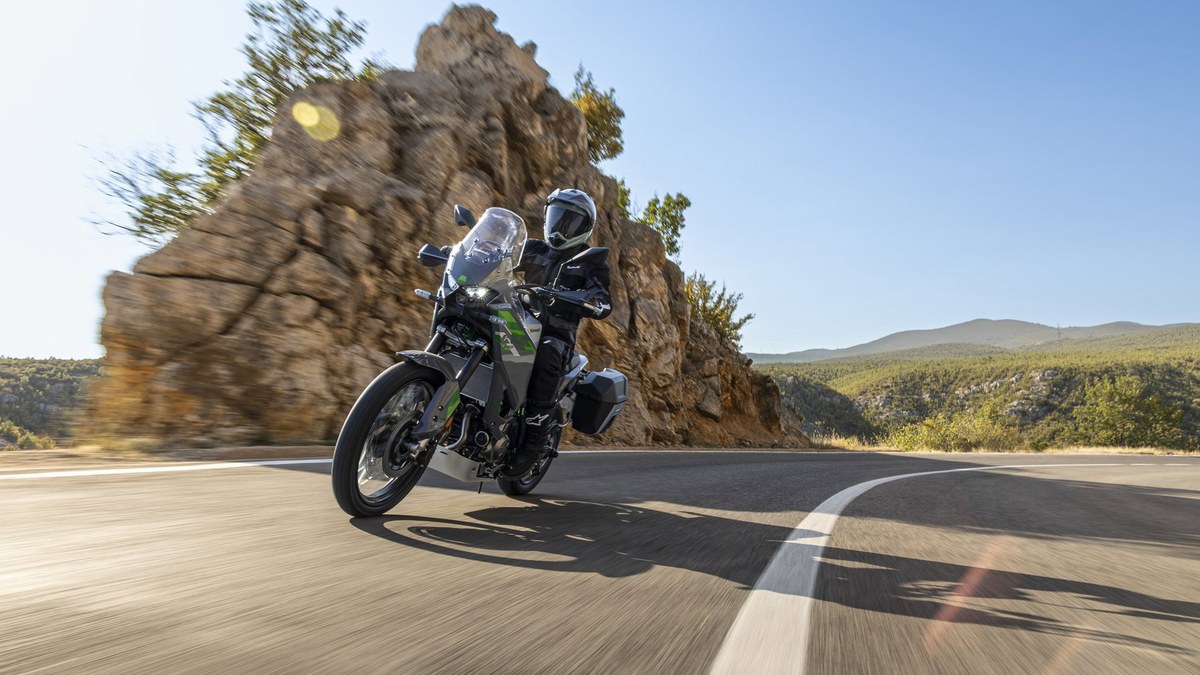
Image: Property of Kawasaki
Kawasaki KLE650: Full Specs, SE Trim and What It Costs
In This Article
Kawasaki has released the full technical detail on the 2027 KLE650, and the headline is not the number most people will quote. Yes, it makes 70PS from a 649cc parallel twin, and yes it has a 21-inch front wheel like the KLE500. But the interesting part is what Kawasaki chose to build: this is not a bigger KLE500. It is a deliberately road-biased adventure tourer that happens to look like a rally bike.
What the KLE650 actually is
The KLE650 shares the smaller bike's rally-inspired silhouette, its 21-inch front wheel, and its compact trellis-frame concept. Kawasaki then reworked the priorities toward comfortable road miles and long-distance touring. That is a different brief than the KLE500, which is more willing to be leaned on in the dirt.
The clearest evidence is in the suspension tune. Both bikes run identical geometry on paper: a 1,555mm wheelbase and a 28-degree steering-head angle. Trail shifts slightly from 104mm to 106mm. But Kawasaki says the KLE650's suspension is set up more for tarmac than the KLE500's, which itself was noted for being relatively firm once the pavement ended. If you ride the Cabot Trail and a lot of gravel access roads rather than true single track, that trade is the right way round.
The engine, and the crankshaft problem
The 649cc liquid-cooled parallel twin is descended from Kawasaki's familiar middleweight, but it is not a straight transplant. Electronic throttle valves, revised intake and exhaust systems, and new calibration are all aimed at delivering torque below 4,000rpm and a smooth pull past 6,000rpm. Kawasaki quotes 51.6kW, which is 70PS, for the European specification.
Here is the part spec sheets skip. The engine keeps the 180-degree crankshaft, which means it will not have the low-down grunt character that adventure riders tend to prefer, the kind a 270-degree crank gives you when you are crawling up a loose climb with a loaded pannier. Kawasaki is using the revised mapping to fill that gap rather than changing the architecture. Whether the mapping is enough is exactly the sort of thing that only shows up on a test ride, and I have not ridden this one yet.
An assist-and-slipper clutch is fitted, and electronic cruise control plus Kawasaki Traction Control are standard on both trim levels. KTRC offers two intervention levels, one for sportier riding and a second for slippery surfaces. Cruise control on a 650 adventure bike is genuinely useful for the long highway stretches out to Cape Breton or up through New Brunswick.
Chassis, seat and the 21-inch front
The frame is a high-tensile steel trellis with a revised swingarm. Up front are 43mm KYB cartridge-type inverted forks with 210mm of travel. At the rear, a new Uni-Trak setup offers 196mm. Those are generous numbers for a bike Kawasaki says is built for covering distance comfortably.
The wheels are a 21-inch front and 17-inch rear spoke combination, wrapped in Dunlop Trailmax Mixtour tyres chosen for paved-road grip and touring comfort. Fuel capacity is 16 litres, though Kawasaki has not published an official consumption or range figure, so any range number you see quoted right now is somebody's estimate, not a factory claim.
Seat height is 870mm, with an optional rider's seat that drops it 30mm to 840mm. That matters more than it sounds. Thirty millimetres is roughly the difference between flat-footing a bike and being on the balls of your feet, and on a loaded adventure bike at a gravel shoulder that difference decides whether you stay upright. There is also an accessory pillion seat that flattens the seating area for off-road standing, and the footpeg rubbers come off without tools to expose serrated pegs. Those two details tell you Kawasaki has not abandoned dirt entirely.
Braking is twin 300mm front discs with a 230mm rear. ABS can be switched off, and it returns to its default active setting when the ignition is cycled. That auto-reset is the right call for a touring-oriented bike, because forgetting to turn ABS back on after a gravel section is a mistake you only need to make once.
Standard or SE: what the extra money buys
The standard KLE650 is not stripped. It gets traction control, electronic cruise control, smartphone connectivity and a new five-inch LCD instrument display. But two things push buyers toward the SE.
The standard bike's spoked wheels use tubes. The SE gets tubeless spoked wheels, which means a puncture on the road is a plug-and-inflate job instead of a tube swap with tyre irons on the shoulder. That alone is worth real money to anyone who rides away from cell service.
The SE also adds a five-inch colour TFT with selectable layouts and turn-by-turn navigation through Kawasaki's RIDEOLOGY app, an up/down quickshifter, a taller screen, an aluminium handlebar, metal-reinforced handguards, a USB-C socket and a larger aluminium skid plate over the standard bike's plastic one. The quickshifter can be added to the standard model as an accessory.
The gap that decides it
Tubeless wheels plus the metal skid plate plus a USB-C port is the touring package. If you are riding the Trans-Labrador or doing the Newfoundland crossing, the SE is the version that does not leave you improvising at the roadside.
Kawasaki has not published kerb weight or Canadian pricing yet. Both are still blank, so any figure circulating is speculation.
What it means for Canadian riders
Two unknowns matter here and both are still open. Kawasaki has not confirmed kerb weight, and it has not confirmed Canadian pricing. The KLE500 sits as the entry point in Kawasaki's new adventure family, and the KLE650 is positioned as the more road-focused, longer-legged member of that family. Where it lands against the Versys 650, which has been the default Canadian sport-tourer for years, depends entirely on those two numbers.
The timing is also worth noting. This detail release comes days before EICMA opens in Milan on November 3, where Kawasaki and most of the major manufacturers are showing 2027 product. That suggests the KLE650 will get its public debut there rather than as a standalone announcement.
My honest read
The KLE650 looks like a sensible, comfortable, genuinely useful motorcycle, and I mean that as praise rather than a shrug. A 70PS parallel twin, cruise control, a 16-litre tank and a 21-inch front is a recipe that works for the riding most people actually do: long days, mixed surfaces, and more highway than hero dirt.
The two things I would want before recommending it are the weight and the price. A 180-degree crank at 70PS with a full load is fine on pavement and adequate on gravel, and Kawasaki's mapping work may well have solved the bottom end. But if the kerb weight comes in heavy and the Canadian price pushes it close to the Versys 650, the case gets thinner. If it lands well under the Versys and the SE comes with tubeless wheels as standard, it becomes a genuinely interesting bike for Atlantic Canada.
Frequently Asked Questions
How much power does the Kawasaki KLE650 make?
51.6kW, which is 70PS, from a 649cc liquid-cooled parallel twin, for the European specification. Canadian figures have not been published.
What is the seat height of the KLE650?
870mm as standard, with an optional low seat that drops it to 840mm.
Does the KLE650 have tubeless tyres?
Only the SE does. The standard KLE650 uses tube-type spoked wheels, while the SE gets tubeless spoked wheels plus a quickshifter, TFT display, taller screen and aluminium skid plate.
Is the KLE650 just a bigger KLE500?
No. It shares the silhouette, 21-inch front and trellis concept, but Kawasaki retuned it for road comfort and long-distance touring rather than the KLE500's more dirt-willing setup.
How much does the KLE650 cost in Canada?
Not announced. Kawasaki has also not published kerb weight, so both numbers are still open as of November 2, 2026.