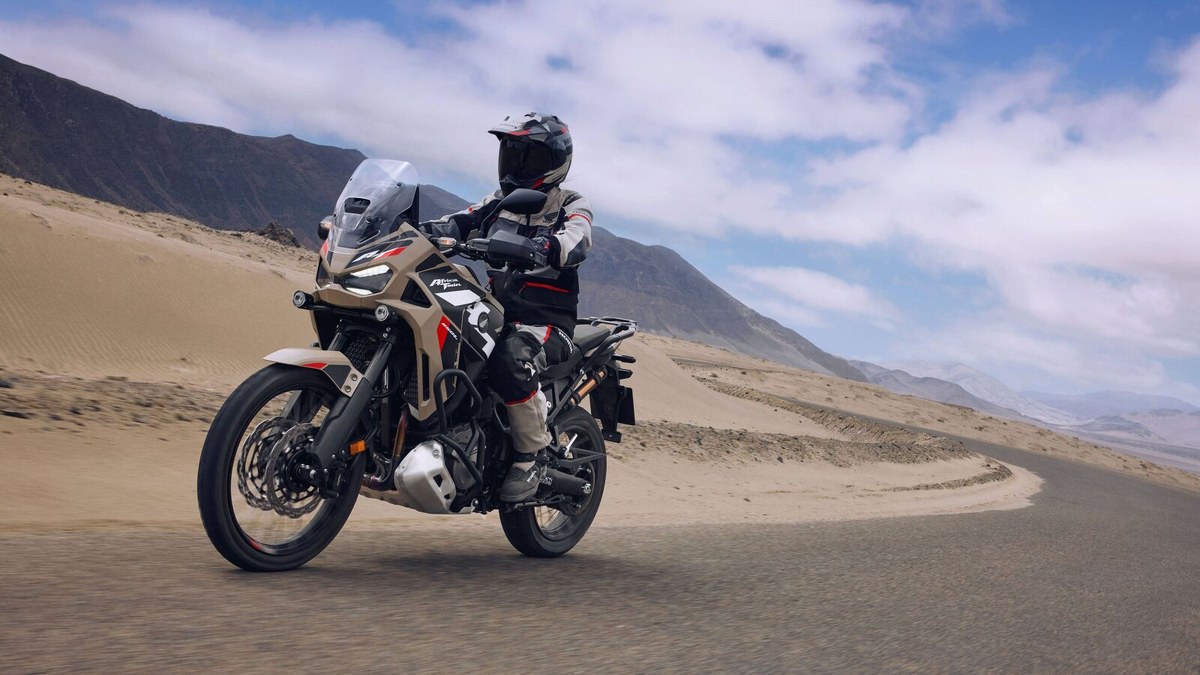
Image: Property of Honda
2027 Honda Africa Twin CRF1150L: 117 HP and Standard EERA Suspension
In This Article
Honda has announced the 2027 CRF1150L Africa Twin, and the model name changed because the engine did. The parallel twin grows from 1,084cc to 1,131cc, and with it the power figure moves from 100.6 hp to a claimed 117 hp at 7,500 rpm. Torque lands at 87.8 lb-ft at 5,750 rpm.
The second headline is suspension. Showa's EERA electronic suspension is now standard fitment rather than a premium add-on, and it arrives with revised Skyhook damping logic plus a new Minimum setting that drops ride height by 0.4 inches.
The caveat that matters most sits here at the top: this is a European announcement made on November 2, 2026. A North American announcement is expected separately, so Canadian pricing and specification are still open questions.
The engine: 1,084cc to 1,131cc
A 47cc capacity bump is not dramatic on its own. The power change is. Going from 100.6 hp to a claimed 117 hp is roughly a 16 percent gain, which is a big step for a bike that was already the class benchmark for a decade.
Honda's parallel twin has always been the opposite of a character engine. It is smooth, reliable and slightly bland, and riders have complained about that for years. A capacity increase plus a torque figure of 87.8 lb-ft suggests Honda is chasing the midrange grunt that adventure riders actually use when a bike is loaded and pointed up a loose climb.
What nobody has yet is a dyno chart or a ride report. Peak figures at 7,500 and 5,750 rpm tell you where Honda wants the numbers to look; they do not tell you what the engine feels like at 3,000 rpm with a pannier full of camping gear. Until someone rides it, that question stays open.
EERA electronic suspension, now standard
This is the bigger change for most buyers. Showa EERA uses electronically controlled damping rather than a stepper motor on a manual adjuster, which means the bike can change damping as you ride. On the previous generation this was a version-specific feature. For 2027 it is standard across the range.
Two details in the update are worth understanding. Skyhook logic is the control strategy that tries to hold the body steady while the wheels move, and it is the difference between electronic suspension that feels plusher over broken pavement and electronic suspension that feels like a very expensive set of stiff springs. Honda's revision is aimed squarely at that.
The new Minimum setting lowers ride height by 0.4 inches, which is about 10mm. That is not a low-seat conversion, and it will not turn the bike into something a 30-inch inseam can flat-foot. What it does is lower the centre of gravity slightly and make the bike easier to manage at a standstill when the tank is full or the bike is loaded. On a 500-plus pound adventure bike with luggage, that is not nothing.
The fork grows too: 49mm replaces the 45mm unit. A thicker fork is a stiffness decision, and thicker forks are how manufacturers address the flex that heavy adventure bikes generate under hard braking and on rough surfaces.
Weight, centre of gravity and the sub-tank
Honda quotes a claimed curb weight of 522 lb for the manual and 545 lb for the DCT. That is roughly 12 lb heavier than the outgoing CRF1100L. Normally that would be a criticism, but Honda paired it with a new fuel sub-tank that lowers the centre of gravity.
Heavier but lower-slung is often the better outcome in practice. An adventure bike feels its weight most at low speed and when it is tipped past a certain angle, and mass close to the ground is mass you can save when it starts to go. That is exactly the failure mode that puts bikes down in gravel parking lots.
Adding weight to gain capacity, electronics and a bigger fork is also honest engineering rather than marketing. Twelve pounds on a 500-pound bike is about 2 percent, and if the electronic suspension and the lower mass distribution are doing their job, the number will not be what you notice.
Standard, Enduro Sports or Adventure Sports
Honda is offering three distinct 2027 variants, and they are not trim packages so much as different bikes.
- Africa Twin is the standard model, with a 5.0 US gallon tank.
- Enduro Sports is the off-road focused version.
- Adventure Sports carries a 6.4 US gallon tank, a 19-inch front wheel instead of the standard bike's 21-inch, and is available as an optional Sensing Ride variant with front and rear radar.
That tank difference is the one to think about. 6.4 US gallons is about 24 litres, against roughly 19 litres for the standard bike. On a bike that will return somewhere in the 40s mpg range when loaded, that is a meaningful extension between fuel stops, and in Atlantic Canada or on the Trans-Labrador that gap between stops is the difference between a comfortable day and a stressful one.
The 19-inch front on the Adventure Sports is a deliberate road bias. A 19-inch front turns in quicker and suits a bike that spends most of its life on pavement with luggage. The standard bike's 21-inch front is the better choice if gravel and two-track are actually part of your riding.
The radar on the Sensing Ride variant is the interesting one for Canadian buyers specifically, because adaptive cruise control is genuinely useful on the long highway runs that make up most of a touring day in this country. Whether the Canadian market gets that variant at all is still unconfirmed.
What this means for a Canadian buyer
Right now, not much that is actionable. No Canadian pricing, no Canadian availability, no confirmation of which variants will cross the border. Anyone telling you what an Africa Twin Adventure Sports will cost in Canada in 2027 is guessing.
What the announcement does establish is the direction. Honda is not letting the Africa Twin drift into being a legacy model. A bigger engine, standard electronic suspension and a radar option put it directly against the European adventure flagship competition, and it keeps the model relevant for another generation.
The practical advice for anyone shopping in the next few months is to wait for the North American announcement rather than buying a 2026 on the strength of the European spec sheet. The suspension change alone is significant enough that a 2026 buyer should know what they are choosing to skip.
My honest read
The 2027 Africa Twin is a bigger, better-damped, more electronically sophisticated version of a bike that has been the sensible choice in adventure touring for a decade. The 117 hp claim gets the attention, but the standard EERA suspension is the change that will matter most to the people who actually buy one.
Two things I want before forming a real opinion. First, a North American specification, so the pricing question stops being theoretical. Second, a ride, because the whole point of electronic suspension is how it behaves over real roads, and Skyhook logic is exactly the kind of technology that either works beautifully or feels disconnected and vague. Honda's previous attempts have been decent rather than revelatory, and this update is a chance to change that.
If the Canadian price lands within reach of the outgoing model, this is the adventure bike most buyers should be looking at. The weight gain is honest and the mass is in the right place. On paper, Honda has done the work.
Frequently Asked Questions
What engine does the 2027 Honda Africa Twin use?
A 1,131cc parallel twin, up from 1,084cc, making a claimed 117 hp at 7,500 rpm and 87.8 lb-ft at 5,750 rpm.
Does the 2027 Africa Twin have electronic suspension?
Yes. Showa EERA electronic suspension is now standard, with revised Skyhook damping logic and a new Minimum setting that lowers ride height by 0.4 inches.
How much does the 2027 Honda Africa Twin weigh?
Honda claims 522 lb curb for the manual and 545 lb for the DCT, about 12 lb heavier than the CRF1100L, with a lower centre of gravity from a new fuel sub-tank.
Is the 2027 Africa Twin available in Canada?
Not confirmed. The November 2, 2026 announcement covers Europe only, and Honda has said a North American announcement will follow separately. Canadian pricing has not been published.
What is the difference between the Africa Twin and Adventure Sports?
The Adventure Sports has a 6.4 US gallon tank versus 5.0 on the standard bike, a 19-inch front wheel instead of 21 inches, and an optional Sensing Ride radar variant.
Does the 2027 Africa Twin have a 49mm fork?
Yes. The 49mm fork replaces the previous 45mm unit, and the bike also gains an electronically adjustable windscreen, cornering lights and a 5.7-inch plus 7-inch TFT dash setup.