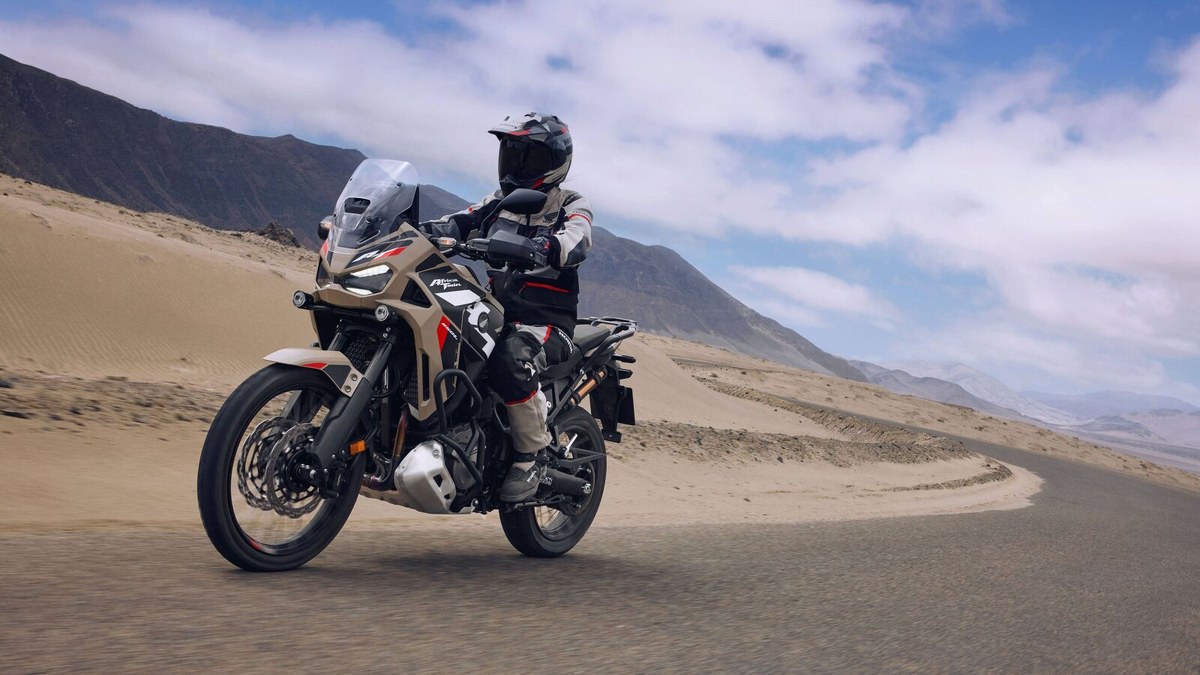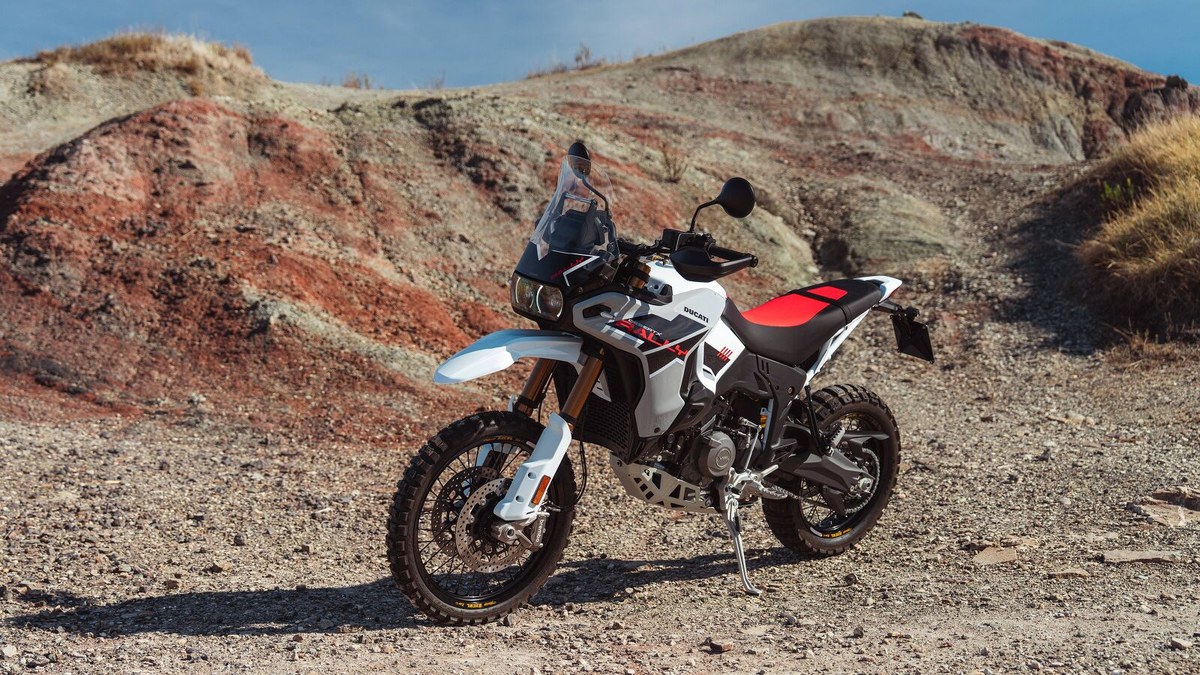
Image: Property of Ducati
2027 Ducati DesertX Rally: What the $3,000 Premium Actually Buys
In This Article
Ducati has built a Rally version of the DesertX on its new 890cc V2 platform, announced at EICMA on November 2, 2026, and priced at $19,995 US. That is a $3,000 premium over the base DesertX, which makes this one of the cleaner value questions in adventure motorcycling right now: what does the extra three thousand actually buy, and is any of it useful to a rider in Atlantic Canada who mostly rides gravel roads and highway rather than racing dunes.
The headline numbers are these. An 890cc V2 making a claimed 110.3 hp at 9,000 rpm and 68 lb-ft at 7,000 rpm, a monocoque frame, a wet weight without fuel of 461 lb, and a long-travel KYB suspension package with wheels designed for tubeless tyres. Ducati says the bike is four pounds lighter than the 2026 Rally it replaces.
The 890cc V2 and the monocoque frame
The engine is the non-Rally DesertX engine, unchanged in output. That is worth being clear about, because the Rally badge on this bike has never meant more power. It means more suspension, more wheel, and a chassis set up to be abused.
Moving the DesertX onto the 890cc V2 platform was the big structural change, and the visible consequence is the weight. Four pounds on a 465 lb motorcycle is a rounding error in isolation, but the way Ducati got there matters more than the number. A monocoque frame uses the engine as a stressed member and does away with a conventional frame cradle, which lets the engineers put the mass where they want it rather than where the tubes fit.
110 hp from 890cc in a bike this size is a sensible number rather than an exciting one. My own Pursuit is a different animal entirely, but the comparison I keep coming back to with adventure bikes is that peak power at 9,000 rpm is a number you will rarely use on a loaded bike on a loose climb. What matters is what happens at four and five thousand, and Ducati has not published a torque curve.
48mm KYB fork with Kashima and DLC
This is where the Rally earns its money. The fork is a fully adjustable 48mm KYB closed-cartridge inverted unit, and it carries two coatings that are worth understanding because they are not cosmetic.
- Kashima coating is a ceramic-like surface treatment on the fork tubes that reduces friction and, in practice, helps the suspension hold a more consistent feel as it heats up over a long rough section.
- DLC (diamond-like carbon) is a harder, slicker coating that further reduces stiction. Stiction is the reason a cheap fork feels harsh over small bumps: the seals resist the initial movement, so the fork skips the small stuff entirely.
Closed-cartridge construction is the other half of this. It separates the damping oil from the spring oil, which means the damping stays more consistent when the fork is working hard and getting hot. On a rally bike being pushed over washboard, that is the difference between damping that stays where you set it and damping that fades into something vague by mid-afternoon.
The Full Floater linkage
At the rear, Ducati fits a fully adjustable KYB shock with a remote preload adjuster, and it mounts through a new racing-derived Full Floater system that places the shock between two different linkages instead of one.
Ducati claims improved comfort, traction and bump absorption from the arrangement. The engineering reason is that the leverage ratio changes differently through the stroke than a single-linkage setup, which lets the suspension be compliant over small bumps early in the travel while still resisting bottoming on a big hit. A remote preload adjuster is the detail touring riders should care about most: loading panniers and a passenger usually means crawling under the bike with a spanner, and remote adjustment removes that job entirely.
Tubeless Takasago Excel wheels
The Rally runs Takasago Excel spoked wheels in tubeless fitment, 21 inches at the front and 18 at the rear, with a 36-spoke rear wheel that Ducati says improves strength and reliability.
Tubeless spoked wheels are the single most practical item on this list for anyone riding in Atlantic Canada. A tube puncture on a spoked wheel means removing the wheel and tyre at the side of the road to patch the tube. A tubeless tyre can usually be plugged in a couple of minutes and ridden home. On a bike meant to be taken into the backcountry of Newfoundland or along the Trans-Labrador, that is not a small difference, it is the difference between a delay and a very long day.
What the $3,000 premium buys
Strip away the marketing and the gap between the base DesertX and the Rally is a specific list: the closed-cartridge coated KYB fork and matching shock with the Full Floater linkage, the Takasago Excel tubeless wheels, an adjustable Öhlins steering damper, a flat one-piece rally seat, Ducati Quick Shift 2.0, a five-inch TFT display and a Termignoni exhaust as standard.
Some of that is genuinely expensive to add after the fact. A closed-cartridge fork with Kashima and DLC coatings is well into four figures on its own. Tubeless spoked wheels are not cheap either, and the steering damper is a part that most riders end up buying separately on a bike that gets ridden hard off pavement.
Some of it is less compelling. A quick shifter and a TFT are nice to have, but they are the sort of thing you would expect on a modern adventure bike at this price rather than a justification for the Rally badge. The rally seat is a real choice and a real trade-off: a flat one-piece seat gives you room to move your weight forward and back off-road, and it is less comfortable on a long highway day than a shaped touring seat. If most of your riding is pavement, that is a check against the Rally rather than for it.
The Canadian question
The $19,995 figure is US pricing, and Ducati has not published Canadian pricing for the 2027 DesertX Rally. Anyone quoting you a Canadian number right now is converting at an exchange rate and guessing at freight and PDI. As a rough indication only, a straight conversion at recent rates puts the bike somewhere in the high twenties in Canadian dollars before freight, PDI and tax, so treat any number you see as an estimate rather than a price.
There is also a practical question of which version Canada gets and when. Canadian allocations of Ducati's more specialised models have historically been small, and a Rally-spec bike with a $3,000 premium over the base model is exactly the kind of model that lands in limited numbers.
The comparison that matters for a Canadian buyer is against the base DesertX. If you are riding Newfoundland gravel, forestry roads in New Brunswick and a few weekends of two-track, the base bike is already far more capable than most riders will use. The case for the Rally is specific: you plan to ride it genuinely hard off pavement, you want tubeless spoked wheels, and you would otherwise spend the money on suspension anyway.
My honest read
The Rally is the version of the DesertX that Ducati's own marketing has been hinting at since the platform moved to the 890cc V2. The weight reduction is small, the power is unchanged, and the chassis work is real.
My reservation is the same one I have about most rally-spec adventure bikes: the specification is aimed at a use case that very few owners actually reach. A closed-cartridge fork with DLC coatings is wasted if the bike never leaves pavement, and a flat rally seat is actively worse if it does. Buy the Rally because you want the wheels and the suspension for terrain you actually ride, not because the spec sheet looks more serious.
What I want before I would call it is a real ride on broken pavement and loose gravel, because the whole argument for this bike rests on how the suspension behaves in exactly those conditions, and that is the one thing no press release can tell you.
Frequently Asked Questions
How much does the 2027 Ducati DesertX Rally cost?
$19,995 US, which is a $3,000 premium over the base DesertX. Canadian pricing has not been published.
What engine is in the 2027 DesertX Rally?
Ducati's 890cc V2 in a monocoque frame, making a claimed 110.3 hp at 9,000 rpm and 68 lb-ft at 7,000 rpm, the same output as the base DesertX.
Is the DesertX Rally lighter than the 2026 model?
Yes. Ducati claims a wet weight without fuel of 461 lb, which is four pounds lighter than the 2026 Rally.
Does the DesertX Rally have tubeless wheels?
Yes. It uses Takasago Excel spoked wheels in tubeless fitment, 21 inches front and 18 inches rear, with a 36-spoke rear wheel.
What kind of suspension does the DesertX Rally use?
A fully adjustable 48mm KYB closed-cartridge fork with Kashima and DLC coatings, plus a KYB shock with remote preload adjustment on a new Full Floater linkage.
Is the DesertX Rally worth the $3,000 premium?
It depends entirely on how much off-pavement riding you actually do. The closed-cartridge fork and tubeless spoked wheels are expensive to add later, but the flat rally seat is less comfortable for highway touring.