Image: Property of Samsung
Galaxy Buds On vs Sony LinkBuds Clip: Which One Fits a Helmet
In This Article
Samsung's first open-ear earbud is now on sale in the United States, and it lands in the same narrow category I spent a week riding with in October: the clip-on earbud that sits outside your ear canal instead of plugging it. The Galaxy Buds On is $229 USD in black, it launched in South Korea on October 27, 2026 at 299,000 won, and Europe follows later.
That is the exact price and the exact form factor of the Sony LinkBuds Clip I reviewed for motorcycle use on November 1. So the useful question is not which one is newer. It is which one is the better earbud when the thing you are clipping it to is a head inside a helmet.
What the Galaxy Buds On actually is
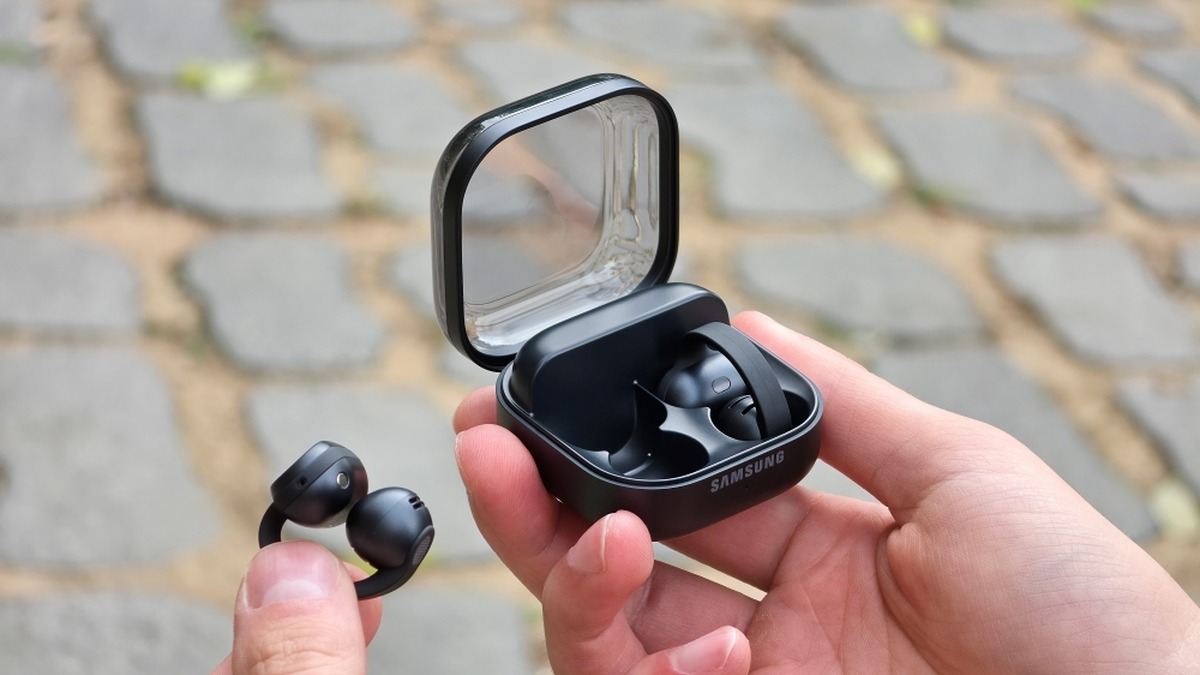
Samsung is explicit that this is its first open-ear design, and the hardware is built around a clip rather than a hook. The band angle adjusts to your ear shape, and Samsung says the speaker and battery placement came out of ear-shape simulations rather than a single fixed geometry. That last part matters more than it sounds like it should, because clip-on fit is the entire product.
The speaker is what Samsung calls TwinBoost, which it claims delivers more bass than previous Galaxy Buds. There is Audio Leakage Reduction, three microphones plus a bone conduction sensor for calls, head gestures for dismissing alarms and checking notifications, and hands-free Gemini Live if you are paired to a Galaxy AI phone. Samsung rates playback at up to 9.5 hours per charge.
Galaxy Buds On
$229 USD
Black only at launch in the US. Launched in South Korea October 27, 2026 at 299,000 won, Europe to follow.
Pricing is US launch pricing. Samsung has not published Canadian pricing, and this site does not guess currency conversions.
The numbers side by side
| Spec | Galaxy Buds On | Sony LinkBuds Clip |
|---|---|---|
| Form | Clip-on, open-ear | Clip-on, open-ear |
| Price (US) | $229 | $229.99 |
| Battery per charge | Up to 9.5 hours | 9 hours |
| Battery with case | Not published at launch | 37 hours total |
| Driver | TwinBoost speaker | 10mm dynamic |
| Water resistance | Not published at launch | IPX4 |
| Weight per bud | Not published at launch | 6.4 g |
| Bluetooth | Not published at launch | 5.3, multipoint |
Two things stand out in that table, and both are absences rather than features. Samsung has not published case capacity, water resistance, weight or Bluetooth version for the Buds On at launch. Those are the four numbers a rider actually needs, and until they exist a comparison is partly a guess on the half of the table Samsung left blank.
What Samsung did publish is a 9.5 hour single-charge figure, half an hour more than Sony's 9 hours. In practice, half an hour is not the difference between finishing a ride and walking home. Case capacity is the number that decides whether earbuds survive a multi-day trip, and Sony's 37 hours is on the board.
Fit under a helmet
This is where clip-on designs win or lose, and it is the reason I bothered testing the LinkBuds Clip on the bike at all. A clip-on sits behind the ear and against the side of your head, which is exactly where helmet padding presses hardest.
The Sony design survives that pressure because it is small and flat. The ear hook does not fold your ear forward, and on a properly fitted lid the pad compresses against it without pulling. The adjustable band angle on the Buds On is the right idea for the same problem, and it is genuinely reassuring that Samsung built adjustment in rather than shipping one fixed shape. But adjusted angle and shell thickness are different things, and Samsung has not published how far the clip protrudes.
Practical advice before you buy either: put your helmet on with the earbuds in, then leave them in for twenty minutes. Discomfort that appears at minute eighteen is the difference between a good ride and a headache you cannot remove without stopping.
Wind noise and what you actually hear
Neither of these is a noise-cancelling earbud, and that is the point. Open-ear means a partially open acoustic path, so wind noise reaches your ear directly. Above roughly 80 km/h the wind becomes the loudest thing in the helmet no matter what is clipped to your ear, and no earbud at this price changes that.
What differs is how much music survives underneath it. The LinkBuds Clip has a 10mm dynamic driver and three audio modes, including a Voice Boost setting and a sound leakage reduction mode, and I found it stayed audible at highway speed while still letting engine and traffic noise through. Samsung counters with TwinBoost bass, which on paper is a real advantage, because open-ear designs are usually thin at the bottom end and thin bass gets swallowed by wind first.
Whether TwinBoost actually cuts through helmet wind is unknown until someone measures it. Samsung's own hands-on material describes running and commuting, not riding, and it notes that leakage varies with volume, ear shape and ambient noise. That is an honest caveat and it applies to Sony too.
Awareness in traffic
Here both products argue the same case, and it is the case that matters most for riding. Because neither seals the canal, you keep hearing what is around you: the car overtaking on your left, the siren two blocks back, the gravel under your front tyre.
This is not a safety feature you should treat as a licence to listen at full volume. It is a reason to prefer open-ear over sealed earbuds, which is a genuine choice many riders get wrong. If you want sealed isolation on a motorcycle, the honest answer is that you want earplugs, not music, and the two do not combine.
Which one should you buy
Buy the Sony LinkBuds Clip if you want a known quantity for riding. It has published water resistance, published weight, published multipoint Bluetooth, 37 hours of case capacity, and a helmet review from this site with real kilometres behind it. At $229.99 it is effectively the same money, and everything you need to judge it is on the spec sheet.
Wait on the Galaxy Buds On if bass is your priority or you live inside Samsung's ecosystem, where Gemini Live and head gestures are genuinely useful hands-free. It is the newer design with more adjustment, and if Samsung publishes case capacity, IP rating and weight soon, it could be the better buy. Right now four of the numbers that decide whether it works in a helmet do not exist.
For a rider buying today, the boring answer is the correct one: the earbud with published specifications and a helmet test wins by default. That is the LinkBuds Clip. The Buds On is a promising second act that has not shown its whole spec sheet yet.
Frequently Asked Questions
How much does the Samsung Galaxy Buds On cost?
$229 USD at launch in the United States, black only. It launched in South Korea on October 27, 2026 at 299,000 won, with Europe to follow.
Are Galaxy Buds On better than Sony LinkBuds Clip for motorcycle riding?
Not yet established. Sony publishes IPX4 water resistance, 6.4 g weight per bud, Bluetooth 5.3 multipoint and 37 hours of case capacity. Samsung has not published those figures for the Buds On, so the LinkBuds Clip is the safer choice for riders today.
Do open-ear earbuds work under a helmet?
Yes, if the clip is small and flat. A clip-on design sits against the side of your head where helmet padding presses, so fit and shell thickness matter more than sound quality. Always test with your own helmet for twenty minutes before committing.
Can you hear traffic with clip-on earbuds?
Yes. Open-ear earbuds leave the ear canal unsealed, so surrounding sound still reaches you. That is the main safety argument for this design over sealed earbuds on a motorcycle.
How long does the Galaxy Buds On battery last?
Samsung rates playback at up to 9.5 hours per charge. Case capacity has not been published at launch.
Does the Galaxy Buds On have noise cancellation?
No. It is an open-ear design, so there is no active noise cancellation in the sealed sense. It uses TwinBoost speakers and Audio Leakage Reduction to keep sound in and the world audible.