
Image: Property of CarpodGo
Short answer: yes for a car, and only with reservations on a bike. The CarpodGo Mini is $119.90 on CarpodGo's own listing, runs a 6.9-inch 1600x720 fully laminated screen at 1000 nits, and needs a 9V USB-C PD feed. It does wireless CarPlay and Android Auto for a vehicle that never had either, with no dash work. What it does not publish is an IP rating, and a motorcycle is the one place an IP rating decides whether a thing survives.
Portable CarPlay screens were built for the millions of cars sold before Apple and Google got into the dashboard. Motorcyclists keep asking the same question about them anyway, because a bike has the same problem a 2012 Corolla has: a small screen, or no screen at all, and no good place to put a phone where it stays visible and dry and charged.
So this is the review the search query is actually asking for. Not "is the CarpodGo Mini good", which it is, but "is a portable CarPlay screen worth it on a motorcycle", which is a harder and more useful question. Every number below comes from CarpodGo's own product listing and technical specification table as published at the time of writing, not from a launch-day press summary.
What the CarpodGo Mini actually is
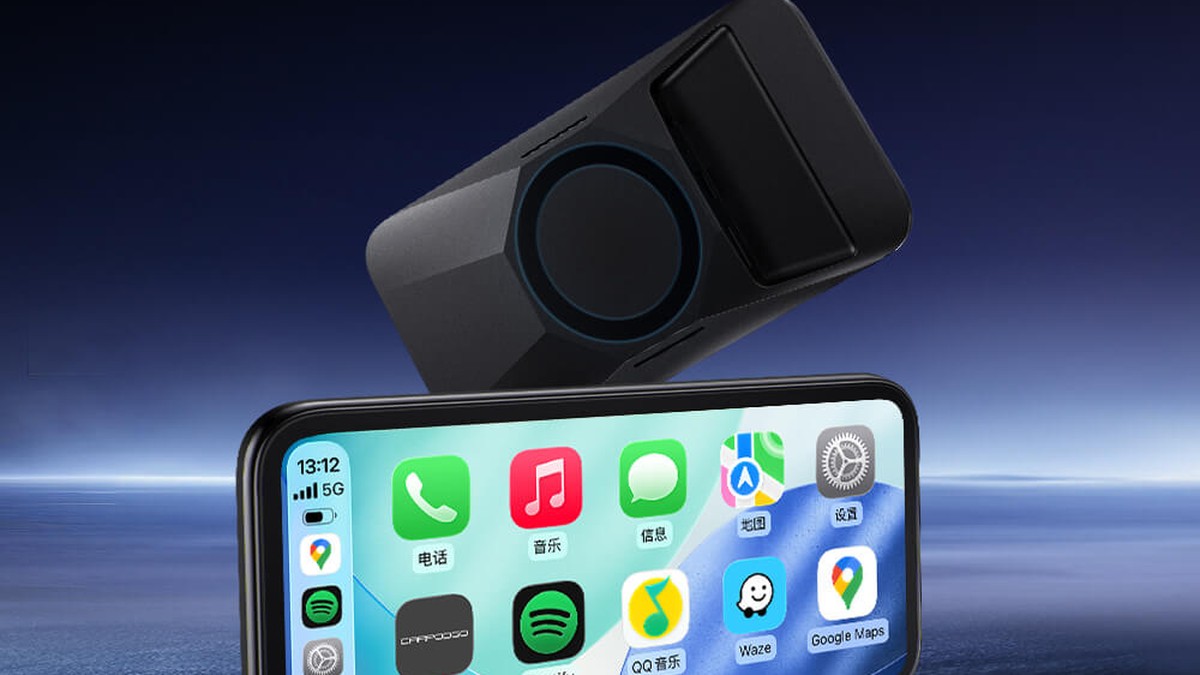
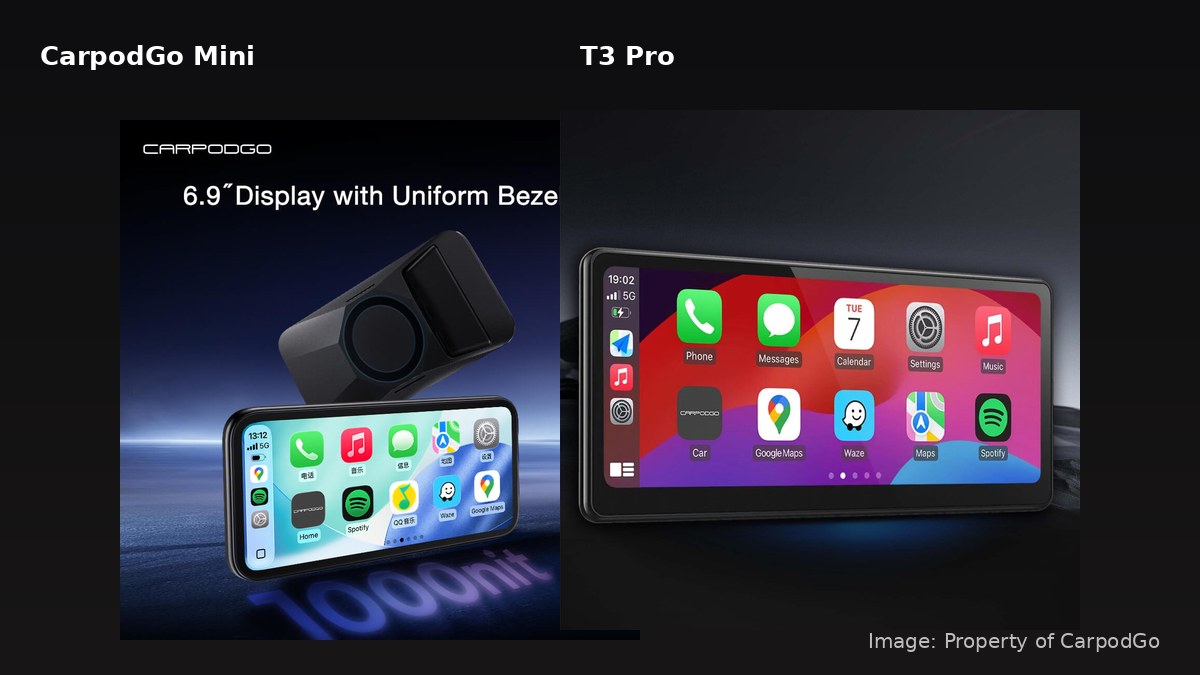
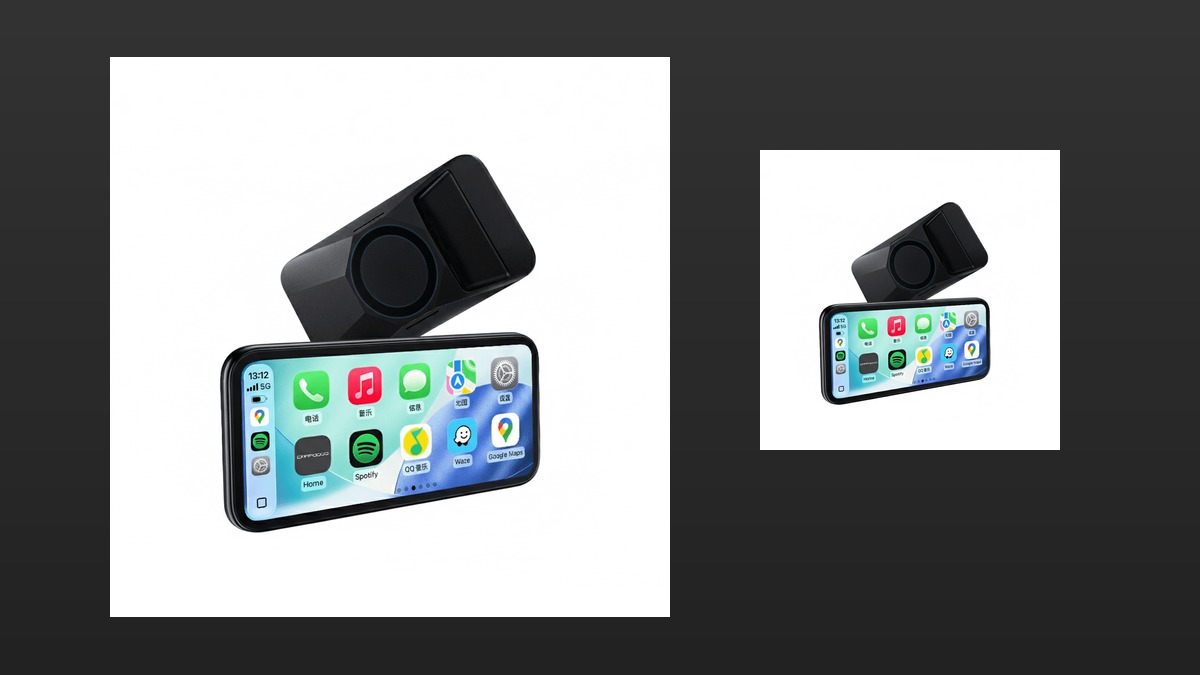
The Mini is the smallest of CarpodGo's three current screens. It is a 6.9-inch display with a magnetic back and a USB-C port, and it does one job: it mirrors wireless CarPlay or wireless Android Auto from a phone so the phone can stay in a pocket. No wiring into the vehicle's loom, no head unit swap, no reverse camera unless you add one.
The part that matters to anyone who has used a cheap portable screen is the panel. The Mini runs a fully laminated IPS display at 1600 x 720 and 254 PPI, rated 1000 nits, with 70% NTSC colour coverage and uniform 4mm bezels. Full lamination is what separates a screen that looks like a piece of glass from one that looks like a sticker behind plastic, and 1000 nits is the number that decides whether you can read a map at noon.
The spec check, from CarpodGo's own listing
CarpodGo publishes a technical specification table for the Mini. Here is that table, with the two entries a rider needs to think hardest about marked out below it.
| Specification | CarpodGo Mini (manufacturer listing) |
|---|---|
| Price | $119.90 USD, free shipping, $20 off promotion running at time of writing |
| Display | 6.9" fully laminated IPS, 1600 x 720, 254 PPI, 70% NTSC |
| Brightness | 1000 nits, ambient auto-brightness sensor |
| Refresh | 60 fps wireless CarPlay |
| Operating system | Linux, fast boot |
| Wireless | Dual-band Wi-Fi (5GHz), Bluetooth 5.0 |
| Dimensions | 164mm x 81mm x 13mm |
| Power input | USB-C with PD, 9V/1A |
| Mounting | MagSafe magnetic mounting |
| Protection | Factory-installed oleophobic tempered glass |
| Camera input | AHD 1080p rear-view camera (camera sold separately) |
| Water resistance | Not published in the specification table |
Two of those rows carry the whole motorcycle argument. The first is power. CarpodGo specifies USB-C with PD at 9V/1A and states plainly that USB-A is strictly forbidden at 5V. That is not a suggestion. It means the 12V socket adapter with a USB-A port that is sitting in your tank bag is the wrong thing to plug this into, and a bike's factory USB socket is very often a 5V USB-A socket.
The second is the last row. There is no IP rating in CarpodGo's specification table for the Mini. For a car that omission costs nothing, because a car is a dry box. For a motorcycle it is the whole question, and no amount of 1000-nit brightness answers it.
The motorcycle problem: power, rain and glare
Power is solvable, cheaply
The 9V USB-C requirement sounds like a dealbreaker and is actually the easy part. A hardwired USB-C PD outlet on the bike, or a PD power bank in a jacket pocket for shorter rides, delivers it. What you cannot do is assume the bike's existing USB socket qualifies. Check the output voltage printed on the socket before you buy anything, because a 5V feed is exactly what the manufacturer says not to use.
Rain is not solvable at all
A portable CarPlay display is a glass-fronted tablet with a magnetic back and an open USB-C port. CarpodGo does not publish an IP rating for it, and nothing in the listing suggests it is meant to be rained on. On a bike that means one of two things: you ride only in dry weather with it mounted, or you accept that a screen with no published water resistance is a fair-weather accessory and you take it off when the sky turns. Atlantic Canada makes the second option the realistic one. I have ridden through enough October rain in Nova Scotia to know that a fair-weather screen is a screen you use about half the season.
Glare and vibration are better than you expect
This is where the Mini earns its price on a bike. Full lamination cuts internal reflections, the 1000-nit panel stays legible in direct sun far better than a phone at 800 nits behind a plastic screen protector, and the auto-brightness sensor means you are not reaching for a slider at dusk. The magnetic mount holds the unit solidly enough for the screen itself, though the mount is designed for a dashboard, not for the vibration a twin-cylinder touring bike puts through a handlebar clamp.
Mounting it where a rider can actually see it
The Mini is 164mm wide, 81mm tall and 13mm thick, and it mounts magnetically. That geometry is the constraint. A RAM arm and a plate adapter will get a MagSafe-compatible surface onto a handlebar or a fairing, and the screen then sits behind the bike's own windscreen, which is the only place it belongs. Mounted above the screen on a naked bike it becomes a sail.
Two practical notes from the listing that matter more on a bike than in a car. There is no power switch on the unit; it draws from whatever it is plugged into, so a switched circuit is the only way to stop it draining a bike battery. And the listing carries a Tesla-specific instruction to use the cigarette lighter adapter because it is the only port that cuts power with the vehicle off. The same logic applies to a motorcycle: wire it to a switched circuit, not to the battery direct.
When a phone in a case wins
For most riders, most of the time, a phone in a waterproof case on a vibration-damped mount does the same job for the price of the case. It runs CarPlay, it runs Google Maps, it has an IP rating because the case has one, and it charges off the same USB-C outlet. The Mini adds a bigger, brighter screen and takes the phone out of the weather, which is a real gain for anyone doing long days where the phone's camera and battery matter.
The case where the Mini clearly wins is a rider who wants the phone to stay in a pocket and charged, and who wants a 6.9-inch map at 1000 nits on the bars. That is a touring use case, and it is the same use case that made a dedicated GPS unit worth $600 ten years ago.
| Option | Cost | Rain | Map size |
|---|---|---|---|
| Phone in a waterproof case, damped mount | Case plus mount | Rated by the case | Phone-sized |
| CarpodGo Mini plus PD outlet and mount plate | $119.90 plus outlet and plate | No published IP rating | 6.9-inch, 1000 nits |
| Dedicated motorcycle GPS | Several hundred dollars | Rated for weather | Smaller, offline maps |
| Factory CarPlay head unit | Well over $500 installed | Rated for weather | Largest |
The verdict
Buy the CarpodGo Mini for the car it was designed for. At $119.90 with free shipping it is the cheapest honest way to put wireless CarPlay into a vehicle that never had it, and the panel is better than the price suggests. My original review of the car use case still stands, with the price correction it needed.
On a motorcycle, buy it knowing exactly what you are getting: a bright, sharp, fast screen that has no published water resistance and needs a 9V USB-C feed. If you ride in dry weather and you want a big map on the bars with the phone in your pocket, it is a good $120. If you ride through Atlantic Canada weather, a waterproof case on your existing phone is the better answer, and the honest recommendation here is to spend the money on the case and a vibration-damped mount.
Frequently Asked Questions
Does the CarpodGo Mini work on a motorcycle?
It can, with two conditions. It needs a USB-C PD outlet capable of 9V/1A, because CarpodGo states USB-A at 5V is strictly forbidden. And CarpodGo publishes no IP rating for it, so it is not a rain-safe device and should not be treated as one.
Is the CarpodGo Mini waterproof?
No water resistance figure appears in CarpodGo's technical specification table for the Mini. Without a published IP rating you should assume it is for dry use, and remove it or cover it in rain.
Can I power the CarpodGo Mini from a 12V motorcycle socket?
Only if the adapter delivers USB-C PD at 9V. A plain 5V USB-A socket is what the manufacturer says not to use. Check the voltage printed on the adapter before connecting anything.
Is the CarpodGo Mini worth $119.90?
Yes for a car without CarPlay or Android Auto. For a motorcycle it depends entirely on whether you ride in rain, because weather resistance is the one thing the spec sheet does not provide.
How big is the CarpodGo Mini screen?
6.9 inches, fully laminated IPS, 1600 x 720 at 254 PPI and 1000 nits, in a body measuring 164mm by 81mm by 13mm.
Facts verified against CarpodGo's product listing and published technical specification table on November 15, 2026. Prices are in USD and change without notice. No affiliate link is used in this article.