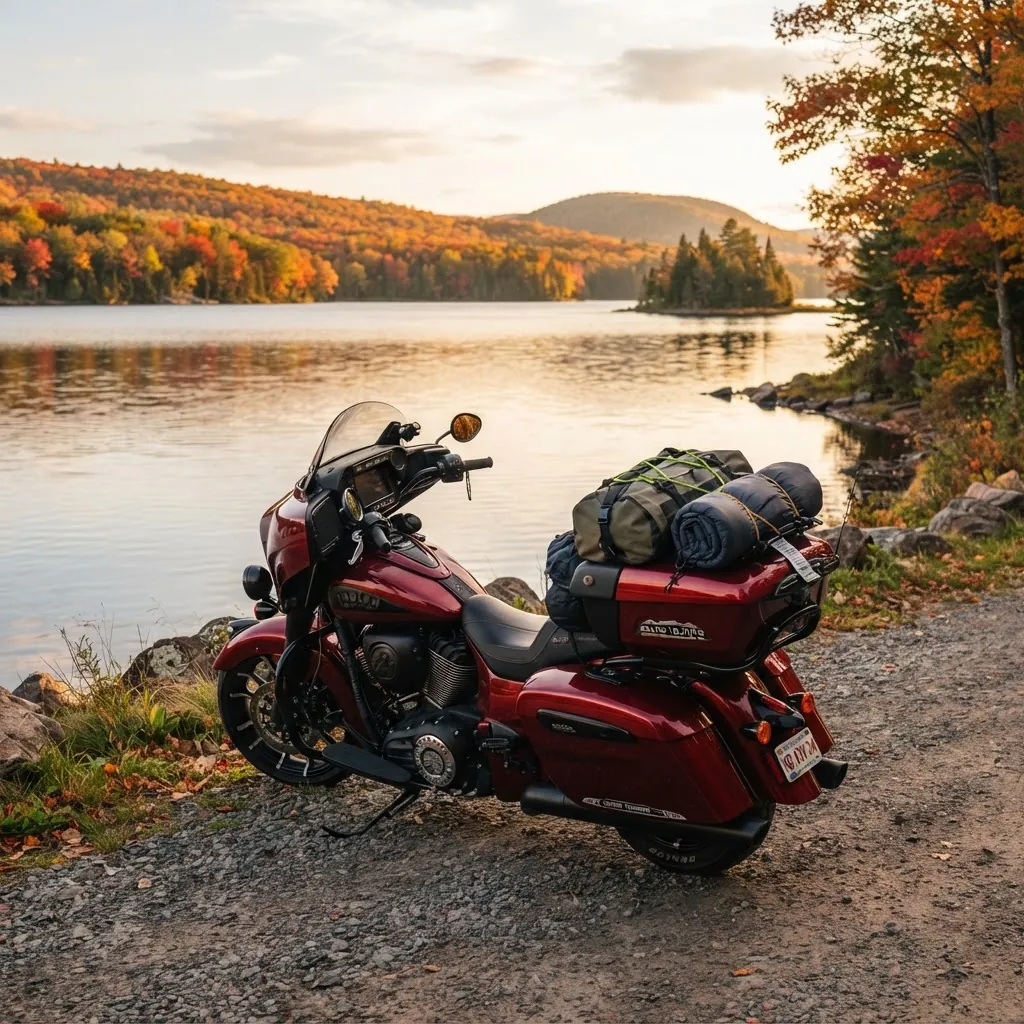
How to Prepare Your Motorcycle for a Multi-Day Tour — 200,000 km of Lessons
I've put over 200,000 kilometres on motorcycles across Atlantic Canada, Quebec, Ontario, and the northeastern US — a mix of solo runs, two-up with Monique, and group rides with friends. The most recent was a 4,000 km round trip from New Brunswick to Muskoka, Ontario for ECIC 2026 on my Indian Pursuit — eight days of rain, heat, construction zones, and the kind of long days that test whether you prepared properly or just threw stuff in a bag and hoped for the best.
Preparation makes or breaks a multi-day trip. Not just "check your tire pressure" preparation — I mean the full system. The bike, the packing, the weather gear, the tech, and the mindset. After enough trips, you learn what matters and what doesn't. Here's what I've learned.
Pre-Trip Bike Inspection — What Actually Needs Checking
You don't need to be a mechanic, but you do need to check the things that'll strand you 500 km from home. Here's what I go through before every multi-day trip on the Indian Pursuit:
Pre-Trip Motorcycle Checklist
- Tires: Tread depth and pressure. On a fully loaded touring bike, run pressure at the manufacturer's heavy-load spec — the Pursuit calls for 36 PSI front, 41 PSI rear with a passenger and cargo. Under-inflated tires on a loaded bike wear fast and run hot.
- Oil and fluids: Check the oil level on the PowerPlus 108ci with the bike upright and warm. Coolant level, brake fluid condition — if it's dark, flush it before a long trip.
- Drive belt tension: The Indian Pursuit uses a carbon-fibre reinforced belt. Check for proper deflection and inspect for embedded rocks or debris. A snapped belt in rural Quebec is not how you want to spend a Tuesday.
- Brake pads: Measure remaining pad thickness. If there's less than 3mm of material, replace them before you leave. Mountain descents eat pads faster than you think.
- Lights and electrical: Every light — headlight, turn signals, brake light, auxiliary lights. Clean connections and carry spare fuses.
- Bolts and fasteners: Go over the bike with a torque wrench. Engine mounts, saddlebag mounts, handlebar clamps, and exhaust brackets all vibrate loose over time.
I do this the weekend before departure — not the night before. Give yourself time to fix things. On the ECIC trip, I discovered a slightly loose saddlebag latch during the check and had it sorted before we left. That's 30 seconds of prevention versus a saddlebag flying open on the Trans-Canada Highway at 110 km/h.
Packing Strategy — Less Is More, Until It Isn't
After years of overpacking, I've settled into a system. The Indian Pursuit has 35+ gallons of combined storage between the saddlebags, trunk, and a waterproof roll bag on the passenger seat. That's plenty if you pack smart. Here's how I break it down:
The Layering Approach to Clothes
Pack for three weather scenarios — cold and wet, hot and dry, and everything between. On the ECIC trip, Day 1 went from sunny 22°C to heavy rain to 28°C all within eight hours. Layer system to handle it: base layer (moisture-wicking), mid layer (insulation), outer layer (waterproof). Roll everything — it saves space and prevents wrinkles.
Tool Kit That Actually Helps
The factory tool kit is a starting point, not a complete solution. I add: zip ties (assorted sizes), a compact multimeter, electrical tape, a tire plug kit with CO2 cartridges, a small adjustable wrench, and the specific hex and Torx bits the Pursuit uses. A compact jump starter like a NOCO GB20 fits in the saddlebag and can save you from a dead battery at a remote gas stop.
Hydration and Snacks
This sounds basic, but dehydration on a 10-hour riding day in 30°C heat will wreck your focus by hour six. I keep a hydration bladder in my tank bag or a water bottle in the saddlebag that's easy to grab at stops. Granola bars, trail mix, and beef jerky live in the trunk — sometimes the next gas station with decent food is 200 km away, especially through rural Quebec or northern New Brunswick.
Weather Gear — Atlantic Canada Reality Check
If you're riding out of New Brunswick, the weather is going to change on you. It's not a question of if — it's how many times. Maritime weather patterns are driven by the Bay of Fundy and the Atlantic, meaning you can start in sunshine and be in fog by the next exit. Then the temperature swings hit when you cross into Quebec's continental climate.
A proper rain suit is non-negotiable. Not a waterproof jacket — a dedicated, one-piece or two-piece rain suit that goes over your riding gear. Rain gloves too. Waterproof boots or boot covers. Once your feet are wet, the rest of the ride is miserable. On Day 1 of the ECIC trip, the rain started 20 minutes in and stayed with us through most of New Brunswick and into Quebec. Without proper rain gear, that day would have been genuinely dangerous — cold, wet, and hours from the hotel.
Tech That Earns Its Place on Tour
You don't need a lot of tech on a motorcycle trip, but a few items make a massive difference in the experience and the memories you bring back.
Cameras Worth Bringing
I run two cameras on the bike for trips like ECIC: the Insta360 X5 and the Insta360 Ace Pro 2. The X5 is the 360° solution — I mount it on a pole off the bike or on a clamp mount, and it captures everything around me in 8K. In post, I can reframe any angle. No need to decide where to point the camera while I'm riding. It also doubles as a drone replacement in places where drone use is restricted.
The Ace Pro 2 is my point-of-view action camera. It mounts on my helmet or handlebar and records 4K at 120fps for smooth slow-motion riding sequences. The low-light performance is strong — important when you're riding through overcast New Brunswick mornings or pulling into a motel at dusk.
Essential Action Cameras
Insta360 X5 — 8K 360° camera, reframe any angle in post, drone-free aerial shots.
Amazon.ca: https://www.amazon.ca/dp/B0DZCBYCNY
Insta360 Ace Pro 2 — 4K/120fps POV action camera with strong low-light performance.
Amazon.ca: https://www.amazon.ca/dp/B0DHGYYXLB
Navigation and Communication
The Indian Pursuit's Ride Command system handles navigation, but I always keep my phone in a Quad Lock mount with a backup route ready. Cell service drops in stretches of northern New Brunswick and rural Quebec — download offline maps in Google Maps before you leave. For group rides, a mesh intercom system like the NYTalk N8 keeps the group connected without phone service, and the range on modern mesh systems (up to 2 km between bikes) means you can spread out on the highway and still communicate.
Route Planning — Flexible, Not Rigid
I plan my route, but I don't marry it. On the ECIC trip, we had a general corridor — Trans-Canada Highway to Quebec, Route 20 along the St. Lawrence, then into Ontario — but we adjusted every day based on weather, construction, and how we felt.
Some practical tips for Atlantic Canada departures:
- Leave early on travel days. Crossing Montreal at 6 AM is a completely different experience than crossing at 10 AM. You're through before the traffic builds, and you gain hours on the other side.
- Build in a rest day. On an eight-day trip, at least one day should have no riding planned. After two consecutive 700 km days, your body needs it — and it makes the riding days that follow safer and more enjoyable.
- Know your fuel range. The Indian Pursuit's 22.7L tank gives me about 320-360 km in real touring conditions. In northern New Brunswick and rural Quebec, fuel stops can be 150+ km apart. I fill up at half a tank every time — the peace of mind is worth the extra stop.
Rider Preparation — The Part Nobody Talks About
Touring isn't just about the bike. It's about you. Long days on a motorcycle are physically demanding — core strength, neck endurance, and mental focus all get tested over hours of wind noise, vibration, and constant scanning for hazards.
In the weeks before a big trip, I make sure I'm riding regularly — even short 100 km rides keep your body conditioned. The first 500 km day of a trip hits hard if you haven't been on the bike in three weeks. I also prioritize sleep in the days leading up to departure. Showing up to Day 1 already tired is setting yourself up for a rough ride.
On the bike itself: earplugs. Not optional. Wind noise at highway speeds hits 100+ decibels over hours — that's permanent hearing damage territory. A good pair of filtered earplugs (like Eargasm or Alpine MotoSafe) cuts wind noise without blocking the important sounds — your engine, your intercom, the car horn that might save your life.
The Bottom Line
A multi-day motorcycle tour is one of the best things you can do on two wheels, but the difference between an amazing trip and a miserable one comes down to preparation. Check your bike thoroughly, pack smart with layers and tools, bring the rain gear even if the forecast says sunshine, and give your body the respect it needs to handle 8+ hour days in the saddle.
The ECIC 2026 trip had rain, heat, construction, and a minor crash — but because the bike was ready, the gear was right, and the planning was done, none of it ruined the trip. It all just became part of the story. And that's exactly how it should be.