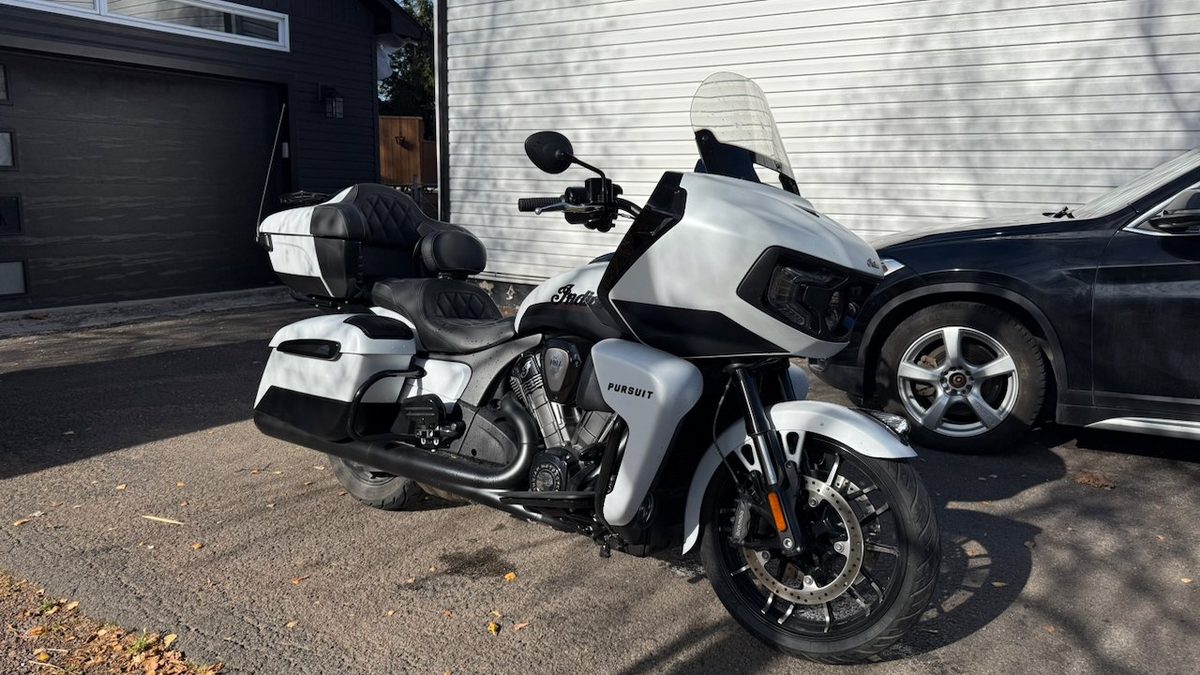

Every spec sheet lists the Pursuit's technology. None of them tells you how much of it you actually touch on a real ride, in real weather, with gloves on. I have lived with a 2024 Pursuit Dark Horse Icon for a season, so this is the honest accounting: three systems earn the package, a short list quietly stopped earning anything, and the rest is a learning curve that flattens out.
The Short Answer: Three Systems Earn It, and They Are Not the Flashy Ones
If I could keep three features and lose the rest, they would be the standalone GPS, the heated grips with the ClimaCommand seat, and the tyre pressure monitoring. None of them is exciting and all three would be missed within a week.
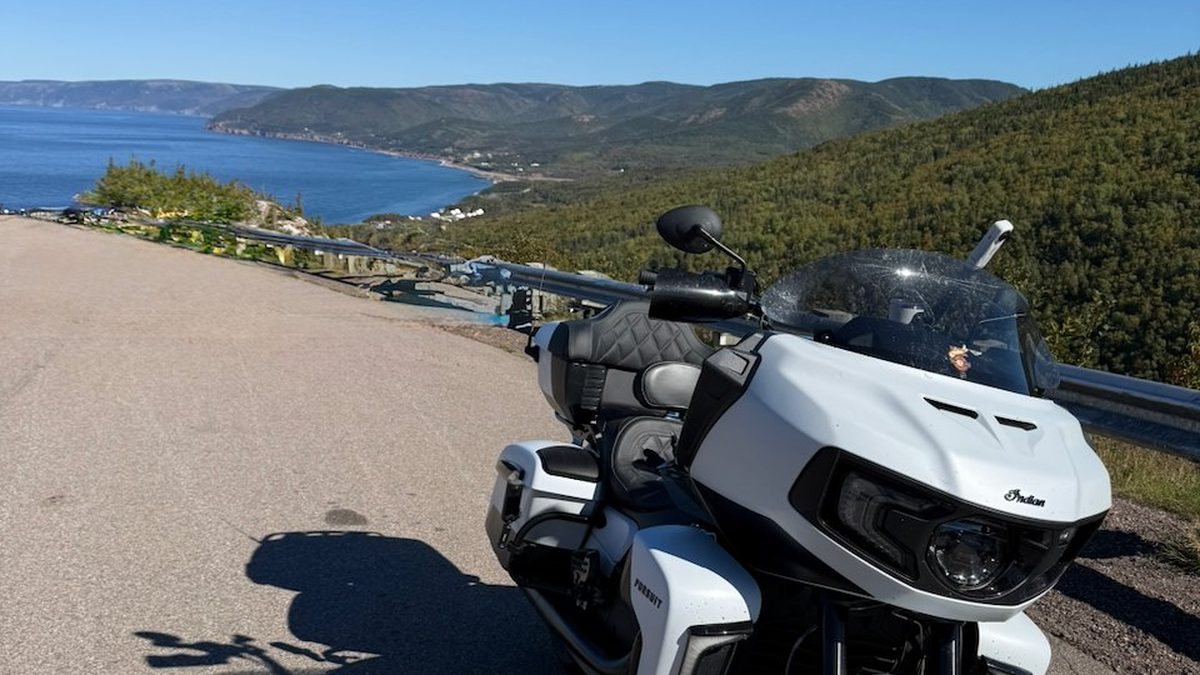
The GPS matters because it navigates without a cell signal, and rural New Brunswick and the Cape Breton interior both have long stretches where a phone gives up. The heated grips and seat turn an Atlantic Canada shoulder-season ride into an ordinary day. Tyre pressure is the cheapest safety on the bike: it tells you about a slow leak before a loaded tourer does, at speed, in the wrong place.
What stopped earning its place is a much shorter list than the internet suggests. I did not switch systems off in disgust. One update hid a control I used, a few screen functions lock out once you are rolling, and the rest of the package is fine. The complication is real, but it lives in the first few hundred kilometres while the switches become muscle memory, not in year two. The package also costs money and weight, and on a loaded bike that weight is real, so the honest question is not whether the tech is impressive but whether the three systems that earn it matter to the riding you actually do.
What the Tech on a Pursuit Actually Is
Judging the surface area means defining it, because a subscription service and a system that intervenes in milliseconds are not the same kind of thing even when they share a screen.
| Group | What it includes | How it reaches you |
|---|---|---|
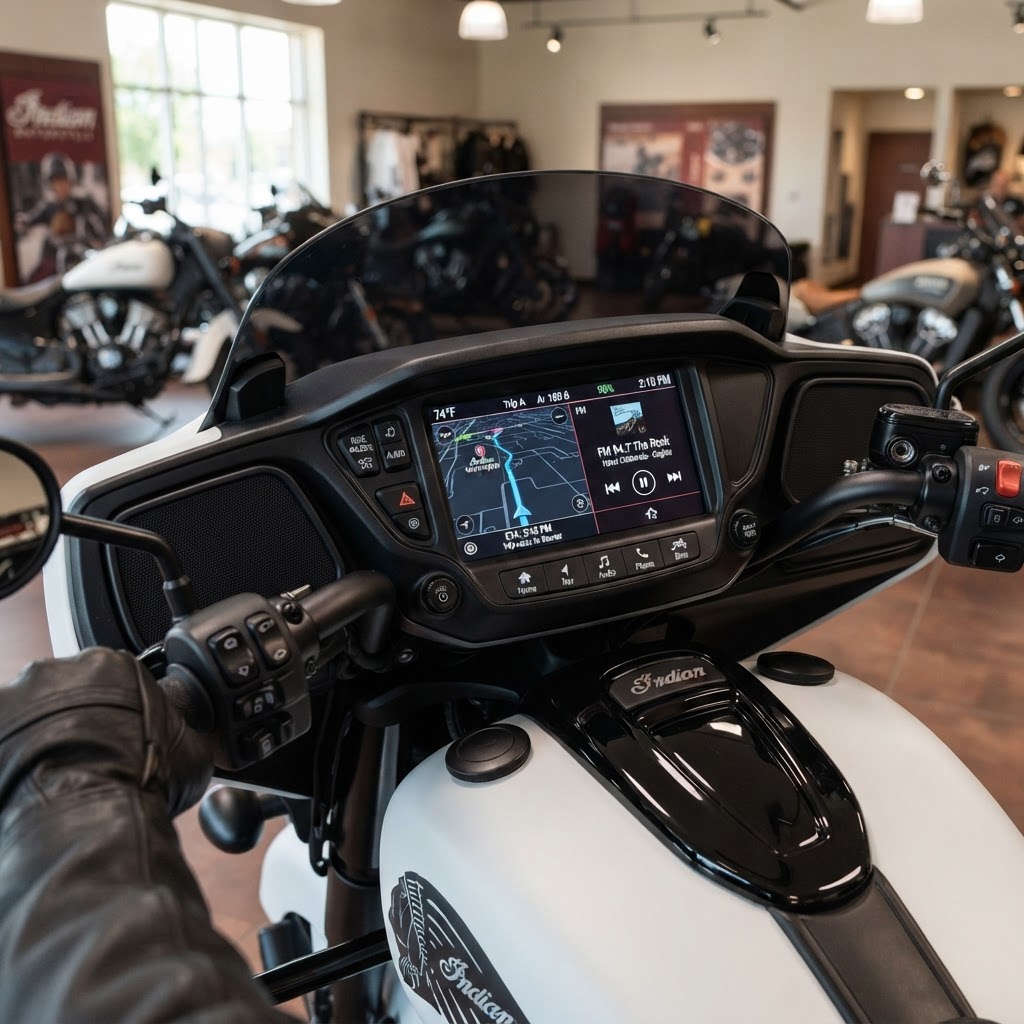
| What you look at | 178 mm (7 in) RIDE COMMAND screen, turn-by-turn GPS, bike health, customisable gauge screens, Apple CarPlay | Touchscreen and the left bar controls |
| What you touch | Keyless ignition, cruise control, three ride modes, heated grips, ClimaCommand heated and cooled seat, electronically adjustable rear preload, remote-locking saddlebags over 140 litres | Bar switches, seat buttons, screen |
| What happens on its own | Cornering ABS and lean-sensitive traction control, tyre pressure monitoring | No input from you |
| What you pay for separately | RIDE COMMAND+ remote status, live tracking and theft alerts | Annual subscription after an included period |
The fourth group is the one buyers miss. RIDE COMMAND+ is a separate layer for remote vehicle status, live tracking and theft alerts, sold as an annual subscription after an included period, and it is the only part of the package that can quietly expire on you. The rest of the technology is on the bike permanently.
Two details worth settling before you shop. Apple CarPlay is factory-supported and wired, so the phone charges while it runs; Android Auto is not offered on this bike and Indian has published no date for it, so buy what is on the bike today. And the phone integration does not replace the bike's own data, which is the division of labour the whole system depends on.
What I Use Every Single Ride
The test of a feature is whether your hand goes to it without a decision. After a season, this is the short list.
Standalone navigation. If the screen lost everything else tomorrow, this is the function I would fight to keep. It knows the next turn without asking a network, and that is a different category of tool from a phone that has cached half a route.
CarPlay, usually Waze. Most highway days it runs the traffic and police reporting the factory system does not give you, while speed, fuel, tyre pressure and engine data stay on the Ride Command side of the screen. That split is why the setup works. CarPlay is wired on this bike, so the phone charges while it works and the screen shows the phone's world, not the bike's. What it will not do is replace speed, fuel, tyre pressure or bike health, and it is not supposed to. I still run an intercom as well, because navigation prompts belong in my helmet where a glance costs nothing.
Heated grips and the ClimaCommand seat. Used constantly from October to May, and the reason a cold morning is a normal ride rather than a short one.
Tyre pressure readout. Checked at every stop, and it has caught a slow leak early.
Electronic rear preload. Sounds like a gimmick until you are loaded for a trip and can adjust it from the screen instead of hunting for a spanner in a campsite.
What I Stopped Reaching For, and the Fixes That Worked
The heated grip icon, after an update. A Ride Command update made the grip icon vanish from my screen. The grips still worked and the bike still knew they existed; the control had simply stopped being visible where I expected it. The fix takes ten seconds: start the engine and press the physical switch under the left fairing cubby, and the icon returns and stays. The lasting effect is a habit, not a grudge: I use the physical switch first, every time, and treat the screen as the second path. Learn where the switches are before you need them.
Screen controls that lock out while moving. Some functions are locked once the bike is rolling. It is annoying in a parking lot and correct at 100 km/h, and it forces the right habit: set the route and the settings before you pull away.
The assumption that the screen replaces everything. My head unit has rebooted a handful of times in a season, Bluetooth has dropped and reconnected, and route recalculation after a wrong turn is slower than a phone. Route recalculation after a wrong turn takes a few seconds longer than a phone, Bluetooth drops and reconnects on its own, and the head unit has restarted mid-ride without losing the route. None of it is a dealbreaker and all of it is why a phone stays on the bars as redundancy. The mount survived the purchase for exactly that reason.
The Glance Problem at 110 km/h
At 110 km/h you cover about 30 metres a second. Two seconds looking down is 61 metres of road you never saw, and that is the number that decides how you should use this screen.
This part is research, not my own testing. NHTSA's visual-manual guidance for in-vehicle interfaces holds that a single glance away from the road should not exceed two seconds and a whole task should not exceed about twelve seconds of eyes-off-road time. The 100-Car naturalistic driving study found glances of two seconds or more roughly doubled crash and near-crash risk, and a study of young drivers put the odds ratio for a single longest glance over two seconds at about 3.8. Those figures come from cars, and a rider has less margin, not more.
So the useful question is not whether the screen distracts you. It is whether a function can be reached without a glance, and if it cannot, whether it can wait until you stop. A gauge check is a glance. A destination search is a task, and it happens parked.
What to Check Before You Buy, and Who Should Skip It
A tech-heavy tourer is easy to demonstrate and hard to assess on a fifteen-minute test ride. Everything in the table can be checked in a showroom or a driveway without tools.
| Check | How to test it | What a fail means |
|---|---|---|
| Software version and last update | Read the version in settings, ask when it last updated | Two identical used bikes can run software a year apart; older versions carry the interface quirks later updates fixed |
| Heated grips respond | Start the engine, press the physical switch under the left fairing cubby, feel the bars | A dead grip or a missing icon means a cold season and a parts bill |
| Tyre pressure sensors read | Check all readings against a gauge before you ride | Dead sensors are a known used-bike cost |
| Screen and controls at a standstill, then rolling | Set a destination parked, then check which functions lock out once moving | Buttons that never respond are a fault, not a feature |
| Subscription status | Ask whether RIDE COMMAND+ is active and when the included period ends | An expiring subscription is a cost the price does not show |
Two things the table cannot show. Ask what the sensors and the head unit cost out of warranty, because a used bike past its coverage turns a dead tyre sensor into a real bill, and ask whether the bike has sat for long periods, since a weak battery and stale software tend to arrive together. Then ride it at highway speed, not around the block: the screen, the grips and the seat are all things you only judge at 100 km/h in cold air.
Who should skip it: the rider who wants gauges, levers and nothing else. That is a legitimate preference, not nostalgia, and on this bike it turns the first season into learning a control layout you never wanted. Choosing simpler costs you three things that genuinely matter here, though: navigation that works without a cell signal, tyre pressure monitoring that catches a slow leak early, and cornering ABS with lean-sensitive traction control.
Verdict: Worth It, Worth Learning, or Marketing
Worth it: standalone GPS, tyre pressure monitoring and the background safety systems. Two of the three work whether you look at them or not, and the navigation is the whole argument in Atlantic Canada.
Worth learning: CarPlay, the heated grip and seat controls, ride modes and the physical switch locations. None of it is hard and all of it is faster once it is muscle memory, which is what turns a distracting screen into a dashboard.
Marketing: the parts of the interface you will touch twice a year. That is a short list, and it is not a reason to avoid the bike. Buy the tech for the three systems that earn it, budget a deliberate first week to learn the rest, and the Pursuit stops feeling like a computer with a motorcycle attached.
Frequently Asked Questions
Is the Indian Pursuit too much tech for a normal rider?
No, once it is learned. The complication lives in the first few hundred kilometres while the switches become habits, and after that the short list that still annoys you is manageable.
What does RIDE COMMAND+ add, and what does it cost?
Remote vehicle status, live tracking and theft alerts, on an annual subscription after an included period. Confirm the current free period and price with a dealer rather than a forum, because Indian has not been consistent about it.
Do the heated grips still work if the icon disappears?
Yes. Start the engine and press the physical switch under the left fairing cubby and the icon comes back and stays back.
What is the first thing to check on a used one?
The software version and when it last updated. Two identical bikes can be running software a year apart, and the older version is where the interface quirks live.
Sources
- Indian Motorcycle media, 2026 Pursuit Dark Horse press page. 178 mm RIDE COMMAND screen, CarPlay, ride modes, cylinder deactivation, keyless, TPMS, ClimaCommand seat, heated grips, electronic preload, Smart Lean Technology, Rider Assist bundle, PowerPlus 112 at 122 hp / 181.4 Nm (EMEA rating).
- Indian Motorcycle Canada, Pursuit model page. Canadian pricing as listed November 2026: $40,499 MSRP plus $875 freight and $600 dealer set-up. The page returns 403 to automated fetches, so the figures are quoted as listed and should be confirmed in a browser.
- NHTSA visual-manual driver distraction guidelines, Federal Register 78 FR 24818. Benchmark used in this article: no single glance longer than 2 seconds, no more than 12 seconds total eyes-off-road per task.
- Simons-Morton et al., Journal of Adolescent Health 2014 (PMC3999409). Single longest glance over 2 seconds associated with an odds ratio of 3.8 for crash or near-crash in a novice-driver sample; the 100-Car study doubled risk at 2 seconds or more.
- Greg Toope Rides, My Indian Pursuit Has Too Much Tech, Or Does It?. Published 15 November 2026. Description and chapters used as the first-hand source for the attention and learning-curve argument.
- Ride Command review, gregtoope.com. Owner notes on standalone GPS, CarPlay, TPMS, glove-friendly touch, OTA updates, Bluetooth dropouts, slow recalculation, reboots, no Android Auto, locked screen controls while moving, inconsistent fuel gauge.
- Heated grips icon fix, gregtoope.com. The icon vanishing after a Ride Command update on a 2024 Pursuit Dark Horse Icon, and the physical-switch fix under the left fairing cubby.
- Indian Pursuit 10,000 km ownership report, gregtoope.com. Measured figures: 5.8 L/100km touring average, 6.5 L/100km ridden hard, 22.7 L tank, roughly 390 km real range, 425 kg running order, $36,500 CAD used purchase.
- Indian Motorcycle self-help KA-02223 (factory warranty). Two-year factory warranty with unlimited miles, quoted as manufacturer self-help guidance; the Canadian booklet wording should be confirmed at purchase. The page blocks automated fetches, so this was confirmed through dealer mirrors.