Indian Pursuit Maintenance Schedule: What Owners Should Track
The expensive part of motorcycle maintenance is often not the scheduled service. It is the small problem that was visible weeks earlier and ignored. On a large touring motorcycle like the Indian Pursuit, tires, brakes, belt condition, battery health, and fluid levels all carry more consequence because the bike is designed to cover distance with luggage and sometimes a passenger. This guide turns those responsibilities into a simple owner checklist while leaving official intervals where they belong: in the current Indian Motorcycle owner's manual.
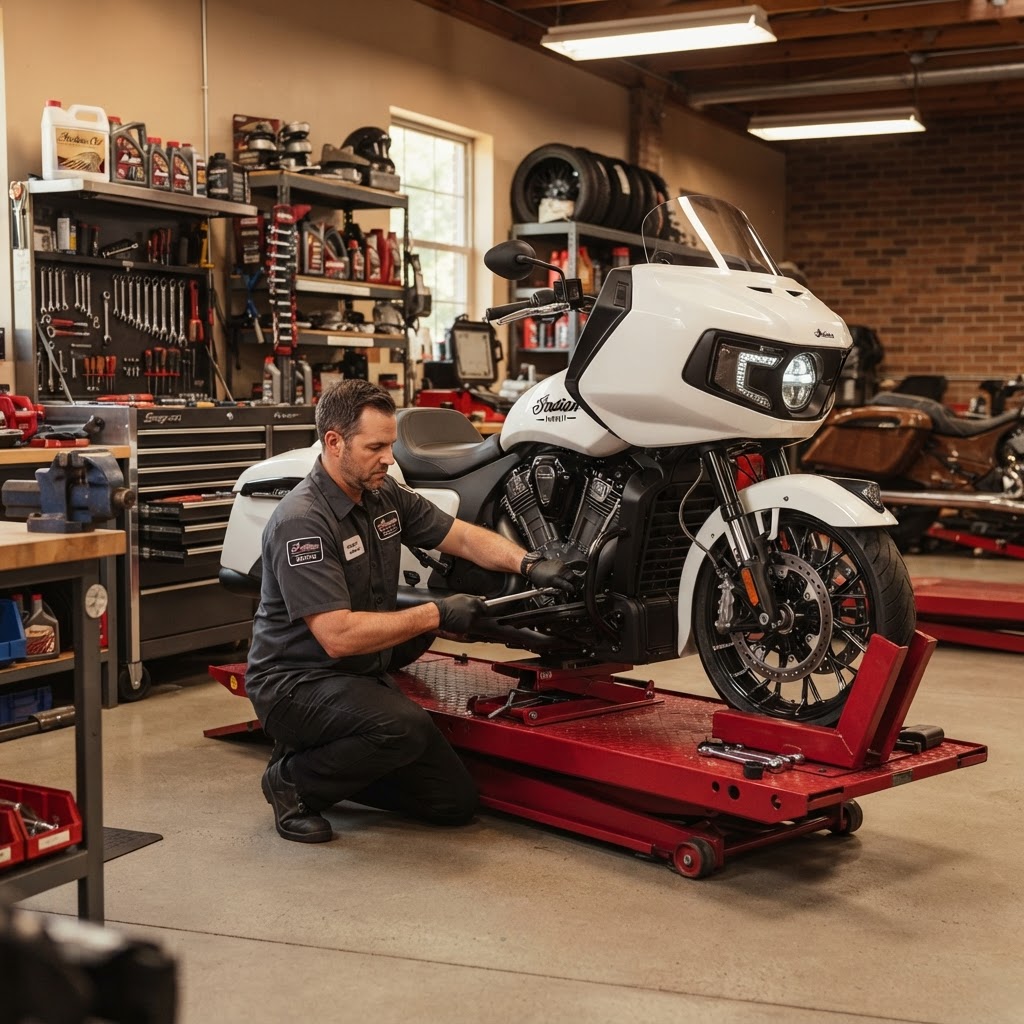
Image: Property of Indian Motorcycle.
Table of Contents
Official Schedule vs Owner Checks
The official Indian Motorcycle maintenance schedule is the authority on when dealer-performed services are due. This guide does not replace it. What it does is help you, the owner, understand what to watch between those services — the items that prevent a $50 problem from becoming a $500 one.
| Mileage (km) | Miles | Service |
|---|---|---|
| 800 km | 500 mi | Break-in service (dealer) |
| 8,000 km | 5,000 mi | Oil & filter change, full inspection |
| 16,000 km | 10,000 mi | Major service, belt inspection, valves |
| 24,000 km | 15,000 mi | Oil change, full inspection |
| 32,000 km | 20,000 mi | Major service, spark plugs, coolant |
My 2024 Indian Pursuit Dark Horse crossed 10,000 km this season, which means the 16,000 km (10,000 mi) major service is the next dealer visit. Between now and then, the items below are what I track myself.
Pre-Ride and Monthly Checks
The pre-ride check takes 90 seconds and catches most problems before they become ride-ending. Before every ride, I walk around the bike and check:
Every ride:
Tire pressure and visual condition. The Pursuit runs 36 psi (248 kPa) front, 41 psi (283 kPa) rear per the Indian Motorcycle owner's manual. A touring bike loaded with luggage and gear loses pressure differently than a light cruiser, so I check cold before loading up. A soft front tire on a 400 kg motorcycle at highway speed is not a risk worth taking.
Drive belt visual check — look for stones, cracking, or debris wedged in the teeth. A quick glance takes five seconds.
Brake lever and pedal feel — squeeze the front lever and press the rear pedal before rolling. Spongy or low resistance means air or low fluid.
Lights — headlight (high and low beam), brake light (front and rear lever), turn signals, and license plate light.
Oil level — check the sight glass with the bike level and upright. The PowerPlus 108 holds approximately 5 quarts (4.7 L) of oil. If the level is at the lower mark, top up before riding.
Monthly:
Tire tread depth — measure or use the wear indicators. Touring tires on a heavy bike wear faster in the center from highway use.
Coolant level — check the reservoir when cold. The PowerPlus is liquid-cooled, so low coolant is a ride-ending risk.
Drive belt tension — the belt should deflect within spec at a known force. I check alignment by rolling the bike backward and watching the belt track on the rear pulley.
Fasteners — give the engine guards, luggage racks, and mirror mounts a quick torque check. Vibration loosens things you would not expect.
Oil and Coolant
Indian Motorcycle recommends oil and filter changes every 8,000 km (5,000 mi) or six months, whichever comes first. For a touring rider in Atlantic Canada who puts on 8,000-10,000 km per season, that means one oil change at the start of the season and one at the end, or at the 8,000 km mark if you reach it mid-season.
The Pursuit's Ride Command display includes an oil life indicator that counts down from the last reset. It is a useful reminder, but it is not a substitute for checking the sight glass. If the bike sits for months during winter storage, condensation can affect oil quality even if the mileage has not changed.
Coolant should be checked at the reservoir monthly when the engine is cold. The PowerPlus 108 uses a closed cooling system, and low coolant will trigger a warning on the Ride Command display — but catching it before that warning is better. I check coolant before any multi-day tour.
Drive Belt Inspection
The rear drive belt is one of the Pursuit's lowest-maintenance components, but it is also one you cannot afford to ignore. Inspect it at every oil change interval — every 8,000 km (5,000 mi), or more often if you ride rough roads or gravel.
What to look for:
Cracking on the belt's outer surface or between teeth. Hairline cracks on the sides are age-related; cracks on the tooth faces are load-related.
Broken or missing teeth. Even one missing tooth means the belt needs replacement. Do not wait.
Stone damage. Small stones can wedge between the belt and pulley. If you hear a clicking or tapping noise that changes with speed, stop and inspect.
Tension and alignment. The belt should track centered on the rear pulley. If it is drifting to one edge, the wheel alignment needs adjustment. Belt deflection should be within the specification in your owner's manual when measured at a known force.
I have not had a belt issue at 10,000 km, but I check it before every multi-day tour. The cost of a roadside belt failure on a touring trip is not just the tow — it is the lost day, the missed ferry reservation, and the rebooked accommodation.
Tires on a Loaded Touring Bike
A touring motorcycle loaded with luggage, camping gear, and a full tank behaves differently than the same bike ridden solo and empty. Tire wear patterns, pressure loss rates, and heat buildup all change with load.
On my Pursuit, I run the factory-spec 36 psi front / 41 psi rear for solo riding. When loaded for a multi-day tour with luggage, I check pressure more frequently — every morning before riding. A rear tire at 38 psi when it should be 41 will run hotter and wear faster under load, and on a bike this heavy, the contact patch change is noticeable in corners.
Touring tire life on the Pursuit depends on riding style and roads. Highway miles wear the center faster; twisty backroads wear the edges. I watch for cupping on the front tire — a scalloped pattern that appears when the tire is under-inflated or when braking is aggressive. Cupping creates a buzzing sensation through the bars and shortens tire life.
Brake Wear
The Pursuit has dual front discs and a single rear disc. Brake pad life on a heavy touring motorcycle is shorter than on a lighter bike because the brakes work harder to slow 400 kg of motorcycle, rider, and luggage.
Check pad thickness at every oil change. If the friction material is thinner than 2 mm, replace the pads. Do not wait until they are metal-on-metal.
Brake fluid should be checked at the reservoirs monthly. The fluid level drops as pads wear, which is normal. But if the fluid is dark brown or black, it has absorbed moisture and needs replacing — typically every two years regardless of mileage. In Atlantic Canada's humid climate, moisture absorption is faster than in dry climates.
Battery and Electrical System
The Pursuit's electrical system powers the Ride Command display, 600W audio system, heated grips, and charging ports. That is a significant load on the battery, especially on short rides where the alternator may not fully recharge what was used to start the bike.
I keep a battery tender connected during storage and any period the bike sits for more than a week. A healthy battery should read 12.6V or higher at rest. Below 12.4V, it is time to charge. Below 12.0V, the battery may not start the bike reliably.
If the bike cranks slowly or the Ride Command display flickers during startup, the battery is telling you something. Do not ignore it — a failed battery on tour means a bump start that may not work, or a tow from a location without cell service.
Seasonal Storage
In Atlantic Canada, the riding season runs roughly May through October. The Pursuit sits for five to six months over winter, which is harder on a motorcycle than riding it.
My winter storage checklist:
Oil change before storage. Used oil contains acids from combustion. Leaving it in the engine for five months means those acids sit against bearings and cylinder walls. Change the oil before parking, not after.
Stabilizer in a full tank. A full tank prevents condensation. Add fuel stabilizer, run the engine for a few minutes to circulate it, then top up again.
Battery on a tender. Remove the battery or connect a maintainer. I use a tender that cycles rather than a constant float.
Tire pressure to spec. Inflate to the recommended pressure before storage. Consider putting the bike on a lift to prevent flat spots on the tires over five months.
Cover and rodent protection. A breathable cover keeps dust off. Check for mouse nests in the air box and exhaust when you uncover in spring — it happens more often than you think.
After one Atlantic Canada winter with the Pursuit on a battery tender and fuel stabilizer in the tank, the bike started on the first crank in May. The spring checklist took about 20 minutes: check tire pressure, top up coolant, inspect the belt, verify brake feel, and test all lights. That 20-minute investment is what lets me ride with confidence on the first warm day.
Touring Inspection Checklist
Before any multi-day tour — whether it is a 500 km weekend or a 4,000 km cross-country ride — I run through a specific checklist that goes beyond the daily pre-ride:
48 hours before departure:
Tire pressure and tread depth. Replace if close to the wear bars.
Oil level — top up if needed. Schedule an oil change if you are near the 8,000 km mark.
Coolant level and condition.
Brake pad thickness and fluid level.
Drive belt visual inspection — shine a light on every tooth.
Chain/belt tension per manual spec.
Battery voltage — should read 12.6V or higher.
All lights functional.
Luggage racks and guards torqued.
Morning of departure:
Tire pressure cold (before loading luggage).
Oil sight glass level.
Quick walk-around for leaks, loose fasteners, or anything that changed overnight.
Phone mounted and charged, GPS route loaded, offline maps downloaded.
Service-Record Template and FAQ
Keep a simple log. I use a notes app on my phone with the date, mileage, and what was done. It takes 30 seconds after each service and creates a record that adds value when selling the bike. Here is the format I use:
Date | Mileage (km) | Service performed | Parts used | Cost | Notes
Example: May 12, 2026 | 8,200 km | Oil & filter change | Indian filter, 5W-40 full synthetic | $CDN | Done by dealer, oil life reset