
Photo: Property of Insta360
Most wireless mic reviews treat a microphone kit as one thing that captures one sound. On a motorcycle that framing falls apart in the first kilometre, because the useful question is not how the mic sounds, it is how many independent recordings you come home with. The Insta360 Mic Pro answers that differently from a plain lav system, and the difference is what makes it usable in wind.
Why the Track Count Is the Whole Point
A wireless kit normally hands the camera one audio stream. Whatever the capsule heard is what you get, mixed with whatever noise the mount picked up, and if that stream clipped or a car passed at the wrong moment, that take is gone. Nothing in post repairs it, because the information was never recorded.
The Mic Pro records twice. The transmitter captures its own file into built in storage, and the paired camera records its own audio as usual. When a Mic Pro transmitter is paired directly to an Insta360 camera, that camera records the mic audio and its own audio on separate tracks rather than folding them together. You finish the ride with two versions of the sound instead of one, and you choose between them in the edit.
That is the feature that matters on a bike. Not the number of microphones, not the display, but the fact that a gust of wind or a loud exhaust does not automatically ruin the audio for the whole clip.
What Each Part Records, and Onto Which Track
The hardware specification page for the Mic Pro is unusually specific about this, and the details decide how you set the system up. Insta360 states that 32-bit float applies to the transmitter's internal recordings, which is the important qualifier: the internal file is the high dynamic range copy, and the wireless stream to the camera is a separate thing with its own format.
| Part | Battery | Rated runtime | What it does for audio |
|---|---|---|---|
| Mic Pro transmitter | 240 mAh | about 10 h | records 32-bit float internally to 32 GB of onboard storage |
| Mic Pro receiver | 410 mAh | about 11 h | manages the link, feeds the camera over 3.5 mm or USB-C |
| Charging case | 2,815 mAh | about 30 h system | refills both from its own battery between rides |
Two things in that table are worth reading twice. The first is the runtime condition: Insta360 measured the ten hour figure with noise reduction and internal recording both switched off. Those are precisely the two features a rider turns on, so ten hours is an upper bound rather than a promise. The second is the storage figure. Insta360's own numbers put the transmitter's internal recording at roughly 44.8 hours in 32-bit mono from that 32 GB, or about 60 hours in 24-bit mono, which means you will never fill it in a riding season of short clips.
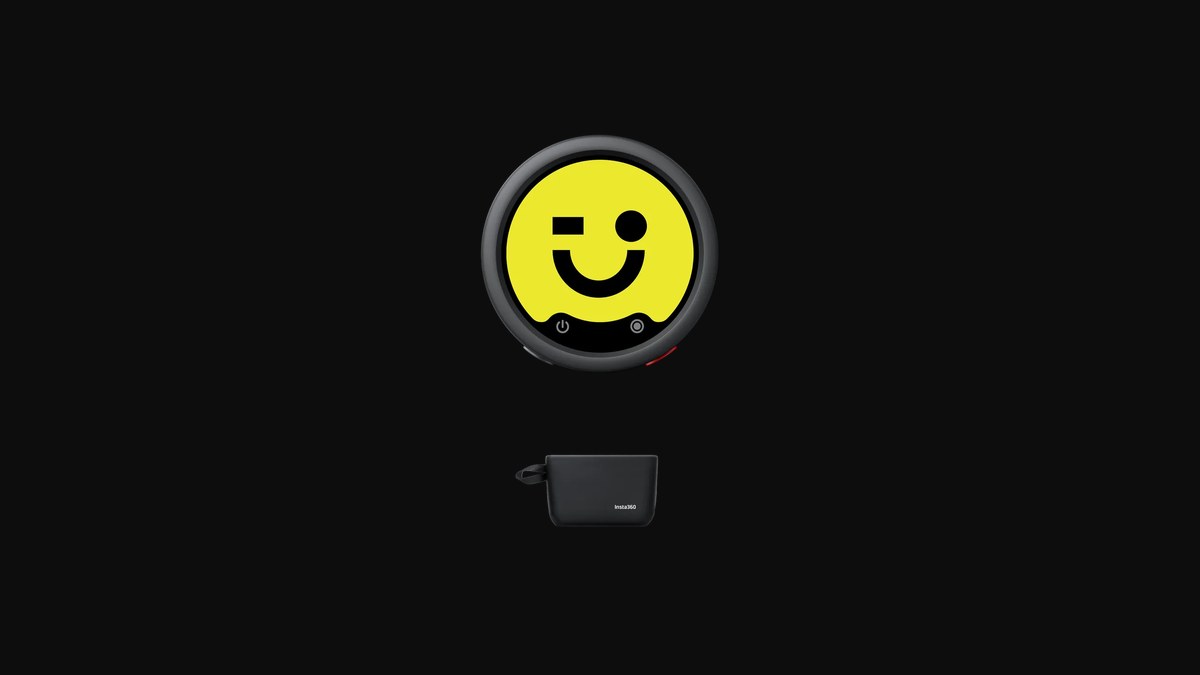
The transmitter also carries a 6 colour E ink display, which is a quiet advantage on a bike: it is readable in direct sun and it does not light up your jacket at dusk the way an OLED would. It weighs about 19.4 g with the dummy card and measures 38 mm across by 12.2 mm high, so clipping it inside a jacket collar is realistic rather than optimistic.
Safety Track Mode and the Wind Problem
The channel modes are where a rider should actually spend attention. The Mic Pro offers Stereo, Mono, Quadraphonic and Safety Track. Safety Track is the one built for the problem wind creates: it records a second copy of the audio at a lower level alongside the main one, so if the loud take is unusable you have a quieter version that is not clipped.
This pairs with 32-bit float in a way that is genuinely useful and is often described badly. A 32-bit float file carries enough dynamic range that a badly loud moment can be pulled back down in post without the distortion a 24-bit file would have baked in. A Safety Track gives you a second, deliberately lower recording. Used together on a motorcycle they cover the two ways audio fails on a ride: a wind gust that overwhelms the capsule, and a source that is simply too loud for the level you set at a standstill.
The 130 dB SPL maximum is the other half of that story. An exhaust at full throttle under load, close to the mic, is within reach of that ceiling. No microphone fixes that. What you can do is give yourself a second copy recorded lower, which is the practical version of the same idea.
Noise reduction deserves a warning, because it is the setting riders enable and forget. It works by processing the signal, and on a bike it will be working constantly. It is also part of the reason the rated runtime is an upper bound. My read is to run it where the mic is exposed and turn it off where the mic is sheltered inside a helmet, and to keep the internal recording running so the unprocessed copy exists either way.
Mounting, Range and What Kills the Signal
The published range figures are large enough that they are not the constraint on a motorcycle. The transmitter reaches the receiver at about 400 m, or 1,312 ft, in open and unobstructed conditions, and reaches an X5 camera directly at about 100 m, or 328 ft. A rider and their own bike are never that far apart.
What shortens that range in practice is the same thing that shortens every 2.4 GHz link on a bike: a body between the transmitter and the receiver, and metal. The specification lists the link as 2.4 GHz with EIRP no more than 20 dBm and Bluetooth 5.4, and that band does not pass through a rider's torso or a fairing happily. Mount the receiver on the same side of the bike as the transmitter, and put the transmitter where the body is not between it and the camera.
| Decision | Setting that works on a bike | Why |
|---|---|---|
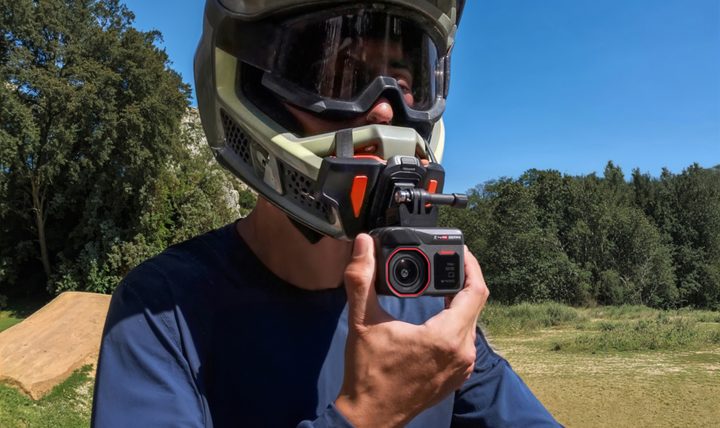
| Where the mic goes | inside the helmet, or collar with muff | shelter removes most buffeting before it reaches the capsule |
| Pickup pattern | cardioid or super directional | rejects sound from behind and from the exhaust side |
| Receiver placement | same side as the transmitter | a torso between them is the main cause of dropouts |
| Channel mode | Safety Track when the mic is exposed | a second, lower copy survives a loud moment |
Cold, Water and the Honest Limits
Here is the part the product page does not lead with, and it matters in Canada from October onward. The Mic Pro's operating temperature range is 14°F to 113°F, which is minus 10°C to 45°C, and the charging range is narrower at 0°C to 45°C. Charging a cold pack is what actually damages lithium cells, so a transmitter that spent an hour on a handlebar in freezing air should come inside and warm up before it goes on a charger.
The larger limitation is sealing. Insta360 lists the Mic Pro as not waterproof and not dustproof. There is no IP rating to plan around. That is a real constraint on a motorcycle, and it changes the plan rather than the product choice: the transmitter goes inside the helmet or under a jacket, not on the outside of a fairing where rain and road spray reach it, and the charging case stays in a dry bag.
That is worth stating plainly because the temptation with a kit this capable is to treat it as weatherproof. It is not, and a dead transmitter from one wet ride costs more than every audio improvement on this page.
A Ride Setup That Holds Up
The configuration I would ride with, built from the published figures rather than guesswork, looks like this. Internal recording on, so the 32-bit float copy exists for every take. Safety Track on when the mic is outside the helmet. Noise reduction on only where the mic is exposed to moving air. Receiver cabled to the camera and mounted on the same side of the bike as the transmitter. Both batteries charged the night before, allowing about 22 minutes to 80 percent for the transmitter and 24 minutes for the receiver on a 5V/3A supply, and the case topped up too, since it adds roughly 30 hours across the system.
The honest summary is that the Mic Pro is not the cheapest way to get a voice onto a motorcycle video, and it is not a set it and trust it device in the wet or the cold. What it gives you is two independent recordings of the same moment and a 32-bit copy that tolerates a bad level. On a bike, that redundancy is the product.
Frequently Asked Questions
Does the Insta360 Mic Pro record two audio tracks at once?
Yes. The transmitter records its own 32-bit float file into 32 GB of onboard storage while the paired camera records audio as well, and when a Mic Pro transmitter is paired to an Insta360 camera the mic audio and the camera's own audio are kept on separate tracks. Safety Track mode adds a second, lower level copy of the main recording.
How long does the Mic Pro battery last on a motorcycle ride?
Insta360 rates the transmitter at about 10 hours and the receiver at about 11 hours, with the charging case extending the system to roughly 30 hours. Those ratings assume noise reduction and internal recording are both off, so plan on less in real use, and put the transmitter on a charger at lunch if you are running both.
Can the Mic Pro be used in the rain?
No. Insta360 lists the Mic Pro as not waterproof and not dustproof, with no IP rating. Keep the transmitter inside the helmet or under a jacket and the charging case in a dry bag rather than treating the kit as weatherproof.
What is the operating temperature range of the Mic Pro?
The transmitter, receiver and charging case are all rated from 14 degrees Fahrenheit to 113 degrees Fahrenheit, which is minus 10 to 45 degrees Celsius. Charging has a narrower range of 0 to 45 degrees Celsius, so let a cold unit warm to room temperature before charging it.
Does the Mic Pro work directly with an Insta360 camera without the receiver?
Yes. A Mic Pro transmitter reaches an X5 camera directly at about 100 metres, or 328 feet, against about 400 metres to the receiver. Using the receiver still gives you the screen and the 3.5mm output for a camera that is not an Insta360 body.
Sources
- Insta360 Mic Pro hardware specifications. Transmitter 240 mAh, receiver 410 mAh, charging case 2,815 mAh; about 10 hours transmitter and 11 hours receiver with noise reduction and internal recording disabled; about 22 minutes to 80 percent and 60 minutes to 100 percent on a 5V/3A charger; operating range 14 to 113 degrees Fahrenheit (minus 10 to 45 Celsius); not waterproof, not dustproof; 130 dB SPL; 48 kHz; 32-bit float or 24-bit, with 32-bit float limited to transmitter internal recording; Stereo, Mono, Quadraphonic and Safety Track channel modes; about 400 m to receiver and about 100 m to an X5 camera; Bluetooth 5.4, 2.4 GHz, EIRP no more than 20 dBm.
- Insta360 Mic Pro store listing. 32 GB onboard memory, 32-bit float internal recording, 48 kHz, 130 dB maximum SPL.
- Insta360 Mic Pro launch announcement. 32 GB built-in storage with stereo internal recording and safety track options.