
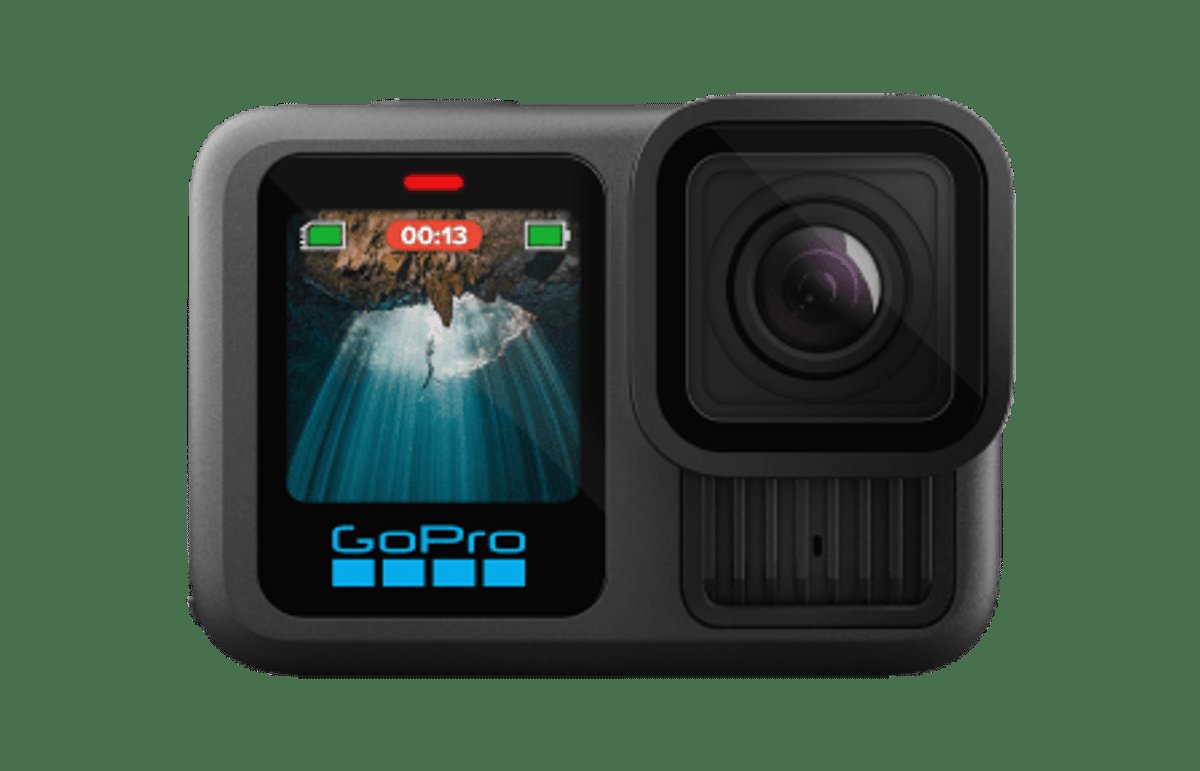
Photo: Property of GoPro
A GoPro that dies at 80% on a two-degree morning is not broken. It is cold, and the fix is a plan rather than a new camera.
What Cold Actually Does to the Battery
Cold does not break a lithium-ion battery. It slows the chemistry, which raises internal resistance, which makes the pack harder to deliver current. The camera reads that as a low battery and shuts down early. Nothing in the pack is damaged, and warming it back up restores almost all of the capacity.
That distinction matters because it explains the two symptoms riders see. The first is a runtime that collapses when the mercury drops. The second is a camera that reports 80% and then dies in one shot at 4K. Neither is a fault. Both are temperature.
GoPro's own Enduro battery for the HERO13 Black is rated to operate in temperatures as low as 14°F (−10°C). That is the number to plan around, and it is roughly the range where a Canadian November ride stops being a maybe and starts being a hard limit on the camera.
The Enduro Numbers, and How Far They Fall
The HERO13 Black ships with a 1,900 mAh Enduro pack, which GoPro says carries 10% more capacity than the previous generation. On paper the published runtimes are generous: more than 2.5 hours of continuous recording at 1080p30, and over 1.5 hours at 4K30 and 5.3K30.
| Setting | Enduro, warm | Plan for in the cold |
|---|---|---|
| 1080p30 | 2.5 hours (150 min) | about 75 to 90 min |
| 4K30 | 1.5 hours (90 min) | about 45 to 55 min |
| 5.3K30 | 1.5 hours (90 min) | about 40 to 50 min |
| 5.3K60 | below the 5.3K30 figure | about 30 to 40 min |
The right-hand column is not a GoPro specification. It is the planning figure: assume roughly half of the warm number once you are below 5°C, and assume the last 20% of the bar is not worth trusting. If you need a hard number to plan a ride around, use the 5.3K60 figure and carry twice the batteries you think you need.
The Settings That Buy You Runtime
Most of the cold-weather gain is settings, not hardware, and every one of these is a knob the camera already has.
- Drop the resolution for helmet footage. 5.3K60 is the reason the pack empties. 4K30 is still above 1080p and roughly doubles the runtime in the cold.
- Turn off rear screen preview when the camera is on a helmet or bar mount. The screen is a heat source in warm weather and a drain in cold, and you are not looking at it while riding.
- Use the HB-Series macro, ultra-wide or ND filter lenses only where the shot needs them. Filters cost nothing in power, but the ND filter does cut light, and a darker image at the same shutter means the camera works harder in low light at dawn.
- Disable voice control if you are riding with wind noise. It wakes the camera on the wrong words and each wake is a power spike.
- Set auto power off to the shortest interval you can live with, 1 or 2 minutes, so a forgotten camera does not sit awake between stops.
- Keep the battery out of the cold until the moment you record, which for a motorcycle means a zipped inner pocket, not a tank bag.
Two of these settings, the resolution change and the screen off, are worth more than the entire second battery in most cold rides.
A Cold Ride Plan That Actually Works
Here is the shape that has held up for me when the temperature is between 0 and 5°C.
| Element | Number | Why |
|---|---|---|
| Batteries carried | 3 (1 in camera, 2 warm) | roughly 40 min each at 5.3K60 in the cold |
| Recording per battery | 2 clips, 8 to 12 minutes | short clips keep the pack from heat-soaking the case |
| Swap window | under 60 seconds | a cold battery on a cold bike loses capacity fast |
| Spare warm pocket | 2 batteries, inner jacket | body heat is a free charger |
| Total usable footage | about 2 hours | enough for a day of highlights, not a full ride |
The mistake is treating the camera as a recorder of the whole ride. In the cold it is a recorder of the moments you chose to film, which is a better edit anyway.
Condensation is the other half of the problem
A cold camera brought inside fogs on the lens and the sensor cover, and that moisture does more damage over a season than the temperature ever will. Leave the camera in its case, sealed, until it reaches room temperature. That is a two-hour wait, not a ten-minute one.
Is the Enduro Pack Worth Adding?
For a rider filming in Canada from October onward, yes, and the arithmetic is simple. The 1,900 mAh Enduro delivers over 1.5 hours at 5.3K30 in GoPro's published figures against roughly 50 to 60 minutes from the older standard pack in the same conditions. Two Enduro packs plus the one in the camera give you the working day.
What the spec sheet does not tell you is that the camera is not the weak link below freezing. The mount adhesive is. A sticky mount that held all summer will let go at 0°C on a fairing, and a camera that survives the cold and then bounces down the highway has solved the wrong problem.
Frequently Asked Questions
How long does a GoPro HERO13 Black last in cold weather?
The Enduro battery is rated for 2.5 hours at 1080p30 and over 1.5 hours at 5.3K30 at normal temperatures, and GoPro rates the pack to operate down to 14 degrees Fahrenheit (minus 10 Celsius). Below about 5 degrees Celsius, plan on roughly half those runtimes and carry spare batteries warm in an inner pocket.
Does cold weather damage the Enduro battery permanently?
No. Cold raises internal resistance, so the camera reads a low battery and shuts down early, but the capacity returns once the pack is warm again. Permanent damage comes from charging a frozen battery, so let it reach room temperature before you put it on the charger.
What settings should I change for cold weather filming?
Drop from 5.3K60 to 4K30 or 1080p30, turn off the rear screen preview, disable voice control when wind noise is present, and set auto power off to one or two minutes. Those four changes are worth more runtime than an extra battery in most cold rides.
Why does my GoPro fog up after a cold ride?
Moisture in the air inside the case condenses when the camera warms up. Leave the camera sealed in its case until it reaches room temperature, which takes about two hours, rather than opening it indoors where the fog forms on the lens and sensor cover.
Is the HERO13 Black still worth buying for winter filming?
It is the only current GoPro that takes the HB-Series lenses and it carries the 1,900 mAh Enduro pack, which is the cold-weather battery. If you already film in the cold, the battery and lens ecosystem matter more than a newer sensor.
Sources
- GoPro HERO13 Black product page. Enduro battery 1,900 mAh, 10% more capacity than the previous generation, over 2.5 hours at 1080p30 and over 1.5 hours at 4K30 and 5.3K30, 5.3K60 recording, HB-Series lens compatibility.
- Enduro battery for HERO13 Black (retailer listing). 1,900 mAh pack rated to operate in temperatures as low as 14 degrees Fahrenheit (minus 10 Celsius); not compatible with older GoPro models.
- GoPro Enduro battery runtime comparison. Enduro delivers roughly 1.5 hours at 5.3K30 at 25 degrees Celsius against about 50 to 60 minutes from the standard pack.