

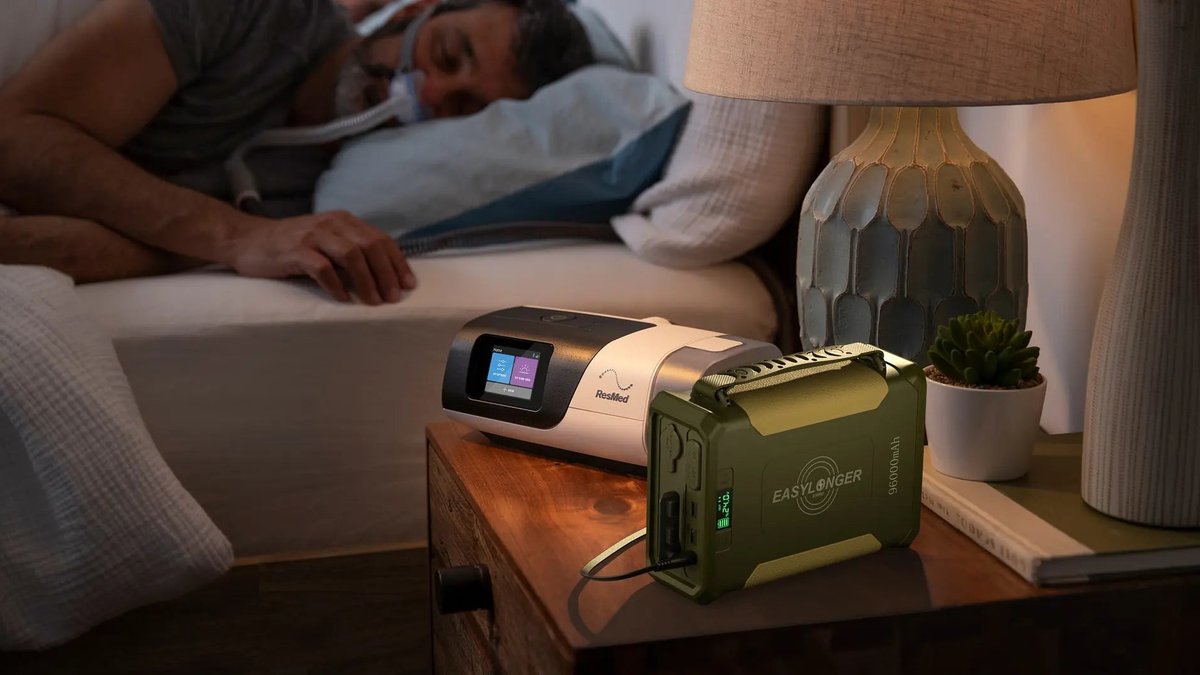
I spent a night breathing through my own Philips CPAP with the ES960 Pro beside the bed. The pack went in at 100 percent and came out at 79 percent, on 12V with humidification low. Then I put that 21 percent back with EASYLONGER's ESP110 panel, in strong sun, in under an hour. Those two numbers are the review.
EASYLONGER supplied the unit. Every measurement here is mine, and where I didn't test something I say so.
Does the ES960 Pro Actually Run a CPAP Overnight?
Yes. A full night cost about a fifth of the pack, and a 110W panel put that fifth back in under an hour of good sun.
| Test | Setup | Start | End | Result |
|---|---|---|---|---|
| Overnight CPAP run | Philips CPAP, 12V setup, humidification low | 100% | 79% | About 21% of the pack for one night |
| Solar recharge | ESP110 110W foldable panel, outdoors, strong sun | 79% | Full | The night's 21% replaced in under an hour |
At 21 percent a night the arithmetic points at four or five nights from full, but plan for three. The last morning of a trip isn't the place for an empty pack. The humidifier is the big variable, not the pressure, and I ran low humidification with no heated tubing, so a high-humidification setup with heated tubing will chew through more.
What the EASYLONGER ES960 Pro Is, and Who It Is For
It's a 297.6Wh lithium iron phosphate (LiFePO4) pack built for CPAP machines first: 3,000-plus rated cycles, 6.6 lb, and a chemistry that doesn't mind being stored full between trips, which is how a CPAP battery spends most of its life.
The ports are the reason to buy this version over the original. Voltage memory for 12V, 19V and 24V. A numeric percentage readout. 100W USB-C, 15W wireless charging, two 12V/15A car sockets, and UPS-style pass-through, so it can sit between the wall and the CPAP and take over when the grid drops. For a CPAP user a night without
It fits the CPAP user who drives to a campsite, trailer, RV or cabin with no outlet, and the household that wants a night of therapy through an outage.
ES960 Pro Specs, Verified
| Spec | ES960 Pro |
|---|---|
| Capacity | 297.6Wh |
| Chemistry and rated cycles | LiFePO4, 3,000+ |
| CPAP DC output | 12V / 19V / 24V with voltage memory |
| Display | Numeric percentage |
| USB-C | 100W |
| Wireless | 15W |
| Car sockets | 2 × 12V / 15A |
| Pass-through | UPS-style |
| Weight and size | 6.6 lb, 8.86 × 6.2 × 3 in |
Capacity sets how many nights you get; voltage memory decides whether setup is a two-second job or a button sequence by headlamp. What no table tells you is how hard your own machine pulls.
The Overnight Test: One Night on My Own CPAP
I connected my Philips CPAP on a 12V lead, set humidification low and went to sleep. The pack read 100 percent before and 79 percent after: 21 percent for a night of therapy. I report a percentage rather than a watt-hour conversion, because the conversion would be my arithmetic dressed up as a measurement.
The 12V path matters: inverting DC up to AC and back down wastes power as heat, and that waste comes straight out of the margin for a third night. Use the DC cable your machine supports.
I did not test high humidification, heated tubing, a higher pressure or a sub-zero night. Each would move the number.
Recharging Off Grid: The ESP110 in Real Sun
The ESP110 is a 110W foldable panel: 18V/6.1A, 23.4 percent cell efficiency, IP65, sold separately at $259.99 CAD. In strong direct sun it took the 21 percent the CPAP had used back to full in under an hour.
The weight is the trade: the panel is 13.6 lb against 6.6 lb for the pack, so bringing solar roughly triples the kit. In a car, trailer or RV that's close to free; on your back or strapped to a bike it is a load, and charging from the vehicle is usually the better answer.
An hour of sun refunds a night, so the limit becomes weather rather than capacity: three clear days cover a week away from an outlet. I've no figure for grey weather, so plan the sunny case and keep vehicle charging as the fallback.
ES960 Pro vs the Original ES960: Is the Upgrade Worth It
Same battery. Both are 297.6Wh LiFePO4 at 3,000-plus cycles, both 6.6 lb, both 8.86 × 6.2 × 3 in. Everything the Pro adds sits in the ports and the software, not in the tank.
| Spec | ES960 Pro | ES960 (original) | What the difference does for you |
|---|---|---|---|
| Capacity | 297.6Wh | 297.6Wh | Identical. Neither buys you a longer night. |
| DC output | 12V / 19V / 24V with memory | 12V / 16.5V / 20V / 24V, 84W max | The Pro remembers your voltage; the original makes you step to it nightly. |
| USB-C | 100W | 60W in and out | Faster laptop and power-bank top-ups. |
| Wireless | 15W | 10W | Both charge a phone on the lid; the Pro is quicker. |
| Price | $429.99 CAD | $319.99 CAD | About $110 for the ports and the software. |
The upgrade that matters is voltage memory. The original steps through 12, 16.5, 20 and 24V with a button every night; the Pro remembers 12, 19 or 24V. In a bedroom that's minor. In a tent with a headlamp it is the difference between therapy and five minutes of squinting at a display.
At $429.99 CAD against $319.99 CAD that's about $110 for the memory and the faster ports: worth it if you plug it in nightly, and not if the pack lives in the car and comes out a few times a year.
Would This Earn Space in a Motorcycle Pannier?
For general touring, no. A phone, camera and intercom don't need 297.6Wh, and 6.6 lb at 8.86 in long takes a real bite out of a pannier. For a CPAP user camping off the bike the calculation changes: the alternative is a night without therapy.
Charging from the bike isn't plug-and-forget. The car sockets are 12V/15A, which is 180W, and EASYLONGER quotes about six hours for a full car charge, more than most motorcycle accessory circuits deliver continuously alongside lights and heated gear. Use a fused lead and charge while stopped.
The Limits: Air Travel, Cold, and What It Will Not Run
Air travel. CATSA follows IATA: up to 100Wh without approval, 100Wh to 160Wh with airline approval. At 297.6Wh this pack is nearly double that ceiling and EASYLONGER states it isn't permitted on passenger aircraft, so a flight means a smaller pack.
Cold. EASYLONGER publishes no operating range on the pages I checked and I did not run it below freezing. Cold cells give up usable capacity, so a cold night costs more than 21 percent; how much more is unknown, and for a CPAP that gap is a therapy problem.
What it won't run. There is no 110V AC inverter here: the outputs are DC, USB-C, wireless and 12V sockets, so it won't run a fridge, a space heater, a microwave or a sump pump. The cable set covers AirSense 11, AirCurve 11, AirMini, AirSense 10, AirCurve 10, DreamStation, DreamStation 2 and the Luna TravelPAP.
Verdict: Who Should Buy the ES960 Pro
| Who you are | Verdict | The number behind it |
|---|---|---|
| CPAP user, drive-in camping, trailer or RV | Buy the Pro | 21% per night measured, three nights planned, recharge in under an hour of strong sun |
| CPAP user worried about outages at home | Buy it, use pass-through | UPS pass-through takes over without intervention |
| High humidification plus heated tubing | Size up, or test first | My 21% did not include either load |
| Flying to the campsite | Skip it | 297.6Wh against a 160Wh approval ceiling |
| Motorcycle touring with a camera kit | Skip it | 6.6 lb and 297.6Wh for devices that need a fraction of that |
What would change this verdict: a published operating range, and a measured night at high humidification.
Frequently Asked Questions
How many nights will the ES960 Pro run my CPAP?
On my setup one night cost about 21 percent: a Philips CPAP on 12V with humidification low went from 100 percent to 79 percent. The arithmetic says four to five nights, but plan three; pressure, heated tubing, a higher humidifier setting and cold nights all pull more.
Can I take the ES960 Pro on a plane?
No. At 297.6Wh it is nearly double the 160Wh ceiling in CATSA's guidance, and EASYLONGER states it isn't permitted on passenger aircraft.
Does it work with a 24V CPAP setup?
Yes, and that's the main functional upgrade. The Pro remembers 12V, 19V or 24V and comes up ready for your machine; the original covers those voltages without that memory. Check your machine's input voltage first.
How long does it take to recharge?
About five hours from a wall outlet, about six from a car socket. With the ESP110 panel in strong sun, the 21 percent used overnight came back in under an hour; cloud and panel angle move that.
Is the Pro worth the extra over the plain ES960?
Only for the ports and the software. Both are 297.6Wh LiFePO4 at 3,000-plus cycles, the same size and weight. The Pro adds voltage memory, a percentage display, 100W USB-C instead of 60W and 15W wireless instead of 10W, for about $110 CAD more.
Sources
- Greg Toope, "EASYLONGER ES960 Pro Tested: Worth the Upgrade?" (video 6aYtSEyJwEs, published 2026-11-16, verified public via YouTube Data API). First-hand source for every measured claim: the overnight CPAP run from 100% to 79% on a 12V setup (04:14), the ESP110 recharge in under an hour (12:29, 16:43), and the note that it isn't approved for commercial air travel. EASYLONGER supplied the review unit.
- CATSA, Guidelines for batteries (Government of Canada). Lithium battery carry-on thresholds: most airlines follow IATA guidelines allowing up to 100Wh without special approval, and 100Wh to 160Wh with airline approval. Used for the air travel limit, not a blog.
- EASYLONGER ESP110 110W solar panel specifications. official spec sheet: 110W, 18V/6.1A, up to 65W output, 2 x 18W, XT60/Anderson/DC adapters; states it recharges every EASYLONGER battery except the ES270
- EASYLONGER Canada store, CPAP battery and solar accessories. Canadian retail pages for the ES960 PRO battery and the ESP110 panel, including current pricing
- Transport Canada, travelling with lithium batteries. carry-on only, never checked baggage; airlines may restrict charging on board